
Why record UK offshore wind auction leaves questions for Scotland and bills
What does AR7 mean for Scotland’s offshore wind ambitions? And what about energy bills?
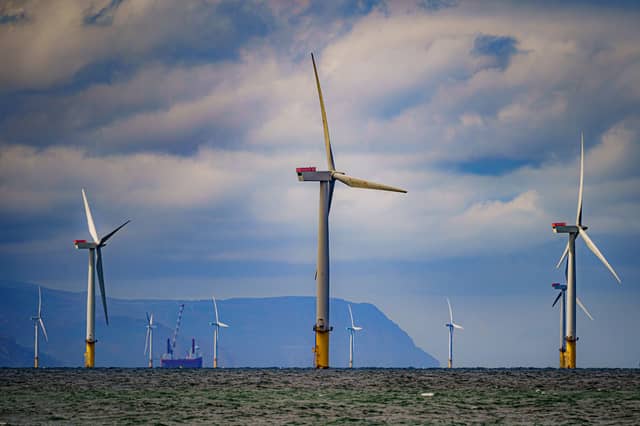


“Stonking” is not a word you often see in UK government press releases.
But it was in a quote by Chris Stark, a senior member of energy secretary Ed Miliband’s team, to describe the results of the latest annual subsidy auction for offshore wind this week.
To many people this year’s auction, known as AR7, is arcane. But it’s a key stepping stone in the journey to building a wind farm.
That’s because it sets the price the government is willing to pay wind farm developers to build, allowing them reasonable certainty that they can at least recoup the huge up-front investments needed to complete one.
On Wednesday, the Department for Energy Security and Net Zero announced it had awarded “contracts for difference” for a record capacity of wind power projects, split between 8.4 gigawatts (GW) for “fixed- bottom” wind farms (where the turbine is fixed to the seabed) and 192 megawatts for “floating” (where it sits on a platform that’s tethered to the ocean floor with anchors).
Under these contracts, consumers of electricity pay wind farm developers the difference between the guaranteed price and the wholesale price. If the latter moves higher than the guaranteed price, developers must pay back the difference.

What does AR7 mean for Scotland’s offshore wind ambitions? And what about energy bills?
By some measures, the result was indeed stonking. It was the biggest such auction so far in Europe, where Poland, France, and the Netherlands – even tiny Malta – are pushing offshore wind. One of the two winning Scottish projects, Berwick Bank in the outer Firth of Forth, would be the world’s largest offshore wind farm if completed.
It was also the single biggest procurement of offshore wind energy at a time when the sector faces considerable cost headwinds, like the Trump administration’s ideologically driven war on windmills.
“I think it’s a sign that the offshore wind sector in the UK is alive and kicking,” says Adam Morrison, co-chair of the UK Offshore Wind Industry Council, and UK country manager at Ocean Winds, developer of the Moray East offshore wind farm that’s run out of Fraserburgh.
Yet in Scotland, there is some disappointment. Only two Scottish projects were successful in a round that included eight in England. One was for the first of three phases in Berwick Bank, backed by SSE. The other was for Pentland, a floating wind farm planned off Caithness, owned by Copenhagen Infrastructure Partners.
None of the 19 projects in ScotWind, Scotland’s flagship offshore wind scheme, made the cut. This is mostly made up of floating projects, and with the technology still in its infancy Ed Miliband, energy secretary, seems to have decided that fixed-bottom projects are the low-hanging turbines when it comes to meeting his Clean Power 2030 target. Unlike floating, these have a supply chain track record going back years and are thus easier to finance.
Indeed, analyst Finlay Clark at Wood Mackenzie said: “This was a last-chance saloon moment for the UK government to chase capacity online by 2030. Today’s [AR7] lifts the awarded offshore wind pipeline to 36.6 GW, with delivery clustered from 2028 to 2031.”
Pentland’s inclusion is positive for floating. It allows the project – recently backed by investments from the National Wealth Fund and Great British Energy - to be used as a demonstrator ahead of commercialisation.
But it’s clear that floating wind will take longer to be feasible than assumed when ScotWind was launched four years ago this week. Unsurprisingly, there is unease in the Northeast. Maggie McGinlay, chief executive of the ETZ, a renewables park in Aberdeen, says: “Four years on from the ScotWind awards, the focus must now be on removing the barriers that risk holding further projects back so they can compete in the next allocation round.”
Meanwhile, what of energy bills? Under AR7, developers are guaranteed a price of £91 per megawatt hour (MWh) for fixed-bottom projects. This is 11 per cent higher than in the previous auction, and about £10 higher than the current wholesale price of electricity.
DESNZ cited analysis by Aurora Energy Research and Baringa that offshore wind farms generating at a strike price below £94/MWh are “saving billpayers money” and that offshore wind is “highly cost competitive” with new generation from gas at £147/MWh, according to government data.
Yet Claire Countinho, shadow energy secretary, countered: “Pretending that securing record amounts of capacity at the highest price in over a decade-before the extra costs of grid, balancing, and backup - is going to cut the cost of the energy system and cut people's bills is not being honest with the public.”
Energy minister Michael Shanks argues that there is no option but to build more wind generation capacity, given the upward trajectory of electricity demand. The choice is building offshore wind at an average of 91/MWh, or gas at higher cost, he says.
“The truth is we see our opponents comparing the wholesale cost of gas with the cost of building and running wind. That’s not a fair comparison. You have to build the gas in the first place. So yes, there is an up-front investment cost [for offshore wind] but then we have virtually free fuel running that electricity as opposed to the volatility of gas that we had before.”
Essentially, the government’s argument is that offshore wind will squeeze higher-priced gas from the system over time, bringing down bills.
But not immediately. This means looking at other parts of the energy mix. Tellingly, a poll out yesterday from offshore energies trade body OEUK found that more than two-thirds (69 per cent) said Scotland can “expand renewable energy while maintaining a role for oil and gas during the transition.”
Comments
Want to join the conversation? Please or to comment on this article.