
Lanarkshire’s Caroline Ashley on Climate, Equity, and the Real Business Case for ESG
Caroline Ashley’s journey to becoming one of the UK’s most respected voices in sustainability began in Lanark, Lanarkshire—where her passion for environmental justice and inclusive development first took root.
Raised in the Scottish countryside, Caroline developed a deep appreciation for landscapes, livelihoods, and the interconnectedness of communities and climate. That early awareness would later shape her global impact, as she emerged as a pioneering figure in business sustainability and policy innovation.
Now recognised as a leading authority on Environmental, Social & Corporate Governance (ESG), Caroline advises multinationals, investors, and policymakers on how to drive systemic change in the face of climate breakdown, economic inequality, and social unrest.
With a background spanning international development, green economics, and corporate strategy, she brings a rare depth of insight into how organisations can lead with purpose while delivering long-term resilience.
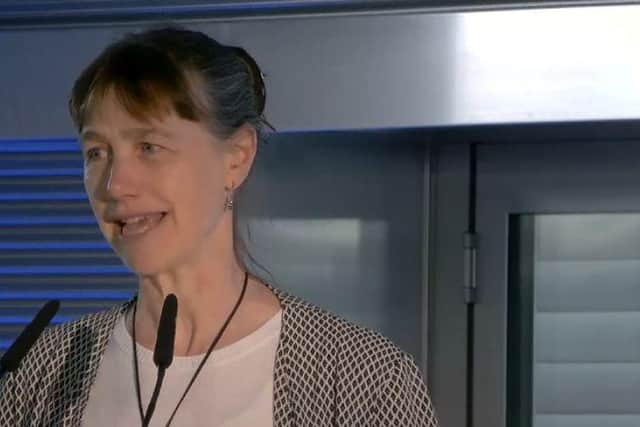

In this exclusive interview with Champions Speakers Agency, Caroline offers a timely perspective on just transitions, sustainable markets, and the future of business in a rapidly changing world.
Q: Given Scotland’s economic ambitions and climate targets, what would you say to business leaders who still view sustainability as a financial burden rather than an investment?
Caroline Ashley: “I would ask, what’s the business case for your business in a world where huge swathes of population can’t live where they’re living, huge parts of our arable land are not arable anymore, basic ecosystem services such as pollination are breaking down?
“Before you reach those, you’ll have societal disruption. So what does a business look like where societies are not working? I would ask, did COVID affect your business? Well, let’s look at the data that’s telling us that the impacts of climate change, and the societal disruption that goes with it, is going to be even greater than that.
“I was just looking at data on heat stress, which has been in the news recently. Obviously, I have a colleague based in India, and he’s telling me about how they have to stay inside in the air conditioning.
“As many people as went off work during COVID, half as many as that are already missing work due to heat stress—and that’s before we get to 1.5° of climate change. So I would ask people to think about COVID, and think about it multiplied.
“And I would finally say, does your business have insurance? They probably would say yes. And I’d say, how will you operate when you get to the point where there are many things for which your business cannot get insurance?
“And that’s not, you know, science fiction. Insurance companies are really thinking about what happens when things are not insurable anymore.”
Q: In your view, what is the single most transformative step that Scottish businesses—large or small—can take to drive meaningful environmental change?
Caroline Ashley: “The businesses are all over the shop. We’ve got some real leaders, and we’ve got some real laggards. So it’s hard to say one thing. But the one thing that I think is common across all of them, they all need, is to understand their role and their responsibility in driving change—and their ambition.
“And I would say that amounts to a few different things. One is to just say, we’re doing better than we did last year. That’s not enough. Is it actually what society needs? Is it actually what the planet needs? If it’s not enough, it’s still not good enough.
“Another is not to say, we’re doing better than other people in our sector. Again, that’s not enough. We can still go to hell in a handcart, to use a phrase, if we’re doing it that way.
“But another really important one is to say, business has a role and a responsibility to be part of a bigger change. So I wouldn’t just say, change your own business to look after yourself. I’d say we’re on a huge socio-economic transition here.
“And it’s about how business teams up with others, how they work. We call it system change—changing everything from the narratives that underlie the surface, to the specific actions. Think about how you’re part of a bigger process of change. Some businesses have done that.
“But if the leaders at the top are not really signed up to being part of the future, I don’t think all these ESG targets and sustainability things on the website—or even just dealing with your emissions, at least in your Scope 1/2—I don’t think that’s going to be enough. You have to have that vision at the top.”
Q: As the transition to a green economy accelerates, how can we ensure it’s a just transition that includes rural communities and those historically left behind?
Caroline Ashley: “I think that’s the key question that we are beginning to realise has not been addressed yet. Change is coming. And is it going to be a just transition? There are two reasons why we have to focus on whether it’s going to be just. One is really practical.
“You might be an immoral or amoral person, but to be honest, any change we have—it’s not going to last, it’s not going to be sustainable, it’s going to be challenged socially or politically if it doesn’t work for people.
“We’ve already seen that in examples where people protest what are relatively small changes, compared to what we need. So, to be practical, it’s got to be socially inclusive and fair.
“There’s also the moral argument that this is our chance to change how we run the economy—to solve these twin evils of biosphere breakdown and gross inequality.
“Due to COVID, for the first time in many, many years, poverty’s actually going back up. Inequality is incredibly deep. We need to address that at the same time we restructure our economy. We can do both now.
“It is interesting that just transition is coming on the agenda, and I’m seeing more discussions about it. But it tends to be talked about in terms of: these are the costs and these are the benefits.
“These are the financial costs—who’s going to pay, like the tax for them, or pay for premium products? And these are the benefits—the new jobs, who’s going to get the jobs? Of course those are important, but it’s not enough. Just talking about the financial costs and the jobs is not a just transition.
“A just transition is where people can decide for themselves what their future locality looks like, which pathway they want, how land will be used differently, what kind of training and skills, and what the new workforce looks like.
“So it’s about people’s decisions and voice. It’s not just about, you know, who gets retrained in AI.”
Q: With the cost of living continuing to rise, is there a viable path toward making sustainably sourced goods accessible to all consumers—not just the affluent?
Caroline Ashley: “No, they’re clearly not. You know, I’m someone on a professional salary who can afford to be picky with what I buy, and I look at the price premium and I think—gulp, do I really want to pay that?
“Of course, they’re not affordable for friends and family members who are on benefits or whatever. I know that. But I think that’s used a bit too much as a hope. “We can’t do this because it couldn’t work for the masses.”
“If we look at the subsidies that we put into the fossil fuel industry, to conventional agriculture, to all kinds of public infrastructure that enables our economy to work as it is—whether that’s roads or garbage or water—there are huge subsidies going into our current economy.
“So we have to change the system so that we do produce things in the way that is sustainable, and then we deploy the subsidies so that people who need them can afford them. We just have to shift several billions so that we can do both: produce what we need sustainably, and make sure people can afford it.”
Q: Many individuals face tension between personal sustainability goals and real-world limitations. What advice would you give to people navigating this sense of contradiction or guilt?
Caroline Ashley: “The last thing is the hardest of all. Extinction Rebellion have a set of really interesting principles. For those who think they’re just about glue, they’re actually really worth looking at—very interesting principles.
“And one of them is: talk about what you do in your life. And another is: don’t be ashamed—because we all have things. I took a flight earlier this year, post-COVID, that will have completely destroyed my carbon footprint this year.
“And it almost stops me talking about all these other things I want to do. But XR—Extinction Rebellion—say: the system’s got to change. It’s not just about you as an individual. So don’t be ashamed—but do talk about it.
“Certainly, I don’t go talking about, you know, I inherited some shares and I’m trying to query the climate impact of that—because that’s a grossly inappropriate conversation with a lot of people. But I am hearing that little voice in my head that’s saying: talk about it more. So I’m trying to do that.”
This exclusive interview with Caroline Ashley was conducted by Jack Hayes.