
Exclusive:Peter Mathieson: 'Unions have weaponised our students in industrial action'
Professor Sir Peter Mathieson said the union is weaponising students to push the university to an unsustainable position

Sir Peter Mathieson has accused Edinburgh University’s largest academic union of “weaponising” students in its campaign against job cuts.
The Vice-Chancellor, who has announced that he will step down in 2028, said he believed the University and College Union (UCU) is timing industrial action to cause maximum disruption to students.
In an interview with The Scotsman, he said the union’s timing of an on-going five-week strike is an attempt to force management to change its position on compulsory redundancies.
READ MORE: Peter Mathieson to step down as Principal of Edinburgh University after decade of turmoil
“I think UCU have weaponised the students by knowing that the way to influence the leadership is to disadvantage them,” Sir Peter said, calling the move “cynical”.
“There have been communications from UCU to their members, suggesting that they deliberately time their actions to coincide with teaching and I regret that.
“I don't think that's reasonable, and I think anybody that really genuinely believes in education or genuinely cares about students would not take such actions.”
On Monday afternoon, announcing the end of his tenure, the professor said he would remain focused on his role until early 2028 when he will leave post after a decade’s service.
His time as Principal and Vice-Chancellor has been marked by repeated industrial action in the face of fraught financial decisions and increasingly bitter industrial relations.
He said students are being “caught in the crossfire of a dispute not of their making” and that he regretted the impact of industrial action on their education.
UCU is in dispute with university management over a swingeing restructuring programme that Edinburgh says is necessary to secure the future of the institution.
The aim is £140 million in budget reductions, which UCU says will include £90m from staff salaries, and the closure of around 90 degree programmes and the loss of up to 1800 jobs .


The union’s central demand is a guarantee that there will be no compulsory redundancies.
However, Sir Peter said he can not give that guarantee.
“I have told them for months that we cannot do that, and I will not promise something that I’m not certain I can deliver,” he said.
Sir Peter, who also served as Principal of the University of Hong Kong, said Edinburgh had already reduced staff costs substantially through voluntary measures.
“We have tried to minimise compulsory redundancies, ideally avoid them altogether.
“Parties are now at an impasse. They insist on a guarantee. We insist that we can’t give it.”

Edinburgh is not unique in making substantial savings. The higher education sector is operating against a backdrop of a structural crisis in university funding.
Sir Peter rejected claims that the university’s financial position was strong enough to avoid cuts, arguing that critics are misled by its substantial reserves.
Most of its money, he said, is tied up in buildings, equipment and other assets.
The institution has an annual turnover of about £1.4 billion, but Mathieson said its size means its expenditure is sizeable.
“We spend £120m a month just paying the bills,” he said.
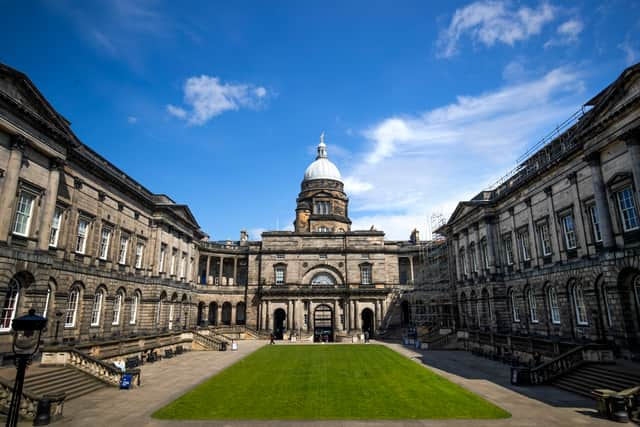
He argued that simply running down reserves would not solve the underlying problem.
“The idea that once you’ve sold something, it’s gone, and you can’t then sell it a second time, indicates that selling assets is just not a way of addressing the underlying problem,” he said.
One of the financial issues affecting UK universities - with a particular impact in Scotland - is the reliance on overseas students.
Sir Peter said it was “fatuous” to suggest universities had expanded their intake of international students as a result of greed.
“Without them, universities in Scotland would not be able to function,” he said, adding that overseas students brought economic, educational and cultural benefits and helped to support the education of Scottish students.
Academic staff at the university have expressed concerns that the cuts will alter the ethos of the university from a sanctuary of academic enquiry to a commercially focused enterprise.
Sir Peter rejected the idea of any fundamental shift away from the university’s academic mission
“We are fiercely proud of our place as an educational institution and a place of research where we find new knowledge,” he said.
READ MORE:Tertiary education minister Alyn Smith: 'Colleges can innovate their way out of funding crisis'
However, he added: “But we can’t keep doing it if we go out of business.”
In May last year the university's most senior academic body, the Senate, passed a vote of no confidence in Sir Peter.
Not long after, a staff survey found fewer than six per cent of staff had confidence in the university’s management.
“I mean, do you think it doesn't hurt?” he said.
The low level of confidence, he said, was “very obviously seen and very much understood”.
“Gathering that opinion is something that Edinburgh had never done,” he said.
Edinburgh University, he added, had never conducted a staff survey until he instigated the first poll when he took over in 2018.
He pointed to the flawed implementation of the university’s People and Money programme, a new HR and payment system, which he conceded “was not well handled and did not go well”.
But Sir Peter insisted the university is taking tough decisions required to secure its long-term future.
He has spent years warning that the funding model for Scottish universities was unsustainable. He said the current crisis had therefore come as no surprise.
The academic argued the Scottish Government is faced with difficult choices on funding for Scottish domiciled students.
“It’s not sustainable to continue to fund inadequately the current number of places because that is not the recipe for long-term success,” he said.
He said universities are being asked to absorb rising costs while the funding attached to Scottish students has remained flat for 15 years.
Yet, saying he may not have attended university without free tuition fees, he said he is a supporter of the principle that study should be free.
The English model, he added, also does not provide a sustainable answer.
Instead, he says the Scottish Government must move to a funding system that is resilient enough to support universities over the long term.
This, he said, could involve either an increase in funding per student place or a cut in Scottish domiciled student numbers.
Sir Peter said the decision to leave had been taken “months ago in my head” but was part of a “natural cycle” of change.
He said there were “personal” aspects to the decision he prefers not to talk about and that it took him a while to become comfortable with the choice.
Improvements to student experience, he said, is a change he is “particularly proud” of.
The university, he said, is now equally skilled at educational excellence as well as academic excellence.
As he looks to the next 16 months in office, he believes his role is to make tough decisions that will allow him to hand the university to his successor in a more robust financial position.
Calling the current situation a “course correction”, he added: “My goal would be to get the hard work done before my successor starts,” he said.
This will involve the difficult job of bringing staff and students along with him.
“I think we’re doing the right things for the university,” he said. “It is a fabulous organisation full of talented people with lots of reasons for being optimistic about its future.
“My successor will be able to come in to a university that's able to be more bold about the future, able to invest, able to be confident they're going to continue to exist.”
He says the Scottish Government and Universities Scotland are too focused on identifying the problem and not considering the solutions.
“What is society going to do to address what I think is a very serious and urgent set of challenges to one of Scotland's greatest assets, which is its universities?” he said.
“I was very pleased in the Program For Government to see some radical thinking being applied elsewhere, but there wasn't any of that radical thinking being applied to universities and colleges. “Similar radical thinking is needed if we're going to, as a country, address the challenges that universities face.”
UCU Edinburgh branch vice-presidents Marion Lieutard and Courtney Stafford-Walter said the claim that UCU was “weaponising students” was “completely disingenuous”.
A statement added: "Since last July, when the strike was decided, UCU has given management countless opportunities to avoid it. We asked again and again for management to negotiate with us, so we wouldn’t have to do this and lose five weeks of work and pay for our members and students. Instead, Peter Mathieson came to the negotiation meeting the week before the strike started, offered literally nothing, and hasn’t met with the UCU since.
"It’s deeply patronising to our students to speak as Peter Mathieson does of the current tidal wave of student mobilisation as if it reflects no more than the default anti-establishment attitude of youth, or as if students are being manipulated by the union. We know our students. It is a privilege to teach them. They are incredibly bright people with a mind of their own. They’re fighting right now for the learning conditions that they deserve and the university model that they believe in: one that centres students and staff voices, people over assets and investments. That simply isn’t what this management is giving them."
Comments
Want to join the conversation? Please or to comment on this article.