
3,000 trees to be planted by Scottish river in flood management and habitat restoration work

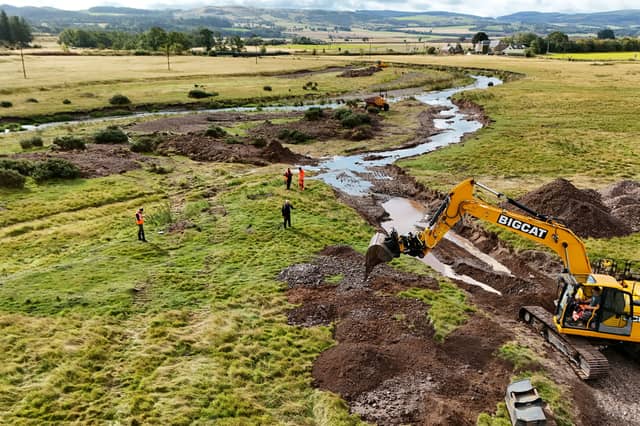

Floods to be prevented and habitats restored on the Water of May in Perthshire
Three thousand native trees are to be planted beside a Scottish river as part of an increasingly used approach to natural flood management and habitat restoration.
The project, on a stretch of the Water of May in Perthshire, is reconnecting the river with parts of its natural floodplain, allowing water to spread across surrounding land rather than being channelled rapidly downstream. The approach can help slow the movement of water through a catchment and reduce pressure further downstream during periods of heavy rainfall.
It is also intended to improve habitat for species that depend on floodplains and conditions for fish in the river, including salmon, which migrate up the Water of May.
The trees, including native alder and willow, are due to be planted over the coming winter. They will eventually provide shade over the river to help keep conditions cool for the salmon and, with the floodplain, help to create a more varied habitat for insects, invertebrates and other wildlife.
Richard Lockett, of Lockett Agri Environmental, has been one of the leads on the project. His consultancy has previously worked on river restoration schemes aimed at reducing flood risk and improving habitats.

One of the company’s most substantial projects was the restoration of the River Peffery at Dingwall in the Highlands. The four-year scheme involved re-meandering the river, with about 30,000 tonnes of earth moved and 350 metres of new river channel excavated.
The Water of May project, which was designed by George Heritage, of Dynamic Rivers, has taken a considerably more “light touch” approach, Mr Lockett said.
“We haven’t touched the river itself in this case,” he said.
“It’s been more tinkering around the banks and flow to get the water to spread out more through the floodplain.”
This has been, in part, due to the Water of May already having a naturally sinuous course, he said. However, previous modifications had left it partly disconnected from its floodplain.
Much of the riverbank is currently open to grazing and has few trees. Fencing is due to begin in the coming weeks, allowing natural regeneration as well as the new planting programme to begin, which is due to finish by early 2027. Mr Lockett said alder seedlings are already appearing in parts of the site.
The project, he said, has cost less than £50,000 and has been funded largely through Scotland’s Nature Restoration Fund, with additional support from Woodland Trust Scotland, who will be helping with the tree planting, Network Rail and the Dupplin Estate, where the work has taken place.
Mr Lockett said the scheme demonstrated what could be achieved without major engineering works or substantial expenditure. He said the work will create about four or five hectares of newly connected floodplain habitat, alongside the 3,000 trees, while allowing parts of the landscape to flood more naturally at different times of the year.
Such projects are being explore more across Scotland as river managers and landowners look at natural ways of reducing flood risk that also helps to restore natural habitats.
Mr Lockett said while the Water of May work is not expected to solve flooding problems downstream on its own, it forms part of a wider approach in which water is slowed and temporarily stored higher up a catchment, while wetlands, floodplains and rivers are allowed to function more naturally.
Comments
Want to join the conversation? Please or to comment on this article.