
A Scottish island's unique hospitality finishes as last remaining residents leave for good

For the first time in decades, Rona’s population will go from two to zero this month.
“Here’s something for your tea,” Bill Cowie said, as he handed me four venison burgers and a bottle of red wine.
I had just arrived on the Isle of Rona, which sits to the north of Raasay on the west coast of Scotland.
There are no shops on the island, with the nearest place to get food being a 45-minute boat ride away in Portree, on the Isle of Skye.


I was grateful for the generous offering as I had mistakenly packed lightly on the food front for my three-day visit, not knowing what to expect.
I’ve been lucky enough to be invited to Rona a couple of times by Bill who, up until now, has been the custodian of the island for the last 25 years.
In that time, small-scale tourism has been set up on the island, with three properties refurbished for paying guests to stay in.
Bill’s wife, Lorraine, visited Rona some 20 years ago on holiday and never looked back.
The couple built their own house and have managed the island together, with Bill establishing Rona’s very own bespoke venison business.

This summer, however, the couple announced their retirement - news that coincided with the island being sold after more than 30 years under the ownership of Danish couple Dorte and Arne Jensen.
It means Bill and Lorraine will leave their island home this month for good and Rona, for the first time in decades, will see its population drop from two to zero. With them will go a unique experience of how to see and learn about life on one of the less trodden of the Hebridean islands.
New island managers will no longer live permanently on the island, with new staff understood to be working on rotation.
The new owners, Fior Rona Ltd, a company set up by hedge fund manager Danny Luhde-Thompson and his wife Cressida Pollock, said they are in an "understand" phase which “includes taking inventories, looking at upgrades to infrastructure and renewables and energy generation, as well as how to continue the venison business, holiday lets and ongoing ecological work.”
My experience visiting Rona
The first time I visited Rona was in the autumn. I was instructed to be ready for an 8am start on Stardust, a wildlife boat that works out of Portree Harbour.
Piling onboard with a group of guests heading to the island, we set sail with the autumn sunrise.


Crossing the sound as dawn became day showed off some of west coast Scotland’s best features, from views of the Old Man of Storr rising on the cliff side, to a sea eagle heading straight towards us from the rocky edges of Raasay.
Some of the skippers, it turns out, can’t resist throwing a titbit to these majestic raptors. Having only seen a sea eagle flying high up in the sky, the sudden shadow cast over the boat by an enormous wingspan as one prepared to swoop down for its treat was an unforgettable sight.

Arriving into Rona’s Acairseid Mhor ("Big Harbour"), seals lay on rocks on either side, unfazed by the regular commuting vessel.
A first glimpse of Bill was a giveaway to what kind of a host he was going to be. Standing right at the tip of the pontoon with a big smile, he already made us windswept strangers feel welcome before we even touched down on Rona soil.

The guests were staying on the island for a week - a standard booking given the effort to get there - so bags of food, booze, dogs and whatever else was unloaded onto the jetty.
We all mucked in, helping transfer the luggage into a cart attached to a quadbike - the only vehicle that can tackle the island’s hilly, rough tracks. Rona means “rugged mountain” in Old Norse. When you’re a passenger in something with wheels on the island, you can certainly understand why.

Before doing anything else, the guests and I were ushered into a cosy bothy with a fire on the go about a minute’s walk from the pontoon. Whisky, coffee and fresh scones were on offer for our arrival around 9am. All three were gobbled as Bill spoke about various paths to follow to find some of the island’s treasures, from the Church cave - a post-medieval church built into a large natural cave, to the Rona Lighthouse, also referred to as South Rona Lighthouse to avoid confusion with North Rona Lighthouse on the Isle of Lewis.
The guests disappeared to their accommodation and Bill took me on a tour of Rona on the quad bike.
“You had better hold on tight,” he said, at various points of the ride. His warning was mainly to do with the terrain, but maybe a little bit to do with his own driving. I later learnt Bill was a biker, among many other things, before he moved to Rona.
As the wheels occasionally sunk into deep bog and bounced off mossy hills, we drove past a sign saying 'BEWARE OF THE BULL' with half the 'u' tippexed out.


There are no roads on Rona, unlike its neighbour, Raasay, which is home to the famous Calum’s Road. Local postie Calum MacLeod had become frustrated by authorities denying road access to an isolated community on the island in the 1960s. So, over a period of ten years, using very basic tools, he single-handedly built a road himself.
Access to properties on Rona is instead made along rough tracks lined with walls of peat and Lewisian Gneiss, one of the world’s oldest rock types.
The landscape is undulating with high points, or cnocs, and low droops to peaty hollows and lochans. It feels truly wild in areas, almost prehistoric, with its knotted vegetation, ancient birch woodlands and bolder-like lumpy hills of bare rock and heather obscuring the view ahead so that, at times, you don’t know what’s round the corner.
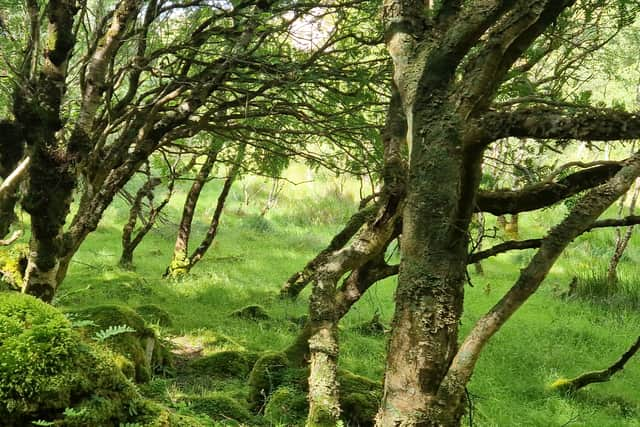
Bill reeled off names of plants on the island, of which there are more than 300 different types, as we rolled on through the scrub, bogs and woodland.
I mentioned I could recognise a real burst of bracken across the island but he was quick to point out there are at least four or five different types of fern alone.
As for the trees, he began naming what seemed like an endless list of different species including aspen, beech, oak, rowan, larch, Scots pine, hazel and willow.
Rona’s social history
Nestled among a kaleidoscope of flora and fauna across the island is a scattering of ruins that tell stories of Rona’s rich social history.
It’s clear from the location of many of the dwellings that life was hard for those who lived off the land, where the soil is characterised by peat and mosses compared to the more fertile grasslands of neighbouring Raasay.
“It’s not unlike St Kilda here with the settlements,” Bill said, as we snaked through some of the deserted stone buildings, including a fire-damaged, crumbling old schoolhouse.
“We are just less talked about.”

The holiday cottages on Rona are neatly refurbished ruins in the ghost village of Acairseid Thioram ("Dry Harbour"), each home to cosy quarters and beautiful wall hangings of delicate dried pieces of Rona’s seaweed created by Lorraine.
Another building that used to be “the cobbler’s house”, Bill tells me, has been converted into a simple museum. When stepping into the building, which has no flooring or insulation, it takes little effort to imagine what the cold winter nights were like for some of the residents in the last century using just a peat fire for warmth.

Records show in the 1820s, Rona was home to 180 people, a high number for an island only five square miles. By the mid 19th century, some of those evicted from Raasay during the clearances chose to make their homes in Rona rather than emigrate to a foreign land. In 1901, the population was 160, but from then onwards it steadily declined. By 1932, apart from the lighthouse keepers, only three members of the MacRae family remained; two aged bachelors and their sister.
By 1944, they finally left for Skye, and Rona remained pretty much uninhabited for the next half century.
As we reached a higher point on the island, we stopped to enjoy the views down to the Big Harbour, nestled in the bottom tip of an elegant V-shape made from Rona’s sloping rocky hills.

“I think Rona has more of a feminine feel to it,” Bill volunteered.
I asked what made him think that.
“It just came to me one evening, early on when I moved here.
“I was thinking about the women who lived here and what they did. The men were likely working away on boats or at war, so it would have been the women working the fields. Maybe that’s why it has more of a womanly feel to it.”
I spent the rest of my time walking across the island, with Bill saying he felt it was important for me to form my own impression of Rona.
Trying and failing in some cases to locate some of the sites on its rugged face, my first thought was how much I enjoyed how little Rona had pandered to tourism. There were very few signs and the “paths” that Bill sent me on were pretty unclear or non-existent it seemed. Walking around made me feel more like a resident living there some 100 years back than a tourist.


While daylight on Rona helps you find the island’s secrets and panoramic views across to Skye and Applecross, night-time brings with it its own intimate experience.
Stepping outside on a still night, you can almost hear the mosses soaking up water and droplets trickling down the rocky outcrops with no noise pollution or distraction around.

Lost in thought, gazing at constellations I’d never seen before, I was interrupted by a rutting stag, barking in the distance. Deer have been a big part of Rona under Bill’s watch, with a herd of around 100 roaming the island. The venison is shot, butchered and processed in a larder on the island he built himself.

It’s a unique experience sitting down eating something that is wild and has been killed, prepared and packaged within metres of where you are staying, but also having been handed to you by the very person who did every bit of the process himself.
Another bonus to night time on Rona was an invite for either a roast venison or a dram up a track at Bill and Lorraine’s to hear more stories about the island.

When sat with them one evening, I couldn’t help but think back to a note I saw in the museum written by Scottish author and journalist A A MacGregor who had visited Rona just before the last few families left.
“The natives of Rona are particularly hospitable and, at all times, are ready to entertain any stranger who may chance to find his way to their shores,” he said.
I can say that I left Rona feeling the same in relation to its last two permanent residents.
Comments
Want to join the conversation? Please or to comment on this article.