
Hay's Way: The Scottish island that claimed me — literally


An island that demands en-jura-nce
The second time I was suctioned into the ground, chest-deep in bog, I thought I was going to give up and let the moor take me for good.
The Isle of Jura claimed me in more ways than one this week. But this Inner Hebridean island literally consumed me on several occasions during a multi-day walk lugging my tent and laptop, my constant load, across its sodden, peaty plains.
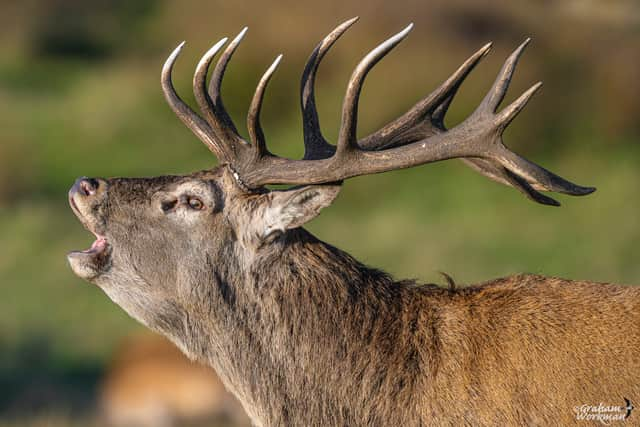
While I am sceptical that Scotland has any places of true “wilderness” left, some parts of Jura come pretty close. Wandering alone through the vast expanse of open moor in the island’s north-west, the only movement aside from a bird in flight were shifting silhouettes of red deer, their antlers forming unique shapes against the horizon of towering ridges. The guttural roars of rutting stags carried by the wind is a magical acoustic spectacle to witness. The experience reminded me just how small, powerless and insignificant I can feel when confronted with one of nature’s rawest moments.
My walk took me to Cruib Bothy nestled in a bay north of Loch Tarbert, about half way up the island. Trying to locate a path to the shelter was like trying to identify a rare bird from a distance with no binoculars.
Heading in a general westerly direction, armed only with a photo on my phone of a vague route outline through the moors from The Long Road — the island’s only ‘main’ road — was, in hindsight, a total roll of the dice when walking on Jura.

Faint deer, machine and walkers’ tracks wriggling across various patches of this rugged landscape made my quest to the bothy feel like a game of snakes and ladders. One minute I was taking the high ground, finding a steady step on a path of some sort, only to descend and fall into boggy land that pulled me back. The tussocks made me so unsteady on my feet that I morphed into a prime candidate for Monty Python’s Ministry of Silly Walks. I regularly collapsed into an involuntary curtsey, only for the roughly 20kg on my back to tip me backwards, forcing me to sink into the ground, where I would leave an imprint like a deer couch—a neat little record of where an animal has stopped to rest.
That was, of course, until the moment I came across a “floating mat” that looked inviting for some respite for my feet, but instead ended up consuming me, putting a brief but soggy end to the struggle trying to navigate the land on two legs. Occasionally, I would look up to find a deer fixed on me, seemingly judging my every clumsy step and perhaps wondering why evolution had been so cruel as to deny humans the nimble limbs, hocks and stifles needed to navigate Jura’s landscape with any semblance of agility.
At one point, my boots were clenched with such force by the sodden, peaty ground that I was propelled forwards, face down. Rolling over onto my back to gasp for air, propped up by my rucksack, I glanced up at the sky to find six pairs of sea eagles riding the thermal updrafts above me. Circling and lowering in their flight, I did wonder if they were just waiting for me to give up entirely.

Finally reaching the bothy, I sought refuge between the thick stone walls for two nights. A little research showed that the building’s name derives from the Scottish Gaelic word crùb, which can translate as a verb meaning to bend, crouch, shrink, squat or crawl — certainly appropriate doing words to narrate the walk there and back. But it can also be used as a noun, with one definition being “a lame foot”. Also fitting.
While a recommended route to the bothy claims the walk is only about six kilometres and can take about three hours, the time of year in which the excursion is undertaken can have an impact on both time and distance.
A night of west-coast Scotland autumn downpours, which I could hear thrashing against the hard stone walls as I lay tucked up in my sleeping bag like a baby in a crib, set the ground up to be even more challenging on my return to the east of the island.
Bursting burns, flooded peat plains and fast-flowing rivers made any potential route even less clear. Whatever paths were etched into the rough, coarse ground had become burns. Or maybe they were already burns.

At one point, with no leapable point between the banks of a fast-flowing river split by stunning, crashing waterfalls, I eventually succumbed to finding a dry way across. Stripping down to my underwear and balancing my rucksack on my head, clutching the laces of each walking boot in my hands, I waded through, the weight of me and the bag withstanding the push of the raging flow against my left rib.
If it is not a bog to swallow you or a river swollen with seasonal rain to take you out on a walk through Jura’s moors, a local jokingly said that one is “surrounded by rifles” when trudging the island’s terrain at this time of year.
It is strongly advisable to contact the estate teams before walking on the island during the stalking season, given the unlikely but slight possibility of stepping into the hunter and stag firing line. Walkers may be asked to avoid certain areas for a day, or simply given the nod to carry on as normal. I was also advised to wear something brightly coloured so I could be seen on the hill—a precaution I took seriously, though I quietly hope no one witnessed the particular walk I made that day, which was enough to make even Jura blush.
Comments
Want to join the conversation? Please or to comment on this article.