
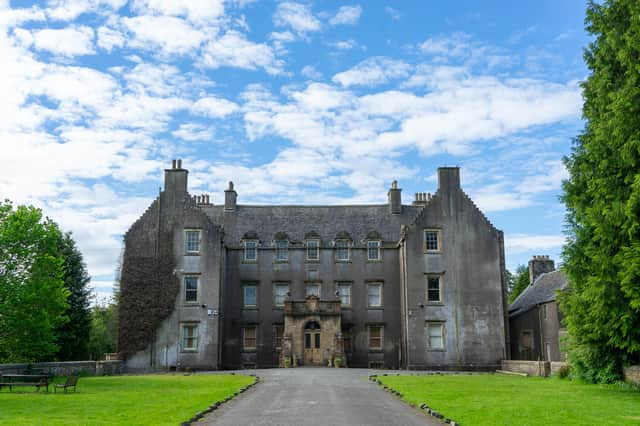
New evidence of plot to kill Bonnie Prince Charlie found at historic Scottish house

The latest evidence follows the landmark discovery of a musket ball hole in the wall of the Prince’s bedroom last year.
Researchers at a Scottish University have discovered new physical evidence of a plot to kill Bonnie Prince Charlie while he stayed at Bannockburn House in January 1746.
The evidence helps to prove an oral tale passed down through centuries about an attempt on the Prince’s life while he stayed at the property during the Jacobite Rising of 1745.
A lead ball consistent with an 18th Century musket shot has been discovered lodged in the bed in the room traditionally associated with the prince.


Archaeological experts from Robert Gordon University used advanced X-ray technology to identify the ball which was concealed within the bed’s footboard.
“This is historical detective work at its finest,” said Dr Catherine Bradley, Conservation Trustee at Bannockburn House.
“For centuries, local tradition spoke of a shooting incident here. Now, fragments of that story are aligning with physical evidence.
“Every new detail takes us deeper into the intrigue of 1746.”

The discovery follows the identification of a musket ball hole on the room’s wall last year.
The house’s oral history traditions claimed that a musket ball was fired at the Prince through the window of the bedroom where he was sleeping and lodged itself in the wall at the head of the bed.
However, this had never been proved until a team of volunteers found the hole left by the musket ball under a secret panel last April.
While the researchers stressed the new evidence does not “conclusively define” what happened, they said it does add to the evidence base of the 300-year-old tale.
They said the latest discovery could imply that multiple shots were fired.
Further analysis and archaeological digs at the site are planned, with the first excavation scheduled later this month.
Associate Professor at Robert Gordon University, Douglas Pritchard, said: “This research improves our understanding of the Jacobite Rising and the dangers faced by Bonnie Prince Charlie.
“Our 3D visualisation technologies allow for the digital preservation of fragile objects and sites, creating records that support further research and public sharing.
“By capturing these assets accurately, we are both expanding our knowledge and guaranteeing their preservation for future study.”
Malcolm McEwan, Chair of the Trust, said: “This is what happens when community heritage meets world-class research. Bannockburn House is not just a building - it’s a living story, and we’re inviting the public to be part of its next chapter.”
Bonnie Prince Charlie recuperated from illness at the house in January 1746 with the help of his lover, Clementina Walkinshaw. The house was also used as a HQ during the Battle of Falkirk Muir, which ended in narrow Jacobite victory.
Bannockburn House was built in 1675 for Sir Hugh Paterson, a prominent Jacobite and uncle of Clementina Walkinshaw. She and the prince went on to have a child, Charlotte, the Duchess of Albany.
The property was bought by the community in 2017 amid a vision to turn it into a community events space where its rich history could be celebrated.
Comments
Want to join the conversation? Please or to comment on this article.