
Remembrance Sunday 2026: Scotland forever! The heroic story of Ensign Ewart and the Scots Greys

On Remembrance Sunday, Lord Mulholland considers wars which are often overlooked and underappreciated
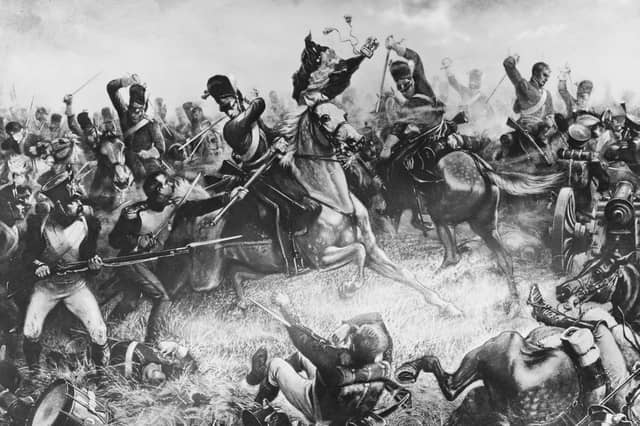
At the bottom of the Castle Esplanade is a public house which is named Ensign Ewart. At one end of the Great Hall of Edinburgh Castle hangs a picture entitled Scotland Forever! This is an 1881 oil painting by Elizabeth Butler depicting the start of the charge of the Royal Scots Greys, a Scottish heavy cavalry regiment that charged the French at the Battle of Waterloo in 1815. The Greys formed part of the Union Brigade which consisted of regiments from England (Royal Dragoons), Scotland (Royal Scots Greys) and Ireland (6th Dragoons).
The title of the painting comes from the battle cry of the Greys as they charged, “Now, my boys, Scotland forever!” On 18 June 1815 on the battlefield at Waterloo, the Scots Greys started the day on Wellington’s left flank. Just after 1:30pm, with the French infantry advancing and threatening to break the British centre, the Union Brigade were ordered, with the Household Brigade, to attack the French infantry.
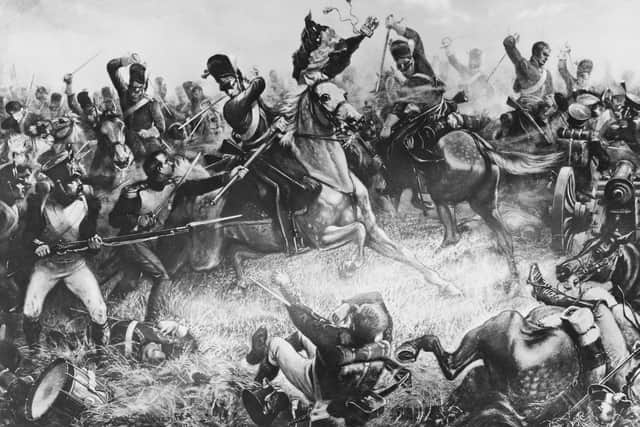
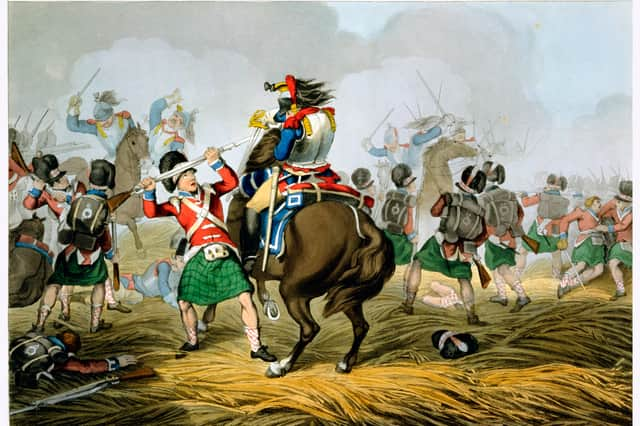
As the 92nd Highlanders’ Regiment began to falter, the arrival of the Scots Greys helped to rally the 92nd Highlanders, who turned to attack the French. The Scots Greys saved the day.
The Scots Greys and Union Brigade suffered heavy casualties. The Scots Greys suffered 104 dead and 97 wounded and lost 228 of the 416 horses.
Where does Ensign Ewart come into this, why is a public house named after him and what has he got to do with the Scots Greys?
Charles Ewart was a British soldier (born near Kilmarnock) of the Royal Scots Greys who fought at Waterloo. He was a powerful man, 6 ft 4 inches tall, an expert swordsman and accomplished rider. He became famous for capturing the regimental eagle of the French 45th Infantry Regiment of the Line at the Battle of Waterloo. French Regimental Eagles were based on the eagle standards of the Roman legions. Regiments carried them and as Napoleon decreed, his troops would defend these standards with their lives.
As the Greys broke through to the centre of the French infantry as it was forming into a defensive line, this sowed confusion and the Eagle was seized by Charles Ewart in close fighting with a number of Frenchmen. The capture was described thus: - “Ewart cut down the officer, deaf to his pleadings for mercy. Dashing forward he now found himself close to the standard-bearer of one of the French Invincible regiments. A short and deadly conflict ensued and as the staff had stuck fast in the ground he was able to lay hold of it without further trouble. Looking round he saw a lancer single him out, gallop forward and hurl his spear at his breast. He had just enough strength to ward off the blow, so that the lance only grazed his side, then raising himself up in his stirrups, he brought his opponent to the ground with one cut of his sword. When riding away with the Eagle, he experienced another narrow escape, for a wounded Frenchman, who he had taken for dead, raised himself up on one elbow and fired at him as he passed. The ball fortunately missed him and he was able to take his prize to the rear.”
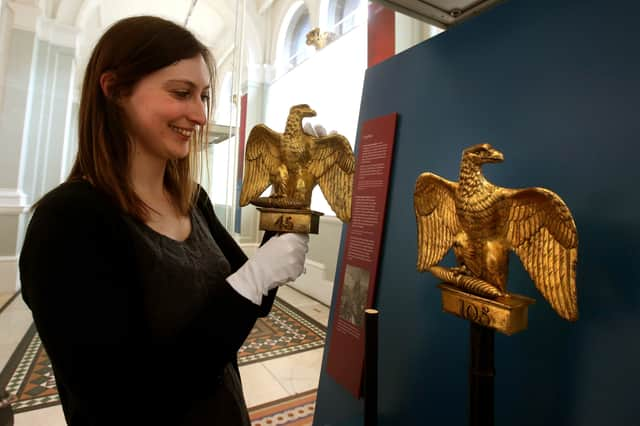
Two French Eagles were captured during battle, both by the Union Brigade. After the battle Ewart was hailed a hero and travelled the country giving speeches. The year after Waterloo he was made a commissioned officer with the junior-most rank of ensign (second lieutenant which is where his nickname comes from), in the 5th veteran battalion in 1816, and left the army when this unit was disbanded in 1821.
The eagle is one of the most prized honours of the Royal Scots Greys and, in commemoration of this, their cap badge shows the eagle. The eagle is displayed at Edinburgh Castle at the regimental museum there. After the battle the Greys were known as ‘the Birdcatchers’, in commemoration of the eagle’s capture.
In 1816 Ewart was invited by Sir Walter Scott to speak at a Waterloo dinner at Leith. Ewart begged that he might be excused, saying that he would rather fight the battle of Waterloo over again, than face so large an assembly.
Ensign Ewart lived out his days near Manchester. He died in 1846 aged 77 years. His body was buried in a graveyard at Bolton Street, Salford. His grave was paved over and forgotten for many years, being uncovered in the 1930s, and his body was reburied by the Royal Scots Greys on the esplanade of Edinburgh Castle in 1938.
Now a pub in Edinburgh, the Ensign Ewart bears his name. Nearby is a monument marking his burial place.
Why does this matter? Well, for the last few Remembrance Sundays, I have written about the contribution of Scots lawyers in the two world wars. As an aficionado of martial history, I have thought for a long time that the Napoleonic wars are often overlooked and underappreciated. The country was in great danger of invasion by a military genius leading a powerful army and navy. Yet the country united fought off this mortal danger and prevailed through the stoic genius of Wellington throughout the Peninsular War and into France and Belgium culminating at Waterloo on 18th June 1815. It has been said that the British army was never so strong as at 1814. By that time, it was one of Europe’s most effective fighting forces, if not the best.
This article is a tribute to the brave men who fought for their country over many years throughout Spain, Portugal, France and Belgium stopping Napoleon and preventing French hegemony over Europe.
I would like to end it by making public a piece of graffiti I saw daubed on the plinth of the stature of Wellington at Waterloo Place, Edinburgh. The graffiti was daubed during the referendum campaign of 2014. It read referring to Wellington as ‘English Imperialism’. This was scored out and replaced with the words, ‘Surely you mean English, Scottish, Welsh and Irish solidarity against French imperialism’. I laughed when I read this!
Comments
Want to join the conversation? Please or to comment on this article.