
Revealed: Rarely-shown images of Scotland's rapid rail expansion
Exhibition also highlights early opposition to trains as “big, dirty, dangerous, loud machines over which we didn’t have full control”

Rarely-shown images reflecting the rapid expansion of the railways which transformed Scotland at the turn of the last century have gone on show as part of the Edinburgh Festival Fringe.
Trains made long-distance travel faster and more affordable, which is shown in the new exhibition by passengers seen thronging in stations and taking day trips to connect with Clyde paddle steamers such as Glen Sannox and Glen Rosa - namesakes of CalMac’s latest ferries.
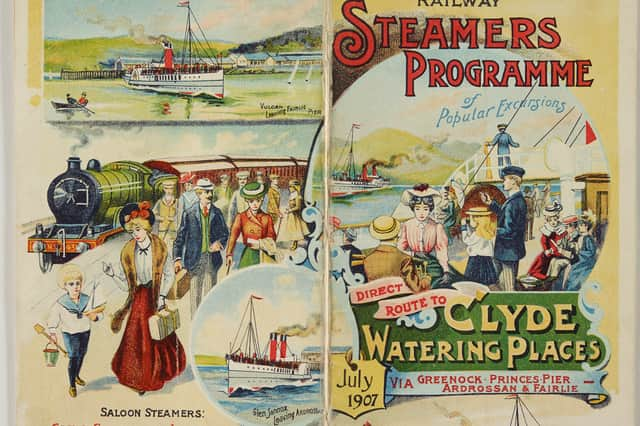

Glen Sannox - namesake of CalMac’s hugely-delayed new ferry - was built in Clydebank in 1892 and was in service until being broken up in 1925.
Glen Rosa - whose namesake is due to be completed in a year’s time - was built in Clydebank in 1893 and operated to Arran until 1939.
It was requestioned by the Royal Navy as a minesweeper for part of the First World War and temporarily renamed HMS Glencross.
The photographs and posters, selected from the country’s largest rail archive held by National Records of Scotland (NRS), also include advertisements for cheap holiday season tickets and the allure of the Highlands, complete with a stag’s head, waterfall and tartan.
The exhibition at General Register House at the east end of Princes Street also features some of Scotland’s best-loved railway landmarks, such as the Forth and Tay bridges, city stations like Edinburgh Waverley and Glasgow Central, and the ornate roof of Wemyss Bay on the Clyde coast.

It forms part of year-long events to mark the 200th anniversary of the modern railway in Britain - although the first lines in Scotland were laid a century earlier, such as between Cockenzie and Tranent in East Lothian.
That coal-carrying wooden “waggonway” is commemorated in the exhibition, with two beautifully embossed journals by carpenter William Dickson, which he started in 1720.

But also featured are pamphlets protesting against railway expansion, such as by those who argued it would destroy the countryside - echoing some of today’s HS2 opponents.
Others feared the appeal of “devious trains” to take people to play golf would distract them from more important matters at home, especially on Sundays.
NRS outreach archivist Veronica Schreuder said: “The Victorian era encompasses huge changes such as urbanisation and industrialisation, and also large changes in the way people moved for work or other travel.”

She said prior to the railways, “it would be difficult for us to imagine the difficulties of movement - most people had very few options and if you were working class, perhaps you would never leave the place where you were born or worked”.
“For the rich, it was dangerous, time-consuming and expensive, even for them,” she said.

“But with the expansion of the railway, it meant people could move both for business, but also for fun. The working classes could take a trip to the seaside and the rich might go to a hydropathic hotel or a Highland estate for shooting, fishing or relaxation.”
Ms Schreuder said opponents of the railways had various motivations.

She said: “Some people believed you were sacrificing the beauty of the countryside for getting people quicker from A to B. Others were worried about safety, who saw trains as big, dirty, dangerous, loud machines over which we didn’t have full control.
“Whilst large cities were welcoming the railway by the 1840s, Oban didn’t receive it until 1880 because it was seen as a wild idea. But by the 1860s, people were recognising they were missing out on a lot by not being reachable by train - such as for bringing in goods or tourists to spend money in your locality.”
Scots on the Move: Railways and Tourism in Victorian Scotland is free to view and continues until September 26.
Comments
Want to join the conversation? Please or to comment on this article.