
The heritage barley Golden Promise that’s making ‘forgotten’ beer and whisky possible
A great lost name in British brewing is making a return thanks to the use of a heritage barley and the discovery of a lost ‘brewing bible.’
One of the great lost names of British brewing is returning to the beer that made its fortune more than 200 years ago – with a new IPA made possible by a heritage barley and the extraordinary discovery of a brewing ledger described as the missing link between one of the world's most popular modern beer styles and its historic roots.
More than half a century after the brewery that helped popularise IPA around the world disappeared from Britain's pubs, Allsopp’s – the modern incarnation of Samuel Allsopp & Sons – has unveiled The Famous Original, a new 4.4 per cent IPA and the culmination of Jamie Allsopp's five-year mission to revive one of Britain's most influential brewing names.
Containing more than 100 handwritten recipes – including IPA, Pale Ale, Double Diamond, Stout, Arctic Ale and dozens of forgotten brews – the ledger was discovered in an attic in Leeds after Jamie had spent almost two years searching for original records from the family brewery and has become the historical foundation for its modern revival.
Jamie had been searching for the beer ledger or ‘beer bible’ from Allsopp’s for years and was getting nowhere until a call from renowned brewer, brewing historian, and collector Steve Holt, of Kirkstall Brewery. Mr Holt revealed what Jamie had begun to fear no longer existed, he had found what is thought to be the only surviving Allsopp’s brewing ledger in an attic in Leeds.
Jamie, a direct descendant of brewery founder and seventh time grandfather Samuel Allsop, says the new IPA represents far more than another addition to the range – but rather the return of the beer at the heart of his family's brewing story.
“Arguably there is no more important beer in brewing history, Jamie said. “And as an Allsopp the story of IPA has a very particular resonance.”
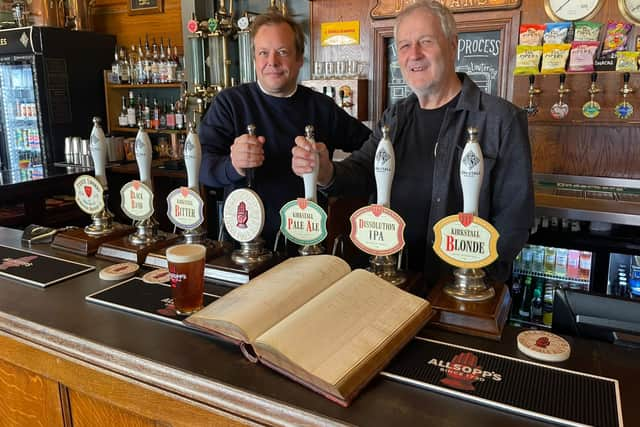

"This is the moment I've been building towards since the day we decided to bring Allsopp's back," he explained. "IPA was the beer that transformed Allsopp's from a regional Burton brewery into one of the most famous brewing companies in the world. Everything we've done over the past five years has been leading here.”
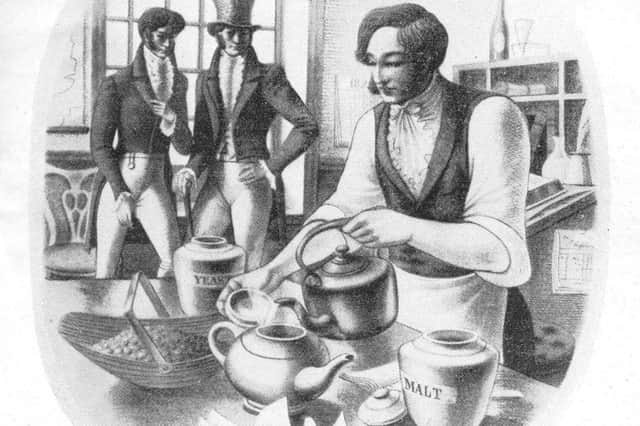
IPA, or India Pale Ale, was created in the 1820s to ship to India as it wouldn’t spoil on the journey. Samuel Allsopp’s recipe helped establish the style of IPA but after a period of boom, expansion and poor commercial decisions led to bust.
But now Jamie has brought back the Allsop name to brewing - after years of searching for the family brewing book - and he’s doing so with the use of a heritage barley.
Rather than attempting to produce a museum-piece recreation of a nineteenth-century beer, Jamie and the brewing team at Kirkstall Brewery have drawn on the historic recipes and Allsopp's brewing heritage to create the IPA they believe the brewery would be making today.
The resulting 4.4% Famous Original IPA is brewed with UK Golden Promise malted barley and Challenger hops, producing a dark copper IPA with herbal, spicy and resinous notes, rounded bitterness and a sweet, malty backbone.
Golden Promise barley is also having a renaissance in Scotch whisky with Aberargie in Perthshire, Ardnamurchan in the Highlands, Benromach in Speyside and Holyrood in Edinburgh have all released whiskies using this heritage grain.
Golden Promise was widely used in brewing and distilling for about 20 years. Developed in the 1950s, it gained popularity in the UK in the 1960s thanks to delivering a rich, sweet, oily and distinct mouthfeel. Something whisky drinkers might now know as being one of the components behind a ’traditional’ whisky.
Brands like the Macallan, Glengoyne and Benromach used Golden Promise for years thanks to its malt-forward flavours and robust mouthfeel but its lack of yield led distilleries to abandon it for higher yielding crops, from the 1980s onwards although some continued to use it up until the 1990s.
In brewing it became a foundational base malt for traditional British cask-conditioned ales (such as Timothy Taylor's Landlord) and early organic beers.
Now it’s back with a bang, with one of the newest releases Aberargie Expressions Golden Promise hitting the shelves last month. Produced from 100 per cent Golden Promise barley and matured in 68 per cent first-fill Bourbon casks and 32 per cent first-fill Sherry casks, the whisky is described as rich and full-bodied, with aromas and flavours of warm buttered pastry, stewed apples, brown sugar and gentle baking spices, followed by a lingering finish.

Whisky expert and author Dave Broom said of Golden Promise malted barley in Aberargie: “When you nose (a whisky with Golden Promise) you can get cereal notes and richness coming through. There’s a real fatty quality to it and you can tell almost by smelling it what the texture is going to be.
“It’s evidence of this idea that I think was perpetuated by the whisky industry that barley variety didn’t matter and it was about yield, which was important. Then you taste something like this (Aberargie Expression Golden Promise) and it can only be Golden Promise that’s driving the flavour.
“It was introduced in 1968 to the Scotch whisky industry and by the late 1970s that’s what whisky was made from in Scotland. The reason being that it was short straw and could cope with the Scottish weather so it was widely used across Scotland and less so in England.
“It was created by scientists; it’s a mutant variety which was bombarded by gamma rays and somehow Golden Promise came out, which just reminds me of the Incredible Hulk.”

As for Allsops new beer, Jamie said: “My seven times great grandfather Samuel perfected his IPA for the drinkers of his generation, and we've tried to approach it with exactly the same spirit more than 200 years later.
“It has the malt character, balance and bitterness that are part of our brewing heritage, but it's unmistakably a modern beer. For me, it's what Allsopp's should be brewing in 2026 – and what I believe we'd still be brewing had the original brewery endured.”
Comments
Want to join the conversation? Please or to comment on this article.