
Whisky industry 'struggling for optimism' amid tariff and export challenges
Escalating domestic and international challenges still impacting the whisky industry has resulted in a ‘struggle for optimism’ according to a new report. But there are reasons to remain positive, finds Rosalind Erskine.
It has been a tough few years for the whisky industry. The soaring sales of the pandemic have gone and with that, domestic and international challenges such as tariffs and duties have contributed to a flattening of the market.
Last year, 1,000 jobs were lost in the sector as it navigates a 17 per cent rise in excise duty over the past three years, Trump’s 10 per cent tariff and falling global demand. These market conditions have led to redundancies in Scotland at distilleries and closures of visitor centres, as well as widespread reduction in production.
Among companies hit by the shifting trading picture is Diageo, which has closed the visitor centre at Clynelish in Brora. Production staff at Bowmore and Laphroaig were offered redundancy and events staff let go at Lindores Abbey in Fife.
Now, a new report has highlighted how these challenges are impacting the sector, with analysis from accounting and business advisory firm Johnston and Carmichael finding that UK whisky businesses are “struggling to maintain optimism” due to these range of escalating domestic and international cost pressures.
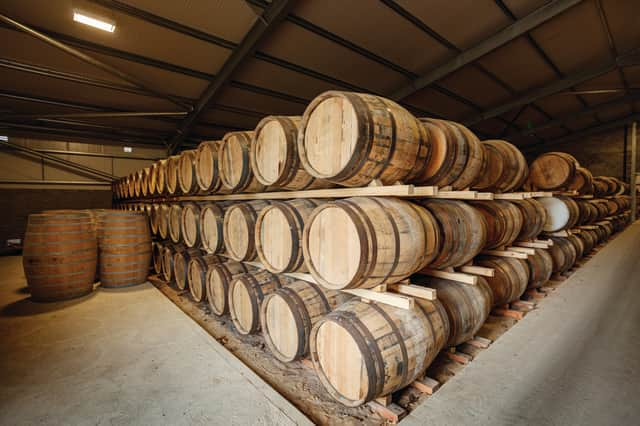

Within the report, the despondent thoughts of whisky distillers have been gathered as they face “major obstacles above and beyond” others in the food and drink business.
The research, which questioned businesses about industry challenges and opportunities over the past 12 months, highlights a number of pressures facing firms and how they are fighting to prosper without significantly rising prices for consumers.
Just 37% of whisky businesses reported feeling optimistic, compared to 56% of the wider group of food and drink firms surveyed.
While the largest area of cost increases for whisky distillers is labour (42%), whisky distillers are also contending with ongoing geopolitical uncertainty and unpredictability. The impact of tariffs is one of their greatest regulatory concerns (37%) alongside taxation (47%).
The effects of this are emphasised by the fact that new export customers remain the main growth driver (37%) for whisky businesses, illustrating the continued importance of trading internationally.
While still being a primary export market (32%), trade sentiment with the European Union (EU) also remains a challenge with just 21% of respondents reporting more positivity than last year compared to 58% reporting either the same or less positive sentiments.
The survey does also report signs of defiance for the industry, with 79% investing in their business to develop new products and increase innovation. Despite the challenges, whisky customers have largely (79%) faced just a 0-5% average price increase.

Grant Roger, audit partner and lead of the whisky finance director club, said: “This year’s food and drink survey has laid bare the magnitude of challenges that are disproportionately affecting UK whisky distillers.
“The issues faced in international trading are in addition to domestic challenges with labour and taxation costs continuing to rise. This, combined with lower Gen Z alcohol consumption, has led to stagnation in the market and goes a long way to explaining why optimism levels are below 40%.”
The stagnation of growth is reflected in its people too. Respondents claimed 37% of people who have left the whisky industry have done so due to stagnant salaries, with a further 27% citing a lack of progression.
Further adding to the sector’s woes, 21% reported that energy costs were the largest cost increase across their business. This compares to just 9% of wider respondents.
Mr Roger added: “The resilience of the UK food and drink industry shouldn’t be understated and there is positivity in the levels of innovation and new product development. But while the sector as a whole faces challenges, whisky distillers are experiencing major obstacles above and beyond what many others are.
“Whisky is crucial to the UK food and drink industry and remains the runway for all other producers to flourish. However, insights are clear that amidst widespread global uncertainty the sector craves greater clarity and stability.”
A spokesperson for the SWA said of the report: “Scotch Whisky has long been a cornerstone of the UK's food and drink industry, and a well-loved product around the world, but growing costs and challenges both at home and internationally are putting greater pressure on the industry. These include the 17% rise in excise duty over the last three years, increasing energy and business costs, and heightened global volatility, including the ongoing effects of a 10% tariff in the US, the industry's top export market.
“The Scotch Whisky industry is resilient, supporting jobs, investment and economic growth across Scotland and the UK, particularly in rural communities. The right support from Government will help to drive growth, and boost business confidence to invest in jobs and communities for the future.”

Blair Bowman, whisky consultant and rare cask broker, said while the survey reflects some understandable caution across parts of the industry, it was important to remember that whisky is not a single, uniform market. He remains optimistic - even if others are not.
He said: “At the very top end, demand for exceptional and rare whisky remains resilient. Among collectors and private clients, the focus is less on short-term market sentiment and more on quality, provenance and long-term value.
“Periods like this tend to reward those who stay the course. The producers and brands that avoid short-term, reactive decisions and remain disciplined in how they build and position their whisky are usually the ones that emerge stronger over time.
“Scotch whisky has, and always will be, a long-term business. Despite the current challenges, I remain optimistic, particularly at the premium and ultra-premium end where global demand for exceptional bottles and casks continues to grow and tends to be less exposed to short-term macroeconomic uncertainty.”
Mark Littler, whisky consultant and rare cask broker is also on the side of optimism. He said: “It is undeniable that the whisky industry is going through a challenging period. However, there are clear reasons to be positive. Export markets such as Vietnam are growing rapidly, and recent tariff reductions in China and Hong Kong present significant opportunities for long-term growth.”
As for changes that can be made? Mr Littler suggested looking at city centres for growth, saying: “I feel that the industry needs to rethink its domestic retail strategy. As growth becomes increasingly export-led, the domestic retail experience matters more than ever.
“Whisky today often sits at price points comparable to luxury goods like Chanel No. 5, yet the in-store experience rarely reflects that positioning.
“Distilleries continue to invest heavily in remote visitor centres, but there is a lack of presence in major cities. Meanwhile, even brands like LEGO and Haribo have embraced city-centre boutiques to control their narrative and reach new audiences.
“If whisky is to justify its premium positioning, it needs to meet consumers where they are and elevate the buying experience accordingly.”
Comments
Want to join the conversation? Please or to comment on this article.