
How the Scottish ski industry got its mojo back in 2026


Whatever the final sales figures show, 2026 will go down in history as a year when Scottish skiing broke a worrying losing streak, writes Roger Cox
A year can feel like a long time in Scottish snowsports. Rewind 12 months or so, and the industry appeared to be on its knees. Not only was the chronically snow-starved winter of 2024/25 the worst on record in terms of the number of lift tickets sold at Scotland’s five ski centres, it also seemed to fit into a worrying trend: not including the Covid-compromised 2019-20 and 2020-21 seasons, four of the worst ever winters for Scottish skiing had occurred in the previous ten years. The climate change-induced doomsday scenario, foretold for so long, finally seemed to be coming true.
But if the climate models do indeed show a difficult long-term future for Scottish snow-sliding, they also tell us that there will likely be a mixture of good winters and bad winters along the way – and the winter of 2025/26 falls squarely into the former category.
How good has it been in commercial terms? We should probably wait until the official sales stats are announced at the end of the season before getting too carried away. However, given that it seems there may be plenty of skiing still to come, with Glencoe and Cairngorm both reporting fresh snow at time of writing, and given that some of the heaviest snowfalls of the winter coincided with the all-important February half-term holidays (albeit bringing with them an un-skiable storm day or two) it seems likely that the final numbers will be cheering, regardless of how the tail-end of the season pans out.
Early indications certainly seem positive. By mid-February, for example, Cairngorm was reporting having welcomed some 23,000 skier visits since the start of the season – that’s almost half of the 51,825 recorded across all five ski centres during the whole of last winter. At Glenshee, meanwhile, they clocked up more than 2,500 skiers and snowboarders on their busiest day.
READ MORE: Scottish Ski & Board 2025/26 e-mag
No matter how this season’s numbers stack up against previous years though, in the medium-term the gains made in PR terms may prove more valuable than any bump in revenue. Because the 2024/25 season was the second near-washout year in a row (the 2023/24 season was the third-worst on record) there was a very real danger that a third bad year could have cemented the idea that skiing in Scotland had had its day. But instead of depressing pictures on the TV news of bare, muddy pistes and empty chairlifts swinging in the breeze, this winter we’ve been treated to wall-to-wall images of snow-covered slopes and headlines like “Best ski season in years on Scotland’s snowy hills”. And while social media can sometimes amplify bad news in a bad snow year, it is much more geared towards amplifying good news in a good year: a post showing someone enjoying powder turns under a sunny sky is far more likely to go viral than a picture of someone hauling their skis across a slushy car park in the rain.
Other notable PR wins? Ace freestyle skier Kirsty Muir may not have bagged herself a medal at the Winter Olympics, but she still did Scotland proud with some gutsy, heart-in-mouth performances in the Slopestyle and Big Air. How many young girls up and down the land will be inspired to give skiing a go having watched her competing on the telly? And then there’s been the successful reopening of the Cairngorm funicular. Given the amount of money it’s cost to get it operational again, that might not sound like such a big win, but for the best part of a decade the big blue snow train has been like a public relations albatross around the neck of Scottish skiing – the fact that it’s no longer a story is more significant than it seems.
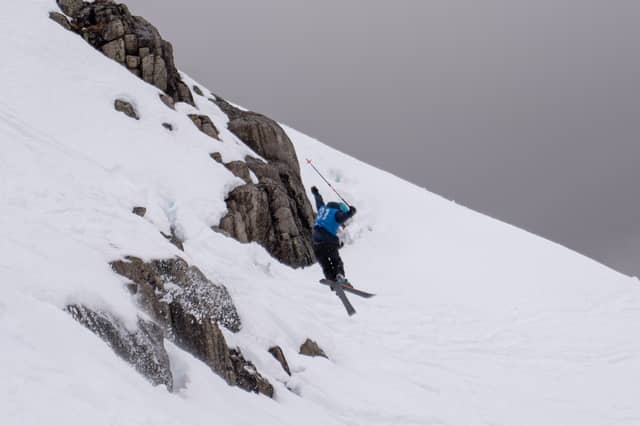
Also important for the survival of Scotland’s skiing and snowboarding ecosystem has been the fact that so many of this year’s competitive and social events have been able to go ahead as planned. Take the Scottish Freedom Series (SFS), for example – Scotland’s annual freeride tour. In both the 2024/25 and 2022/23 seasons, the whole series had to be cancelled due to lack of snow, and in 2023/24 only two events were able to go ahead. This year, however, it has been possible to complete all three of the scheduled competitions, with the third and final event, the Coe Cup, taking place at Glencoe on 21 March. This success is due in part to a new format for the series, which gives the organisers more flexibility in terms of picking dates when conditions are at their best, but the main contributing factor has undoubtedly been this winter’s snow bounty. Similarly the UpBattle event for split-snowboarders – another victim of cancellations in recent seasons – was able to go ahead as planned at Cairngorm in mid-March. Footage of grinning boarders slogging up to to the top of the resort and then enjoying well-earned turns on the way back down was all over social media in the days immediately afterwards.
Neither the SFS or the UpBattle could really be described as mass-participation events, but they both attract highly-motivated people – the kind of people a marketing professional might describe as “hardcore enthusiasts”. These aren’t just folk who show up on a whim – they are your true believers and potentially your proselytisers as well. Keep them happy and engaged, and the chances are that next year they’ll return to your event with a few friends in tow.
So, whether this season’s lift ticket sales figures turn out to be record-breaking or just a little above average, the overall picture for Scottish skiing is looking infinitely better than it did this time last year.
Want the latest Scottish headlines sent directly to your phone? Sign up to our new WhatsApp channel here.
Comments
Want to join the conversation? Please or to comment on this article.