
Moby Dick whale behaviour becomes reality, St Andrews University research confirms

Headbutting between these majestic ocean mammals has been scientifically proven.
The leviathans that once haunted the pages of Moby-Dick have resurfaced—not in fiction, but in newly revealed scientific research.
Sperm whales, the deep-diving titans that inspired author Herman Melville, have now been filmed engaging in behaviour long associated with what 19th century mariners described in logbooks: headbutting.
In new research led by the University of St Andrews, these ocean giants were captured on camera using their immense, oil-laden foreheads as battering rams—striking one another and nearby objects.
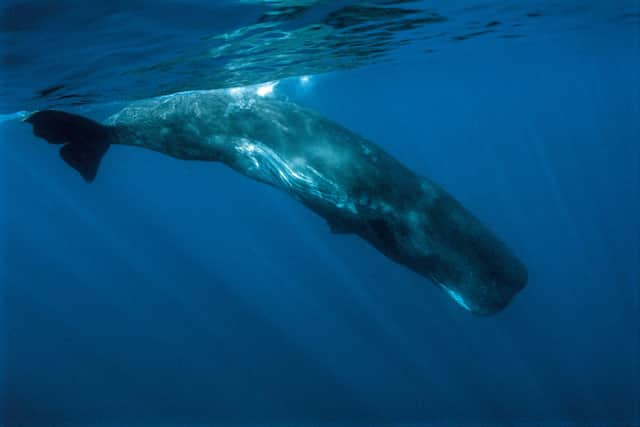

This defensive behaviour, while rarely observed in modern times, was documented in several high-profile incidents that directly inspired Herman Melville's Moby-Dick.
To record such activity today, researchers used drones to film the behaviour of sperm whales in the Azores and Balearic Islands between 2020 and 2022.

Their findings, published in Marine Mammal Science, showed how younger whales engaged in headbutting rather than between larger males as previously thought.
The university said the report raised “intriguing” questions about the reasons and consequences behind such behaviour, as well as its impact on group dynamics.
Lead author Dr Alec Burslem, who carried out the research while at the University of St Andrews in collaboration with researchers at the University of the Azores and Asociacion Tursiops, said: “It was really exciting to observe this behaviour, which we knew had been hypothesised for such a long time, but not yet documented and described systematically.”
Sperm whales using their heads to push and strike objects have been reported anecdotally since the open-boat whaling of the 19th century.
The sinking of the whaling ship the Essex is one of the most famous examples and one that inspired Melville’s novel Moby-Dick. The 27-metre sail-powered whaleship was reported to have been sunk by two head-on strikes from a large bull sperm whale off the Galapagos in 1820.
Owen Chase, first mate oboard the Essex described the force of the whale’s headbutt in a contemporaneous report quote: "I turned around and saw him about one hundred rods [approx. 500 m] directly ahead of us, coming down with twice his ordinary speed of around 24 knots, and it appeared with tenfold fury and vengeance in his aspect. The surf flew in all directions about him with the continual violent thrashing of his tail. His head about half out of the water, and in that way he came upon us, and again struck the ship."
Other similar accounts of whaling ships being sunk by sperm whales include the sinkings of the Ann Alexander and the Kathleen in the 19th century.
Dr Burslem, who is now based at the University of Hawaii, said: “This unique overhead perspective for observing and documenting near-surface behaviour is just one of the ways drone technology is transforming the study of wildlife biology.
“It’s exciting to think about what as-yet unseen behaviours we may soon uncover, as well how more headbutting observations may help us to shed light on the functions the behaviour may serve.
“If there are people out there with similar footage, we would be very keen to hear from them.”
Comments
Want to join the conversation? Please or to comment on this article.