
The Sustainable Shepherdess: How livestock and peatland recovery can go hand in hand


‘We are never going to maximise output if it’s not sustainable’
“Oh my goodness, stop, that is a Hen Harrier I think.”
A bird has flown quickly across the landscape in front of us, giving us a passing glimpse. Cora Cooper slams on the brakes and gets out of the car, scanning the hillside: heather, marshy grassland and a little pond attracting birds of all shapes and sizes.
“Of all the days to forget my binoculars,” she exhales, visibly gutted.
I ask her if she has seen one here before. She tells me no. There had been rumours of hen harriers living on the hillside, backed up only by a few rare sightings. Yet in recent years, the Coopers have seen the return of grouse, snipe, curlew, lapwing, golden plover and red kite.
Cora farms Tardoes Farm in the Muirkirk Uplands of Ayrshire with her husband David, their three children and a team of nine Huntaway and collie sheepdogs. It’s no small operation. Built up over the past 20 years, it covers more than 5,050 acres and carries a flock of 4,000 Herdwick and Welsh Mountain sheep. Earlier this year, I was visiting on behalf of NFU Scotland to learn more about their peatland restoration project.
Cora’s route into farming was far from conventional. She grew up in Glasgow, studied law and went on to work in PR and events for major organisations. Today, she is Chair of Women in Agriculture Scotland and is Vice Chair of NFU Scotland’s Environment and Land Use Committee.
I ask her how she manages it all. She simply smiles.
“We are just shepherds, we haven’t reinvented the wheel, it’s a system that’s been developed over thousands of years,” she says. “And for us, it’s about sustainability: what’s sustainable for the land, and what’s sustainable for us. We are never going to maximise output if it’s not sustainable.”
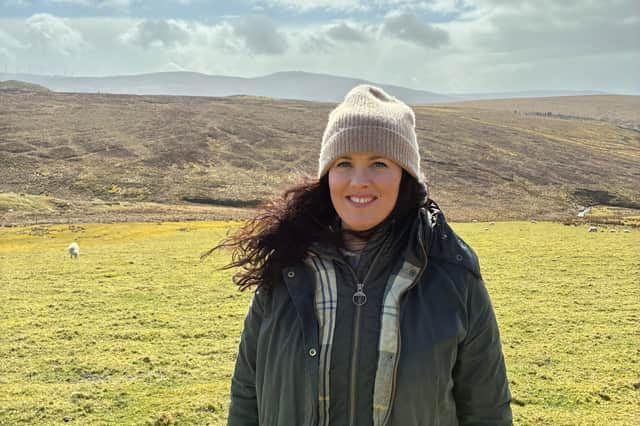
It was this mindset that led Cora to quit her job and go all in on the farm when they had their first child. In an area where childcare was unavailable, it seemed a sustainable solution for their family. And the same mindset that shaped their response when, in 2018, Clive Walton from the RSPB chapped on their door to ask if they would be interested in a peatland restoration project on their land.
Their answer was straightforward: if it improved the resilience of the land and their business, then yes.
Tardoes Farm already had Special Protection Area status, alongside clear evidence of peatland scarring from former drainage trenches, believed to have been dug after the war to increase food production.
Over the decades, these great chasms in the peat had continued to weather. What Cora and David were faced with in 2018 was a death trap for livestock and a landscape that was increasingly inaccessible, which in turn placed more grazing pressure on other areas of the farm. The way the peatland was heading was beginning to compromise the Coopers’ adaptive mob grazing system.
When approached with the idea of restoring the peatlands, Cora and David put their cards clearly on the table: the project had to work for them and the farming system they had in place.
Having sheep on this hillside was vital. Not only did they help manage the heather growth, but the Coopers also believe the land benefits from livestock.
It was a challenge accepted by the project developers. Over two winters, Cora, David, Clive Walton and Richard Johnstone co-designed a restoration project that worked alongside the farm’s sheep enterprise.
Between 2019 and 2021, the three-phase project put more than 800 hectares of the most damaged peatlands on the road to recovery, using a range of techniques to block the drains and restore the exposed peat.
“Restoring these peatlands has massively improved the ecological health of the hill, but has not negatively impacted our sheep farming business at all, it’s added to its resilience. The value of the land for farming has increased tenfold.”
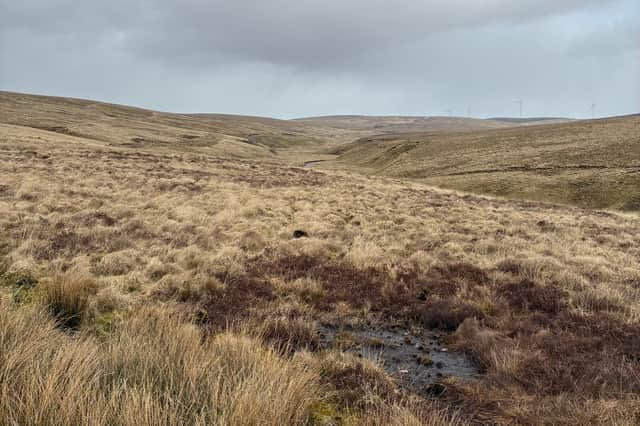
Walking the hillside with Cora, we spend time hunkered down exploring the minutiae of life that have taken up residence, from pools of sphagnum moss to the first brave green buds of spring emerging. We let rich, dark soil, alive with invertebrate life, trickle through our hands – a world away from the damaged landscape of decades past.
Alongside one burn, Cora points out an apiary of bees and some new native trees planted with visiting geoscientists from America, keen to find out more about the role of sheep grazing in the restoration of a former coal opencast site.
“Farming is about adding nature where the land isn’t top-grade,” she says. “Restoration should work alongside food production, building resilience and food security. And when you look at Scotland’s landscape, you’ll realise that’s been happening for hundreds and thousands of years. Farmers have always cared.”
Towards the end of the day, Cora takes me to a spot on the farm with a view of both the restored peatland and, to its right, the harsh, damaged areas, with huge swathes of exposed peat and steep, almost cliff-edge gullies.
“We’ll get this done too,” she says pensively.
Reflecting on saying yes to the project, she tells me: “It has, single-handedly, been one of the best risks we’ve taken on the farm.”
She laughs and follows up: “And we’ve taken a lot of them.”
The first, she recalls, was turning up at Tardoes Farm for the very first time to help out in the sheep pen on shearing day wearing a dress.
Cora’s love for her land is infectious. She cares deeply, and when I ask her why, she simply says her farm gives her hope.
Megan Williams, Editor of Scottish Farming Leader, NFU Scotland membership magazine
To find out more about joining NFU Scotland, visit joinnfus.org.uk/join-nfus/
Comments
Want to join the conversation? Please or to comment on this article.