
Nigel Farage may not be in power - but he is already dictating, as Lucy Connolly reaction shows: Euan McColm
Silently looming over every decision the Conservatives make is the shadow of Nigel Farage – their reaction to Lucy Connolly’s release from jail was just the latest example

Lucy Connolly was not jailed for political reasons but for the serious crime to which she confessed.
Hours after 17-year-old Axel Rudakubana murdered three children in an attack on a dance class in Southport last July, Connolly used social media to call for brutal violence against asylum seekers.

As civil unrest spread, the 42-year-old childminder posted on Twitter, urging mass deportations.
“Set fire,” she wrote, “to all the f****** hotels full of the bastards for all I care.”
Later arrested, Connolly pleaded guilty to distributing material with the intention of stirring up racial hatred and was sentenced - in keeping with statutory guidelines - to 31 months behind bars.
Since her imprisonment last October, Connolly has become a martyr to some, with many alleging she was a victim of “two-tier” justice. Why, she got more jail time than people convicted of different crimes, don’t you know?
The mundane, if grim, truth is that Connolly did a dangerous, deeply racist thing and then admitted as much. She did not exercise her right to free speech, she called for violence against innocent people at a time when rioting was breaking out across the country.
Upon her release from prison last week, after serving 10 months of her sentence, Connolly was hailed as a homecoming hero by some. There were softball interviews with sympathetic right-wing commentators and a surge of donations to a crowdfunder to help Connolly “rebuild her shattered life”, which has now raised more than £160,000.
Connolly is now an icon of the hard right. To supporters of agitator Tommy Robinson or the “send them back” types who flock around Reform UK’s Nigel Farage, her case represents evidence that the system is skewed in favour of immigrants.
This populist and entirely reckless position has now been adopted by the Conservative Party.
On Connolly’s release, Tory leader Kemi Badenoch issued a statement in which she demanded to know why prosecution had been considered to be in the public interest.
Connolly, wrote Badenoch, had received a punishment harsher than those found guilty of attacking police during riots.
And then the leader of the opposition raised the case of Labour councillor Ricky Jones, found not guilty of inciting violent disorder when he called, during an anti-racism rally, for far-right activists’ throats to be cut.
Badenoch stopped short of making a direct link between the cases of Connolly and Jones. Rather, the implication was that the two had experienced very different standards of justice.
Badenoch didn’t allow herself to get bogged down in troublesome details such as the fact Connolly admitted her guilt while Jones chose trial by jury, decisions which make the cases - and their outcomes - incomparable.
Badenoch promised a radical new direction for the Conservatives under her leadership but did anyone expect that to mean she would abandon the long-standing claim that hers was the party of law and order?
While Badenoch continued to pander to the populist right last week, Scottish Tory leader Russell Findlay had to deal with the fall-out of his party’s shift away from the centre ground.
Lothians MSP Jeremy Balfour, who had been the Tories’ spokesman on social justice at Holyrood, quit the party saying it had “fallen into the trap of reactionary politics”
In a brutal letter of resignation, Balfour - who plans to sit as an independent - wrote that “Increasingly, decisions seem to be made by advisers who lack experience, while senior MSP colleagues are ignored.”
Balfour’s departure from the party follows the defection, in April, of Tory MSP Jamie Greene to the Liberal Democrats.
Under the leadership of Russell Findlay, the Scottish Tories have promised to “wield a claymore” on Scottish spending. In the unlikely event of the Conservatives winning next May’s Holyrood election, there will be a Scottish DOGE, just like Donald Trump’s cost-cutting operation in the USA.
In their own ways, Badenoch and Findlay are changing their party and not, I think, for the better.
Silently looming over every decision the Tories make is the shadow of Nigel Farage.
Reform UK may have just four MPs, right now, but polls show the party continuing to devour Conservative Party support both north and south of the border.
Farage so terrifies the Conservative establishment that its policy positions are no longer based on what we might consider to be the party’s traditional values but on the answer to the question “what would Nigel do?”
The Reform UK leader does not need to be in power to wield considerable influence over our political debate. Not only is he all but dictating Tory policy, he is also influencing Labour which, since last July’s landslide General Election victory, has promised new and stronger measures to halt the flow of small boats carrying undocumented immigrants across the English Channel.
Had this shift rightwards by both the Tories and Labour happened just a few years ago, the SNP would have seen a golden opportunity to strike. A move towards the politics of Nigel Farage would have added weight to the nationalists’ position that the politics - indeed, the values - of Scotland and England are fundamentally different.
But the SNP are not immune to the threat from Reform UK.
In June’s by-election for the Westminster constituency of Hamilton, Larkhall and Stonehouse - won by Labour - Reform came a very close third behind the Scottish nationalists. A cursory glance at the result shows that Farage’s party did not only take votes from the Tories but from the SNP, too.
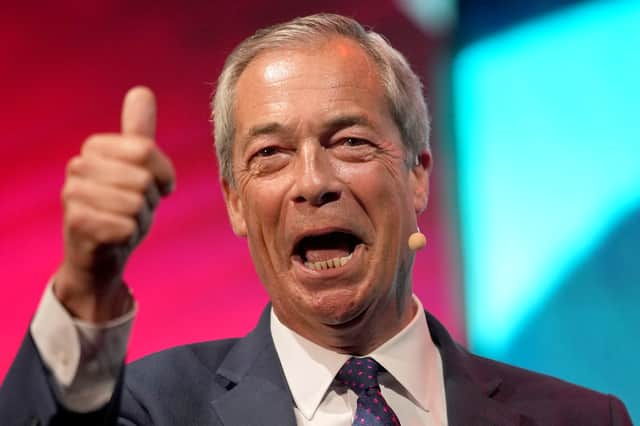
Nigel Farage may be one of just four Reform UK MPs at Westminster but he has the influence on our politics of the most powerful of government ministers.
Comments
Want to join the conversation? Please or to comment on this article.