
Fears grow for long-term future of 'orphan child' of British broadcasting
Pressing funding woes spark concern around sustainability of flagship Gaelic language service

For nearly two decades, it has provided a vital voice for the dwindling numbers of native speakers of a language on the edge of Europe, reflecting their culture and lives while also supporting a new generation of talent via hundreds of jobs across the Highlands and Islands.
But amid a surge in the number of Scots with Gaelic skills, the body behind the flagship BBC Alba television channel has warned of stormy waters ahead as it finds itself facing a looming financial crisis that risks undermining its efforts to provide a modern minority language media service.
The chair of Scotland’s Gaelic broadcasting body was warned that it is in “real jeopardy” as it deals with an “unsustainable” fiscal footing, and stressed that if the current BBC charter review did not deliver more stable funding, it would be “catastrophic.”
In evidence to MPs at Westminster’s Scottish Affairs Committee, John Morrison, the chair of MG Alba, which runs the BBC Alba channel in partnership with the corporation, said it was “the orphan child of British broadcasting,” and had “fallen between the stools.”

Having contended with a long-standing funding freeze and a sharp drop in the quantity of new output it produces, concerns are mounting that the channel is in danger of losing audiences its audiences, a trend that has intensified calls for it to obtain a firmer standing and a funding model more akin to that of S4C, the Welsh language television channel.
But how did Scotland’s main Gaelic-language television service reach this point, and what needs to be done to safeguard its future?
Surge in ‘symbolic’ Gaelic
For anyone with a casual interest in Gaelic’s fortunes, the precarious situation outlined by MG Alba’s chair may well come as a surprise. After all, the latest census in 2022 showed that around 130,000 people in Scotland had any kind of Gaelic skills, a significant increase on the 87,000 registered in 2011.
There has also been a rapid upscaling in the provision of Gaelic medium education. In 2025/26, 37 local authority secondary schools in Scotland offered at least one subject in the medium - up from 32 the previous year - with new Gaelic units set up in English language schools and increased rolls in Gaelic schools.
On the face of it, such progress is encouraging, yet it belies more entrenched problems facing a tongue that continues to be classed as endangered by UNESCO. Tellingly, the 2022 census showed that even in the language’s heartland of Na h-Eileanan Siar, the number of people speaking the language had dropped to 45 per cent from the 52 per cent recorded in the 2011 census.
Those who champion the importance of native-speaking communities are keen to assert the distinction between the decline in vernacular, first-language Gaelic and the rise of symbolic, or second-language Gaelic. Addressing such a divergence requires a joined-up approach that spans issues such as depopulation and employment prospects.
But broadcasting too has a key role to play, allowing a community of speakers to speak to itself while giving them a window on the wider world.
Warning of audiences turning away
That driving ambition undoubtedly sat at the heart of BBC Alba when it launched in September 2008, backed by a £14 million budget. The schedule from that first evening showcased its creative power, with a live music outside broadcast from Skye accompanied by an original period drama set in Lewis, a drama-documentary.
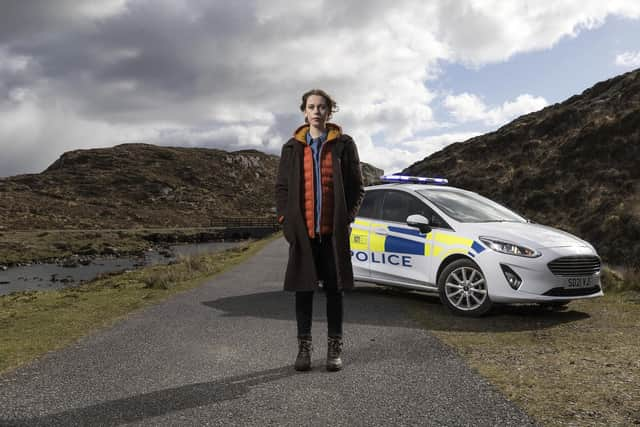
Countless other innovative ideas have flourished in the years since, not least the award-winning Gaelic thriller series, An t-Eilean, which cost more than £1m per episode to make. But the goal of creating original programming that can win over new viewers and help the language flourish is proving increasingly hard to meet.
Mr Morrison told MPs last week that new content accounts for just over 20 per cent of BBC Alba’s weekly output. When the channel launched 18 years ago, the figure was 40 per cent. Such a decline, he said, had sparked concerns around the ability to retain viewers, especially those who are learning Gaelic.
“If we slip below that we can see that audiences go away, particularly young audiences, because like everybody else they’re consuming Netflix and Apple TV,” he explained. “Unless we’ve got new content, they go away.”
Grant almost unchanged
The primary reason for such woes, as it nearly always is, boils down to money. MG Alba received a Scottish government core grant of £13m in 2025. That the grant was almost identical five years ago, at £12.8m, would give some impression of the financial challenges facing the service, but the fact it received the exact same amount as long ago as 2015 underscores the point.

On top of that, production inflation has continued to exert pressure on commissioning budgets. In spite of co-commissioning funds and external co-funding from agencies such as Creative Scotland, there is little in the way of wriggle room.
“Sustainability is key for us, as I'm sure the committee is aware,” Mr Morrison said. “We are in real jeopardy and that cannot be overstated because the value of our budget has dropped by about 45 per cent. That trajectory is unsustainable for any organisation or company.”
Mr Morrison, a former chief political correspondent with BBC Scotland, told the committee hearing into the future of Gaelic broadcasting that at after he was appointed as the chair of MG Alba at the start of 2023, the accounting giant, EY, was commissioned to carry out an analysis which showed that its budget “should have been double what it was at the time, because it had fallen so far behind”.
Lamenting years of funding freezes, he said that if MG Alba’s financing had kept pace with inflation, it would have had an annual budget of around £30 million. Instead, its baseline grant for 2025/26 from the Scottish government was £15m, with the BBC also providing funding.
Asked by Labour MP Kirsteen Sullivan what the implications would be for Gaelic broadcasting if the BBC charter review did not result in more stable funding and a statutory framework, Mr Morrison said it would be “catastrophic,” explaining: “If you are running any sort of private company and the value of your turnover had reduced by 45 per cent over a decade, that trajectory would be very concerning indeed.
“We are the most visible representation of Gaelic that exists anywhere in the world, so all the young people who are going through Gaelic medium education, and who watch drama, sport, and television in their own language, where would they go? We can’t continue on this trajectory.”
Charter review deemed key
The way in which that trajectory can be changed, according to supporters of Gaelic broadcasting, requires a concerted multi-faceted approach. They point out that S4C receives a significantly better funding package, including license fee cash funding of £95m. Such relatively vast sums are beyond the wildest dreams of those at MG Alba and BBC Alba, but there remains a determination to obtain what some figures describe as “parity of esteem” for Gaelic and Welsh language broadcasting.
Mr Morrison and others want to see the partnership between MG Alba and the BBC formally entrusted, securing its role for the next decade and delivering an allocation of licence fee financing via a transparent, ring-fenced funding mechanism.
The UK government Department for Culture, Media and Sport consultation on the BBC charter review noted that it will “consider options” for providing MG Alba with “more certainty” over its funding, and there is hope that a solution can be found so that the body is no longer seen as - in Mr Morrison’s words - the “orphan child of British broadcasting”.
Donald Campbell, the chief executive of MG Alba, said the ambiguity around how funding was provided was longstanding, and left Gaelic language broadcasting as the poor counterpart of other minority language services.
“There isn’t a mechanism that says this is what the licence fee will contribute, and this is what Scottish ministers will contribute,” he told the Scottish Affairs Committee. “There isn’t a compact that says clearly why that’s important, how much it is going to be, and that in a nutshell is what we are proposing.
“When you look at the discrepancies between the Gaelic situation and Irish and Welsh [language broadcasting], it’s predominantly that they have that certainty of why it’s important, who’s going to be delivering, and how much resource is going to be allocated.”
Italian football seen as way of ‘normalising’ language
In the meantime, those behind BBC Alba are pressing ahead with their programming plans. Work is well underway on a second series of An t-Eilean, following on from other new ideas such as Mas Fhior, a dedicated Gaelic quiz show, and The Hebridean Baker. It is also continuing its focus on sports coverage, which accounts for around a quarter of the budget, with one particularly high-profile capture being the rights to Serie A games, where a growing number of Scots footballers are plying their trade.
As was the case during the recent Glasgow Commonwealth Games, the decision to screen Italian football on a Gaelic television channel has been met with predictable moaning and groaning from those who question BBC Alba’s scope. But Mr Campbell, among others, believes it has a valuable “normalisation” effect on the language.
“English language handles Italian sport, Welsh language handles Italian sport, why shouldn’t Gaelic language handle Italian sport?” he reasoned. “What distinction are people drawing in their minds that would say Gaelic broadcasting and the Gaelic language is only for a certain number of things?
“It’s a very deep part of the Gaelic revitalisation strategy so that Gaelic is just normalised and has the right to cover whatever territory it wants provided it finds an appreciative audience, and in our context it’s value for money.”
Given the financial pressures, it may be too soon to shout Viva Alba in complete confidence, but it is clear that those behind Scotland’s premier Gaelic media service are willing to do more with less while they hope for a deal that will secure the channel’s future for a third decade and beyond.
Comments
Want to join the conversation? Please or to comment on this article.