
Dear John Lewis, the nation’s grannies are worth far more than any extravagant Christmas gift – Susan Dalgety
Grandmothers are not out-of-touch oldies who can only win their grandchildren’s affection by buying expensive gifts

On every visit to their great-grandmother – my mother – my four grandchildren would rush to her bedroom and pull out the box of cheap toys she kept for them under her bed. Most of the plastic tat had been bought in one of the three local charity shops. Nothing cost more than a pound. Some items were broken.
But my four grandchildren loved that box and its contents. It was GG’s chest of surprises, and when she died last year, my youngest granddaughter asked if we could keep it, as a reminder of the hours she spent playing with them at the feet of a woman she barely knew, but was connected to in a way familiar to most. Granny, the heart of the family.
Fast-forward to John Lewis’s eagerly awaited 2026 Christmas advert which landed a few days ago, with a stellar cast. Springsteen acolyte Sam Fender does the soundtrack – the Rolling Stones classic, You Can’t Always Get What You Want.
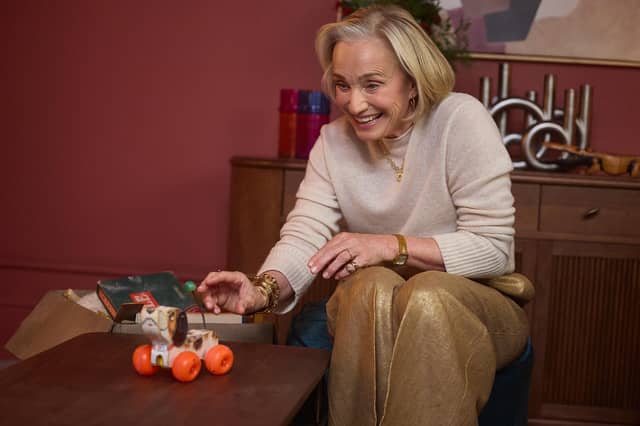
Comic superstar Paul Whitehouse is the voice of Pickles, a wooden toy dog, circa the 1980s, and one of the UK’s best actors, the impossibly beautiful Kristin Scott Thomas, plays Gloria, the most glamourous granny since, well forever. Throw in a pair of mixed-race grandchildren and a sumptuous London townhouse and the marketing gurus must have thought they had a huge hit on their hands.
‘Gran Cave’ loaded with gifts
Instead, the short video unleashed a torrent of complaints on social media, best summed up by Yorkshire writer Kathryn C Hall who wrote: “John Lewis have, in a two-minute advert, destroyed the true meaning of Christmas and made children look like spoilt brats who have no respect for their elders. Well done.”
The essence of the story is that Scott Thomas tries to entertain her grandchildren with Pickles, no doubt a once much-loved toy of her daughter’s, only to have them turn up their privileged little noses. Broken-hearted, she rushes off to John Lewis, in a pink rickshaw no less, where she buys up the contents of the haberdashery and tech departments to create a ‘Gran Cave’ for little Maggie and Freddie.
Instead of the envelope of cash she had planned to give them, Gloria unveils a magical room on Christmas morning, finally eliciting a smile from her grandchildren as she slips a record onto the brand new turntable. The video ends with the legend: “Don’t give up on giving.”
It’s about “rediscovering the joy of gifting”, says the John Lewis website. A more realistic interpretation would be that it portrays today’s generation of children as entitled monsters and grandmothers as distant, out-of-touch oldies who can only win the affection of their grandchildren by lavishing expensive stuff on them. Neither of which are true, in particular the portrait of a contemporary grandmother as played by Scott Thomas.
READ MORE: Every John Lewis Christmas Advert: Here are all 20 iconic festive ads from the high street retailer
The grandmother hypothesis
Throughout history, families, indeed society, have depended on grandmothers for their very survival. There is even a very persuasive ‘grandmother’ hypothesis by leading anthropologist Professor Kristen Hawkes which argues that female humans, unlike other primates, evolved to have a long life after menopause so that they could help feed and care for their grandchildren.
This grandmother care led directly to a significant increase in the number of children who survived and so the human race flourished. Today’s grandmothers may not wean their children’s offspring, but millions provide free childcare.
Studies also show that children who have close relationships with their grandmothers have fewer emotional and behavioural problems. And it is grandmothers who pass down knowledge through the generations, the stories that bind families together, even during the most testing of times.
In our all-purpose ‘family room’ sits a red plastic double-decker bus held together with sticky tape and love. It is about 45 years old, a Christmas gift for my eldest son from his granny. It would have cost pennies. On it, my two sons wrote their names in black marker pen and over the years, their children have added theirs, along with a few wonky stars.
No one has played with the bus since the mid-1980s, but everyone loves it. Like my mother’s box of cheap toys, it symbolises something much deeper and more essential to humanity than any piece of expensive tech ever could. Roots. Continuity. Love. When I die, my four grandchildren will argue over who inherits it.
Scott Thomas’s character thought her grandchildren would feel the same about Pickles, the Fisher Price dog, as mine do about our battered bus. John Lewis’s ‘clever’ marketing people thought different, but they were wrong.
The importance of family traditions
Today’s children may be more entitled than those of us brought up in the shadow of the Cold War. My grandchildren definitely have far more ‘stuff’ than I ever had as a child, just as I enjoyed more material comforts, including toys, than my mother, and her mother before her.
And it is a fact known to every grandparent that it is well-nigh impossible to choose the right Christmas gift for a teenager, even one who carries your genes. Cash may be a cop-out, but it is always welcome and won’t be sold on Vinted before Hogmanay.
One thing remains true. Children may demand the latest over-priced toy or smartphone, but what they crave are family traditions that hold meaning, whether preparing too many trays of pigs in blankets on Christmas Eve or treasuring a toy bus.
And grandmothers, glamorous or not, are the keepers of the family history, the loving presence – in real life or online – which helps a child build her own identity and her sense of belonging. We are the gift that keeps on giving.
Comments
Want to join the conversation? Please or to comment on this article.