
Euan McColm: Glasgow has changed again - and not for the better
Euan McColm’s hometown was never the notorious ‘mean city’ to him but he has noticed a recent decline with existing problems of homelessness and crime exacerbated by asylum ‘experiment’
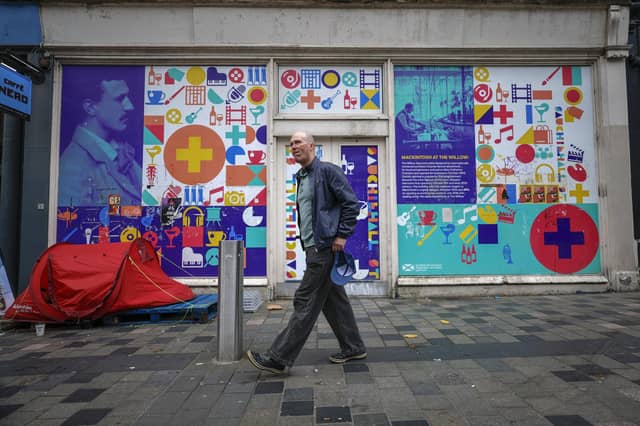

Growing up on the edge of Glasgow in the 1970s and ’80s, I was entirely aware of the dark reputation of the place of my birth.
It was the UK’s mean city, once overrun by warring razor gangs and, by the time I was in high school, being carved up by rival heroin barons.
In the popular culture of the UK, the violent Glaswegian drunk was both a feared bogeyman and a tired comic trope. If you looked at someone the wrong way, he’d plunge you or, at the very least, deliver the local kiss.
Throughout my childhood, much of Glasgow’s magnificent architecture – the fabulously ornate city chambers, the art deco cinemas on Renfield and Sauchiehall Streets, the grandly elaborate Central Station – was blackened and unloved. Beyond the city centre, new estates which had promised post-war utopian living were already beginning to fall apart, the collision between their swift physical decline and rising unemployment rendering the isolation of their inhabitants all the more stark and creating new no-go areas.
Yet for all I had heard and – more importantly – all I had seen, I could not square the idea of Glasgow as a uniquely dangerous place with my own experience of it.
Even as a child – and not a terribly confident one – I never felt fearful as I walked Glasgow’s streets.
In part, of course, this was because Glasgow was never as bad as legend had it. Yes, by 1983 drug dealers were selling gear from ice cream vans but, at the same time, the incipient bohemian could experiment in Buchanan Street cafes with open sandwiches and other markers of sophistication. Cloudy apple juice, for example.
But the reason I did not fear the city in which I lived is the same reason most people don’t fear their hometowns: I knew the place well enough – and had enough common sense – to know which areas to avoid.
The Glasgow of my childhood was not a scary place, but a city covered with soot and reeking of Wimpy Bar sadness; the city of my teens was a playground that smelled of beer sweetened with perfume.
For decades, I strode around Glasgow – avoiding illusion-shattering alleys and reality-checking side streets – like I owned the place.
And then, one day in the summer of 2024, I did not.
A rare visit to the city centre, on a bright clear afternoon, found me walking uneasily down Union Street, the thoroughfare I’d visited on almost every Saturday afternoon of my teenage years, and becoming aware that things had changed dramatically and in ways that made me feel old and uncertain.
The changed Glasgow, the city that suddenly no longer felt quite like home was the subject of the BBC’s Disclosure documentary team, last week. Their film “Welcome to Glasgow” showed broad-daylight drug dealing, horrendous flashes of brutal violence, and what appeared to be a major homelessness crisis.
The centre of what felt to me as I walked through the city two years ago like a new no-go zone is the “four corners”, the junction where Union and Argyle Streets cross.
There, day or night, the visitor to the city may choose from a number or fast food options or, if they prefer something with a bit more zip, they can buy crack from a masked teenager on an E-Bike.
It is wise, when struck by the conviction things aren’t what they used to be, to check oneself. Throughout history, the ageing bore has lamented the decline in standards.
But mine is no rose-tinted view. The scenes shown in last week’s documentary could not have been filmed 20, even 10, years ago. Glasgow has changed and not much for the better.
Painfully for the sentimental Glaswegian who prides himself on the hospitable nature of his city, the experiment to make it the most welcoming in the UK to asylum seekers has not worked.
With around 4,000 refugees in Glasgow, existing problems of homelessness and crime have been exacerbated.
The middle class residents of the city’s West End and South Side may love nothing more than taking to the streets to declare their support for this experiment but those living in more deprived areas – the run down estates where asylum seekers are usually placed – are less enthusiastic.
While Instagram-ready progressive politicians spoke “for” Glasgow, insisting its people were uncommonly compassionate, the residents of declining parts of the city who raised concerns about how local services might cope were either ignored or dismissed as racists.
Now, there is mainstream political consensus that this project has failed but little sign that the SNP at Holyrood or Labour at Westminster has much idea of how to improve things.
The BBC’s documentary has fuelled an ongoing political row over asylum in Scotland and compounded the case that Glasgow may be a city in collapse.
But, if this is so, it is not alone.
We wail about the decline of cities in an era that has no real need for cities. Glasgow is not what it was, but neither is anywhere else.
The truth is that, while Glasgow is now scarred, it is no hellhole. It remains a vibrant, beautiful city, with a bit of grit in its eye.
Twenty years ago, I could cross the city on foot at night, confident I could find the safest, clearest line home. I could do the same tonight but path would, undoubtedly differ.
The world around us changes and so do we. We adapt and we take new routes.
Comments
Want to join the conversation? Please or to comment on this article.