
Euan McColm: Rise of populist extremists Reform and the Greens threatens political centre
Reform and Greens on course to play significant roles in next Scottish Parliament, stoking division and offering unrealistic solutions to complex problems
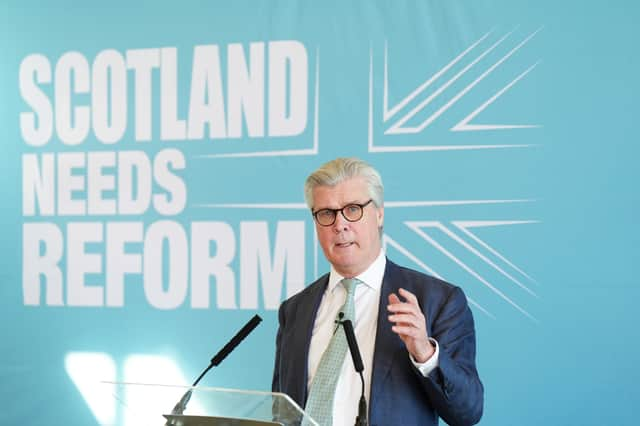
When Reform UK’s Scottish leader Malcolm Offord last week spoke of his dislike of faith schools, the reaction from political opponents was swift and predictable.
Interviewed by The Times, Offord said he was personally opposed to the long-tradition of having both non-denominational and Catholic schools in Scotland.
“We don’t,” he said, “want sectarianism.”
No sooner had Offord’s views been made public than Scottish Labour leader Anas Sarwar had written to Scottish bishops and archbishops restating his party’s support for Catholic schools.

Critics of these establishments, wrote Sarwar, lacked understanding of their history, role and ethos.
In the face of this backlash, Offord engaged reverse. Not only had his comments been “personal”, they had (drum roll, please) been taken “out of context”.
Offord explained that he had been ruminating on his own experience of being separated, aged five, from a friend who’d gone to a local Catholic school in Greenock.
It is tempting to see Offord’s intervention on the issue of faith schools as a blunder.
Among Scotland’s political parties, only the Greens advocate for a fully secular, non-denominational school system. Others see the value of these schools – or, at the very least, of the votes of parents who choose to send their kids to them.
I find it difficult to believe that Offord – who will stand for election in Inverclyde in May’s Holyrood election – did not know his words would cause a storm. Anyone who grew up in the west of Scotland recognises just how sensitive this issue is.
Offord may have gone through the motions of backtracking on the matter but the word is out now, and there are plenty of voters in Inverclyde and across the West of Scotland electoral region who will agree with his initial intervention.
So, sure, perhaps Nigel Farage’s man in Scotland spoke without thinking but it is also possible that he knew precisely what he was saying and to whom he was saying it.
In the west of Scotland, particularly in working class areas such as Inverclyde, an attack on sectarianism is liable to sound sectarian. And, unpleasant though that may be, it may not be unhelpful to Offord.
When he wasn’t winding up Catholics, last week, Offord was playing dangerous games with race.
Discussing a stabbing in Edinburgh, Offord spoke of a “massive insurge of immigrants”.
Just has Reform’s Scottish leader faced a backlash over his remarks on faith schools, so he came under fire for his comments on immigration.
Offord denied fuelling racial tensions (well, of course he did) then claimed statistics showed a rise in crime by people “from foreign lands”.
There is no statistical evidence to support that assertion but I’m sure that’s irrelevant to Offord who was speaking directly to Reform voters who believe immigration, and what they see as its failure, to be an issue of the utmost importance.
Offord’s opponents will look at his recent interventions and see chaos but the uncomfortable truth is that he is entitled to consider it all rather successful.
Under – and in the image of – Nigel Farage, Reform has made immigration its number one issue and, while that might make traditional parties uneasy, a significant number of voters agree that it is time for tighter restrictions on who should be allowed to settle in the UK.
As well as standing in Inverclyde, Offord will top Reform’s list of candidates for the West of Scotland so, unless some catastrophe befalls his party between now and Thursday May 7, he will soon be an MSP. While not everyone who votes for him will be a racist or a religious bigot, Offord has certainly increased his chances of winning the support of those particular demographics.
Reform is not the only party contesting this year’s Holyrood election that stands to benefit from the sectarian instincts of a substantial number of voters.
The Scottish Greens are also enthusiastic about dividing people along religious and ethnic lines.
Under the joint leadership of Ross Greer and Gillian Mackay, the Greens have cemented their position as the party of choice for those who declare support for Palestine.
Not only have the Scottish Greens previously condemned Zionism as “a racist ideology based on Jewish supremacy in Palestine”, Greer recently called for any Scots who have fought with the Israeli military to face prosecution for war crimes if they return home.
The Greens’ sister party in England recently showed how far this particular section of the left is willing to go to exploit tension over Gaza. The party’s campaign in the Gorton and Denton by-election in Manchester saw it put conflict in the Middle East front and centre.
The victorious Green candidate Hannah Spencer was accused by critics, including the Campaign Against Antisemitism, of running a sectarian campaign.
We should not be surprised if the Scottish Greens mimic the tactics of their colleagues in Manchester, who went so far as to produce leaflets in Urdu – urging voters to “punish” Labour for its stance on Gaza – for distribution in areas with large Muslim populations.
Both Reform and the Greens are on course to play significant roles in the next session of the Scottish Parliament.
Recent polling suggests that Malcolm Offord could be leader of the largest opposition party at Holyrood after May 7.
And those same polls, which have the SNP falling short of an overall majority, show the Greens likely to be in a strong position to demand concessions from First Minister John Swinney in return for their support in parliamentary votes.
The political centre may, just about, be holding for now but the rise of populist extremists on right and left has placed it under mounting pressure.
Both Reform and the Greens stoke division while offering unrealistic solutions to complex problems. Both of these insurgent political forces think the answer is to burn down the house.
The choice for voters is whether that blaze starts with a discarded cigar or a dropped spliff.
Comments
Want to join the conversation? Please or to comment on this article.