
How Labour is betraying the world's poorest people – and its core values
Labour international development minister’s remark that the UK Government would no longer be a ‘global charity’ shows just how much attitudes have changed since the days of mass ‘Make Poverty History’ marches


Twenty years ago, on a sunny July day in Edinburgh, nearly a quarter of million people marched through the city centre demanding that the then Prime Minister, Tony Blair, and his G8 colleagues should “make poverty history”. The carnival atmosphere was underpinned by serious intent.
In March that year, the Labour government had published the Commission for Africa, a blueprint for accelerating development in the continent from which all humanity emerged, but which by the start of the 21st century was struggling to escape the impact of colonialism and cope with disease, hunger and climate degradation.
Blair’s powerful argument that the world had a “moral duty as well as a powerful self-interest” to assist Africa persuaded the G8 leaders who gathered at Gleneagles in July 2005 to accept 50 of the commission’s 90 recommendations. The world’s biggest economies agreed, among other things, to cancel $36 billion of debt for 19 countries; double aid for basic education, including boosting efforts to keep girls in school; fund a significant programme of antiretroviral treatment for HIV/Aids; and put in place strong anti-corruption measures.
40% cut in aid budget
It seemed that Blair’s “noble cause” of fighting for Africa’s development had become a truly global campaign, with even US President George W Bush and President Vladimir Putin signing up to make poverty history.
On Tuesday afternoon, Labour’s international development minister, Baroness Chapman, a close associate of the current Prime Minister, dismissed Blair’s noble cause with a carefully chosen phrase. “The days of viewing the UK Government as a global charity” were “over”, she told the House of Commons Select Committee on International Development, before going on to detail the likely impact of the 40 per cent cut to the UK’s aid budget, first announced by Keir Starmer in February.
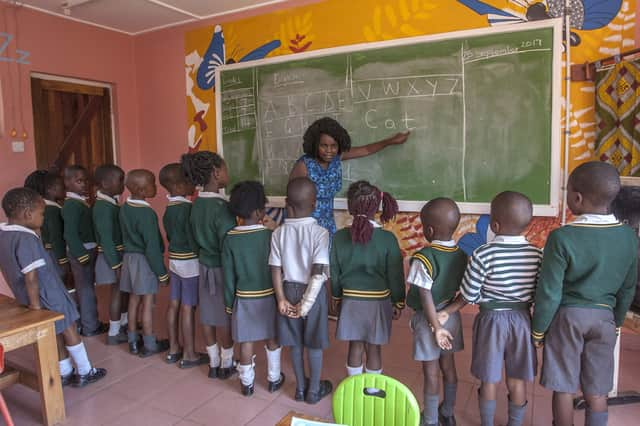
“Inevitably, this means that in some areas and countries there will be less to spend, and I think there’s no point in being anything other than completely open about this, I think that is likely to be on education and gender,” she said. To put Chapman’s assertion in context, in the five years from 2015, the UK Government has helped 20 million African children to get a “decent education”. But not for much longer.
The committee chair, Labour MP Sarah Champion, couldn’t hide her distress. She told the minister: “I was just thinking of the girl in Malawi who’s no longer getting her education supported. She probably doesn’t care whether it’s driven by ideology. She just knows that her opportunity is just collapsing.” Her intervention was to no avail. Baroness Chapman said the decision to cut aid was “a choice that has been made, and a choice that we have to implement as best we can”.
Early marriage, prostitution
I know from direct, personal experience what will happen to girls in Malawi who will no longer benefit from an education paid for by the British government. A government, by the way, that only ‘gave’ Malawi its independence 60 years ago.
Many will be forced into early marriage, mothers before they are even adults. Some will scrabble to earn a few Malawi kwacha through casual labour. Others will, as one girl told me only last October, “sell sex to old men” to survive. Girls, who with an education could be nurses, teachers or police officers, will be burdened with five, six, seven children they are unable to feed properly, or become prostitutes so they can eat.
Baroness Chapman rightly says that the UK needs to be “an investor not just a donor” – but education is an investment. No country, be it Malawi or Scotland, can develop its society and economy if its people are uneducated.
Rise of populism
I understand the world is a different place to what it was that glorious sunny Saturday in Edinburgh on 2 July 2005. The public’s support for making poverty history has waned – the most recent YouGov tracker poll shows that 60 per cent of people think the government spends too much on foreign aid.
My own social media feeds are full of people – some I respect on other issues – telling me in no uncertain terms we need to focus on children in Scotland, not in Africa. The UK’s own debt burden is the highest it has been in recent years, and the rise of populism, personified by Nigel Farage and his Reform party, has shaken the traditional parties to their core.
It seems that Starmer’s response is to shift the Labour party rightwards. Baroness Chapman’s “charity” soundbite came hard on the heels of a speech by the Prime Minister in which he warned of Britain becoming an “island of strangers” through uncontrolled migration.
But Starmer’s embrace of populism, particularly when it comes to international aid, is a strategic error, a similar, short-sighted, knee-jerk policy to ending the winter fuel allowance for all but the very poorest pensioners. Abandoning Labour’s core values, such as support for international development and tackling poverty at home, will not persuade a single Reform supporter to switch back to Labour.
Deliberately divisive language
Yes, there need to be better controls on migration, not least because spending billions on housing illegal migrants instead of on educating girls in Africa is morally wrong, but a Labour government can surely manage migration better than successive Tory governments without resorting to deliberately divisive language.
And a truly smart Labour leader would not dismiss the UK’s role in international development as “charity”. Instead, Starmer should argue that support for education is not a handout but an investment to create the conditions for economic growth in Africa, which will in turn help stabilise the world.
Labour is nothing if it is not a party of social and economic justice, of fairness, open to the world. Something it seems the Prime Minister has still to fully understand.
Comments
Want to join the conversation? Please or to comment on this article.