
How the Scottish anatomist who bought Burke and Hare's victims developed radical ideas about sexual biology
In a new book, Dr Ross Brooks rediscovers the science of sex that occupied the anatomist at the centre of the Burke and Hare scandal in 19th-century Edinburgh


The shocking West Port murders remain among the most notorious crimes in British history. William Burke and William Hare killed at least 16 people in Edinburgh. They sold their victims’ bodies to Scottish anatomist Robert Knox, who bought the corpses for his anatomy classes seemingly without knowledge of the murders behind them. Hare escaped punishment by giving evidence against Burke who was hanged, and his body was then dissected. His skeleton remains in the Anatomical Museum of Edinburgh Medical School.
While the scandal is widely remembered, another side of Knox’s work has largely been forgotten. As Burke and Hare embarked on their murder spree, he was developing radical ideas about sexual biology that anticipated some of the major theorists of the modern scientific study of sex – sexology – including Charles Darwin and Sigmund Freud.
Knox argued that all animals, including humans, begin life with both female and male characteristics. In the language of the period, he claimed embryos were ‘hermaphrodite’ before developing more recognisably male or female traits. Crucially, he believed elements of both sexes remained throughout an individual’s life.
In my new book – Darwin and the Queer Origins of Life: A History of Sex and Science – I trace the discoveries, creatures and people that led Knox to his startling theory, and how other Georgian and Victorian scientists found irrefutable evidence of our intersex origins and inheritance. Much of this research took place in Edinburgh.
Socially taboo subjects
At the time, many people believed the sexes were entirely separate and fixed. However, scientists were discovering examples in nature that challenged this assumption. Some animals, such as the slugs and snails we find in our gardens, naturally have both female and male sexual organs. Others can change sex during their lives.
Individual birds of many species with apparently separate sexes can develop cross-sex characteristics. Such transformations provided insights into perplexing physiological phenomena and allowed naturalists to openly discuss scientifically interesting, but socially taboo, subjects such as the mutability of sex differences and same-sex sexual behaviours.
Knox drew on these observations to develop his theory. He even exhibited the genital organs of an intersex pig that had shown attraction to both sexes. He argued that such cases proved that male and female biology were deeply interconnected and coexistent in every individual.
Knox publicly promoted his theory soon after the Burke and Hare furore erupted. As suspicion mounted over his links to the killings, he sought to restore his reputation by presenting his sexological ideas to the Royal Society of Edinburgh. It was the best he had, a new and provocative theory on one of the hottest topics in European anatomy which he hoped would shift attention from scandal to science. It didn't work.
A blood-drenched pig
In the years following the West Port murders, Knox continued to advance his theory. In 1835, he examined the German ‘hermaphrodite’ Gottlieb Göttlich, who had been born Marie Rosina Göttlich and who toured Britain and Ireland exhibiting their body to leading anatomists. After seeing Göttlich in Edinburgh, Knox declared them to be genuinely hermaphroditic, insisting that the case affirmed his view of essential intersexuality, “such as I long ago proved to exist in every fœtus of a certain age”.
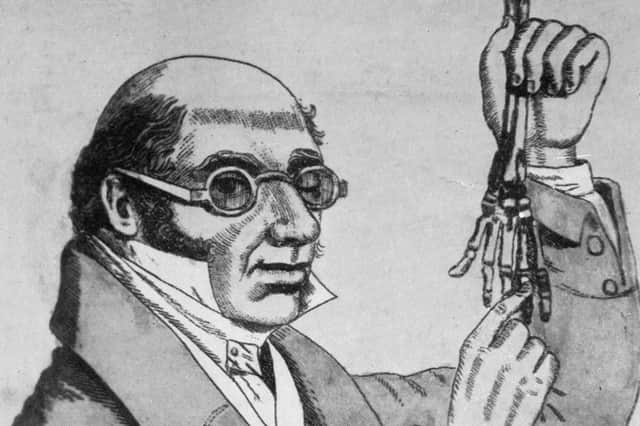
Scottish lithographer RH Nimmo cast aspersions on Knox’s moral character in a series of prints produced in the wake of the murders. One, called The Lecturer, turns Knox’s interest in the biology of sex against him. It depicts him dissecting the genital organs of a blood-drenched pig before a packed anatomy class. This is the bisexual pig he had used to illustrate his intersex theory. The image portrays Knox as morbidly fascinated with strange sexual phenomena while profiting from killing.
Although Knox was never charged with wrongdoing, the scandal destroyed his career in Edinburgh. He moved to London, supporting himself through writing and lecturing until his death in 1862.
A cultural sexual revolution
Popular culture has continued to depict him as a sinister figure. Among the various films to have revelled in the gruesome story of the Edinburgh bodysnatchers, he was portrayed by Peter Cushing in the 1960s horror film The Flesh and the Fiends while Tom Wilkinson played him for laughs in the 2010 black comedy Burke and Hare. His sexological ideas were ever overshadowed by his association with Burke and Hare.
Yet continued discoveries lent support to some of his central claims. Most significantly, scientists established that all mammalian embryos initially develop two sets of reproductive ducts before one usually disappears during development.
The implications were profound. Increasingly, authorities embraced the notion that we are all fundamentally dual-sexed. Scottish medical writer George Drysdale did so. “But a theory has lately been proposed,” he wrote in his popular 1855 book The Elements of Social Science, “and received by many of the profoundest anatomists, that in truth all living beings, including man, are hermaphrodite.”
By this time, Charles Darwin was also running with the theory, jotting in a private notebook as early as 1838: “Every man & woman is hermaphrodite.” This insight helped shape a scientific and cultural sexual revolution that continues to shape how we think, and argue, about sex today.
Knox, however, was barely mentioned, his role as pioneer of one of modern science’s most influential sexological principles obscured by his lasting association with the West Port murders.
Dr Ross Brooks is the author of Darwin and the Queer Origins of Life: A History of Sex and Science, published by Yale University Press. He is in Edinburgh to speak at the joint meeting of the European Society for the History of Science and the American History of Science Society, and will be giving a talk about his new book at Lighthouse, Edinburgh’s Radical Bookshop, on July 14.
Comments
Want to join the conversation? Please or to comment on this article.