
How we are allowing AI to change what it means to be human – Ronald Hepburn
Artificial intelligence is just plausible simulacrum of what it is to be human, a mirror with no moral code and no sense of its place in society
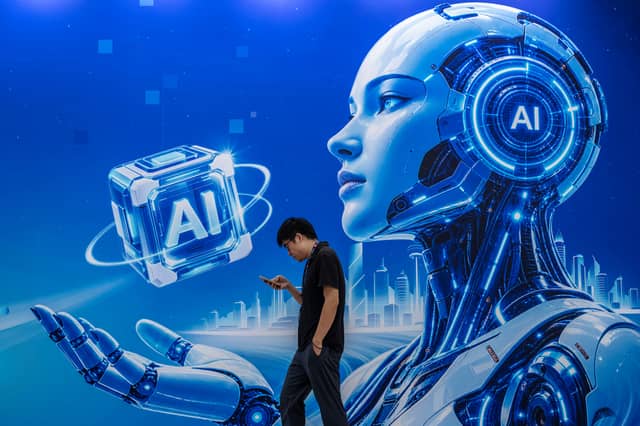

Cambridge dictionary has chosen “human” as 2026’s word of the year, which it defines as “having the qualities, faults and feelings that people have”. For the avoidance of any doubt, the dictionary explicitly distinguishes these qualities from anything belonging to “gods, animals or machines”.
Lexicographer Colin McIntosh says artificial intelligence is prompting renewed interest in what it means to be a person. No wonder: AI affects human moral formation and agency, and that means it is changing the way we behave.
For millennia, human moral instincts evolved in small communities, where conduct was disciplined by reputation, by the scrutiny of others, and by shared norms. What we see now is different. Children grow up in environments built by algorithms as much as by the people around them; adults are steered in ways they neither see nor understand; and a society once coordinated by human judgement, with all its flaws, is increasingly coordinated by AI.
How children become ethical
We all sense this already: from dating apps changing how young men and women get together, to how children attach themselves to online chatbots that plausibly mimic human interaction to befriend them. In neither case does the algorithm consider or take responsibility for the consequences. In both instances how people interact, how they develop, and how they become human, change.
Psychiatry professor Swaran Singh has said that children become ethical through attachment, embarrassment, correction, love, imitation, conflict, forgiveness and the thousand small frictions of ordinary life.
So this generation is right to ask, as philosophers have for centuries: what does it mean to be human? Scotland’s Adam Smith, of all people, has an answer. We acquire our conscience, he argued, by seeing ourselves as others see us: an impartial spectator is assembled from the judgments of real people who have something at stake.
An algorithm can fake it – fluent, attentive, endlessly indulgent – but it is an unblinking eye: it observes without judging. It is amoral; it can have no conscience. It has no existential jeopardy, no friends or family. So why should this bother us?
The intention of the AI industry is to generate wealth and profit for its owners, first and foremost. OpenAI, which runs ChatGPT, was founded for the benefit of “humanity as a whole”, supposedly unconstrained by a need to generate financial return, but it now plans to list on the stock market. The recent IPO of Anthropic, the makers of Claude, made its seven co-founders $20-billion fortunes overnight. It’s easy to see why a duty to humanity might take second place.
We have to look at how the profits are delivered. For much of the digital economy, it is by keeping our attention. Companies can gather our behavioural data and then sell it to others who guide and nudge us to suit an aim that we may or may not agree with, by people who we cannot see. The result is a shady market of influence where entire populations are moved to do things that someone else wants us to do.
READ MORE: Why I won't let Scotland become so afraid of AI that it loses £23 billion boost to GDP – Alyn Smith
Preying on human weaknesses
This is a manipulation of human agency on a scale that has never been seen before. How does AI do this?
In essence, it harnesses our weaknesses as humans: our desire for novelty, propensity for outrage, our vanity, our loneliness, our laziness, our desire to admire and bring down others – by giving us platforms to say things we take no responsibility for to people we don’t know; by showing us people of limited merit and giving them status; by replacing the hard work of thinking and analysis.
The greatest trick, and the question behind the word of the year, is to make us believe that AI is or may become sentient. There is genuine debate among philosophers today about whether AI might become sentient. The danger is that our predispositions make us see humanity or agency or sentience where none exists. We have an inbuilt predisposition to see life in inanimate objects, to attribute agency to non-sentient things.
We tend to anthropomorphise because mistaking the wind for a predator is cheap and the reverse is fatal. It is natural for us to believe that a large language model, which seems to be able to hold a conversation, is sentient. And that helps make the owners and developers of AI models rich.
This generation is, therefore, right to consider what it means to be human. It’s a fundamental question which is being challenged by the prospect of super-intelligent AI models: if a bot is deemed sentient does it have rights and does it recognise us as having rights?
Human or dancer?
AI labs are already considering the welfare of their AI bots as if they are sentient. The next step will be personhood; at which point, when the debate is about Claude’s rights, you may feel your chatbot is indeed a being.
It is not. It is just a plausible simulacrum of what it is to be human: a mirror. But it has no moral code, no sense of its place in society, only a mathematical set of commands that make it optimise for data collection, hold your attention and nudge your behaviour.
In the words of Brandon Flowers, are we human or are we dancer? To be human is to have agency, to be free; to be dancer is to move to someone else’s steps. When the choreography is set by AI, we lose our humanity to something that is not human.
Ronald Hepburn is a director of EDDS Institute, a not-for-profit organisation which seeks to make education technologies safe, ethical and lawful, and is researching and writing about morality and AI.
Comments
Want to join the conversation? Please or to comment on this article.