
The burning question that John Swinney must answer about NHS Grampian scandal – Brian Wilson
Scotland’s system of quangos, including health boards, has been producing dogs that do not bark when trouble arises

The revelations surrounding Grampian health board and the whistle-blowing surgeon, Dr Mohammed Habib, should be the stuff of fiction… a dedicated professional pleading for years that people were dying unnecessarily; lobbying everyone he could; writing repeatedly to the highest political figure in the land… and being ignored, deflected, ignored.
It’s a strong storyline. One principled man taking on the system and suffering constant rebuffs from a self-serving, back-covering elite before finally, the truth escapes and all the figures of importance who stand to be exposed are left scrambling for self-preservation.
Alas, this is no work of fiction but an accurate summary of what appears to have happened at Grampian health board. And here’s the worst part of it. Few are particularly surprised because Scotland has become so accustomed to a culture of scandal, cover-up and closing ranks in which the measure of success is that nobody is held accountable.
READ MORE: NHS Grampian scandal: Chief medical officer Professor Sir Gregor Smith resigns as crisis deepens
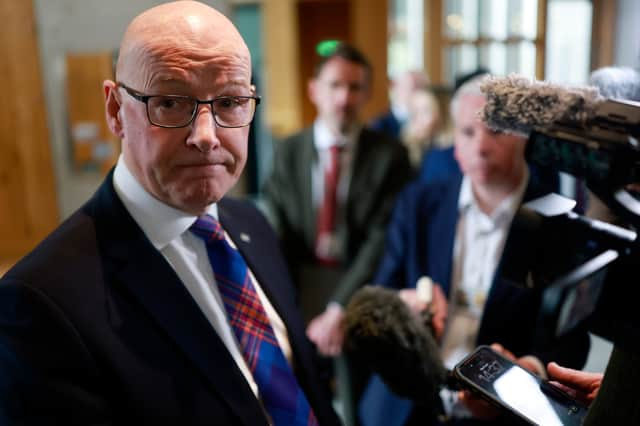

Obligatory expressions of regret
For a small devolved government, ours seems disproportionately prone to creating a regular flow of these botched jobs from which it requires cunning and ruthlessness to escape political responsibility. Accompanied, of course, by the obligatory expressions of regret and promises to get to the bottom of things when the actual intention and practice is the precise opposite.
The Salmond inquiry, the ferries scandal, Covid in care homes, multiple health-related debacles involving human tragedy… they follow the same pattern and end the same way. The short-term objective is to kick them into touch. Then undermine any inconvenient findings. Obfuscate or redact until most people forget. Then carry on as before with nobody in the St Andrew’s House magic circle paying any price.
The lawyer, Aamer Arwar, who knows his way round this course, says the proposed NHS Grampian inquiry lacks most of the “critical powers” required to do its jobs properly. It will not be able to compel witnesses, take evidence under oath or force the disclosure of documents. There will be no penalty for anyone who obstructs it, destroys evidence or lies. That sounds like par for the course.
Why did Swinney not know?
An inquiry which depends on truthfulness and goodwill from individuals – including politicians – who have such strong vested interests in being economical with both is of little use to bereaved families or indeed Scottish society. Mr Swinney’s resistance to a statutory inquiry should be rejected by MSPs. People who have waited years for the truth now deserve its forensic exposure and will wait a little longer to get that.
A key political question in the Grampian affair is how on Earth it was possible for Dr Habib to write three times to the current First Minister of Scotland (and a clutch of other ministers and law officers) telling them that patients were dying unnecessarily, without Mr Swinney being made aware of these allegations. It is incomprehensible.
If true, which is a significant caveat, it points to an appalling culture which goes beyond mere incompetence. Whether implemented by special advisers or house-trained civil servants, the response to unwelcome information was, for years, to divert and effectively suppress it, rather than address the grave issues raised. Just keep it clear of the great leader.
Yet this is his job. The Scottish government, and hence the First Minister, are not elected to manoeuvre for a state-in-waiting. Their actual duty is to set policy for and administer devolved responsibilities, among which there is none higher than the NHS in Scotland. When something is going so grotesquely wrong, accountability cannot be shuffled off to any third party.
Scotland’s rotten quangos
And what of Grampian health board? I have been banging on for years about Scotland’s quango appointments system which I have long believed to be deeply corrupt; not in the sense of money changing hands but because it produces faces who flit from one to the next, the only precondition being that they have not blotted their copybooks in the eyes of ministers. It is a system designed to breed dogs that do not bark.
Quangos are supposed to be at least quasi-independent and, where necessary, speak truth to power. If there is something rotten going on, then their job is not only to identify it but to alert ministers – ie, the same people who have appointed them. That requires an independence of inquiring minds which now rarely exists in Scotland’s quangos, including health boards.
The role of Grampian health board over the years will doubtless feature in any inquiry. So too should an examination of how and why its members were appointed, how much they were told and what efforts they made to find out what was happening. How close were they to the communities in which complaints were rife – or was remoteness from people’s concerns a criterion for appointment? I can certainly point to quangos in which this has been, most definitely, the guiding principle.
Grampian’s multiple problems led, 18 months ago, to the appointment by the Scottish government of “an assurance board that will report to the director general of health and social care, and chief executive of NHS Scotland”. Sounds good. But why did the “assurance board” not learn about, and act on, the copious information that eventually required the whistle-blowing surgeon and his astute lawyer to turn into the major scandal it now is?
This true story still has a long way to run. Maybe by the time it is completed, some public-spirited documentary maker will have turned it into a drama for Netflix. For now, I would like to focus on that single question.
How could it have been possible for Dr Mohammed Habib to write three times to John Swinney on a matter of this exceptional seriousness and to get no response or action? If Mr Swinney cannot provide a satisfactory answer, then it is not only chief medical officer Sir Gregor Smith who should be resigning.
Comments
Want to join the conversation? Please or to comment on this article.