
The future is electric: Why the energy transition is about making progress, not sacrifices – Fredrika Klarén
From Scotland to Spain, wildfires are demonstrating that our climate is changing. Our way of life should too
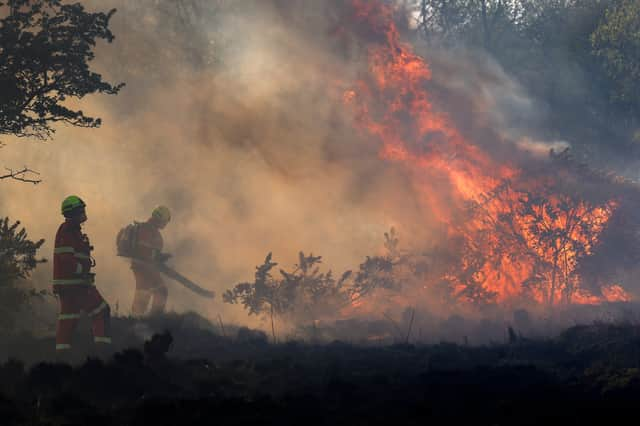
Summer is here and it’s on course to be the driest in more than a century, creating tinderbox conditions that have fuelled devastating wildfires from the Cairngorms National Park and the Isle of Wight to France and Spain, forcing communities to evacuate and destroying homes, habitats and livelihoods.
Rivers across eastern Scotland are suffering from prolonged dry weather, with some running at exceptionally low flows for the time of year. South of the Border, 2026 has seen many parts of England declaring their third drought in the past five years.
In recent weeks, Prince William has warned that increasingly extreme weather poses growing risks to communities, nature and the economy. Climate change is no longer a future threat; it is already reshaping lives, livelihoods and landscapes across Scotland and Europe.


£1.2 billion cost of extreme heat
Even Britain, one of Europe's most northerly countries, is seeing thousands of heat-related deaths. If current climate trends continue, this summer may well be among the coolest we experience for the rest of our lives.
In the Cairngorms, dozens of firefighters and helicopters have spent weeks battling blazes at the height of the tourist season. Calls are now growing for government support for accommodation providers, cafés, estates, visitor attractions, activity businesses and their suppliers to help communities recover from the wildfires and offset the cancellations, closures and lost income many are facing.
Beyond the human suffering and health impacts, extreme heat is also becoming a significant economic burden. The UK’s Office for National Statistics estimates that extreme heat costs the UK economy £1.2 billion a year in lost gross value added. Allianz, the insurance company, using their own models, have estimated that the most exposed European economies might face cumulative heat-related GDP losses of between 5 and 7 per cent until 2030.
The exact scale of the losses will vary by country and methodology. Scotland has clearly been swept up in a nationally exceptionally hot, dry summer, even though its own temperature anomaly has been more modest than the rest of Europe. What is beyond doubt is that extreme heat is already carrying a significant economic cost.
Taking back control
The response follows a familiar pattern, as many of us go into crisis mode, reminiscent of the Covid-days. We fight over the last fans in the hardware store; we discuss the best air-conditioning units and kids jump into the rivers and lochs. Reactive steps to manage short-term consequences, without addressing the root cause.
For too long, sustainability has been sold as a sacrifice. It isn't. It is about taking back control of our energy and water, our economy and our future. The real cost lies in clinging to polluting, volatile systems that leave us poorer, less secure and more exposed.
Investing in sustainability means investing in healthier communities, stronger water and energy security, and a more resilient, prosperous Scotland.
Transport is one of the clearest examples of why we need to tackle the cause, not just the symptoms. Every oil price spike reminds us that we have built our mobility on a finite resource we neither control nor need to depend on. More and more people are already making the switch to electric. Why? Because electrification fixes the broken equation.
Deadly price of polluted air
Electric cars are already significantly cheaper to run. In the UK, driving 100 miles in an electric car typically costs around £5-£10 in electricity when charging at home, compared with roughly £13-£20 in fuel for a comparable petrol car. A typical 100-mile journey, such as a round trip from Edinburgh to St Andrews, can therefore cost an EV driver significantly less in energy costs than the same journey in a petrol car, with savings of around 50 per cent or more in many cases.
Electric vehicles run on energy that can be produced locally from clean sources, making transport cheaper, more sustainable and less dependent on volatile fossil fuels. They also deliver cleaner air in our towns and cities, reducing pressure on public health services and strengthening the UK's energy resilience. The scale of the challenge is clear: Public Health Scotland estimates that around 2,000 deaths each year in Scotland are attributable to long-term exposure to air pollution.
Policies such as Europe's new carbon pricing system for road transport can help reflect the true cost of fossil fuels while making cleaner alternatives more attractive. That is how we begin to turn off the oil tap, rather than simply paying to mop up the consequences.
Climate changing before our eyes
Climate action is no longer just environmental policy. It is economic policy. Health policy. Security policy. More politicians need to wake up to this reality – their voters already have. We can no longer afford to bury our heads in the sand. You don't need to be a climate scientist to see that our climate is changing before our eyes.
People don’t wake up thinking about carbon budgets. They think about keeping their families safe, managing household costs and building a better future for their children. Increasingly, these priorities point in the same direction.
The transition to electrification is not about asking people to accept less. It is about giving them more control over how they move, how they power their lives and what they spend. The best climate solutions are the ones that solve everyday problems at the same time.
Car makers shouldn’t see sustainability as a trade-off, but as a strategic advantage. Better technology for drivers. Cleaner air for cities. Greater energy independence.
This is not a story about sacrifice. It is a story about progress. And about finally turning off the oil tap.
Fredrika Klarén is head of sustainability at electric car firm Polestar
Comments
Want to join the conversation? Please or to comment on this article.