
Venezuela: Why Donald Trump’s good cop, bad cop routine makes the world a safer place
The forces of despotism have been set back considerably by Donald Trump’s decision to capture Venezuela’s Nicolás Maduro and bring him to justice

Those that automatically condemn the actions of Donald Trump’s power play in Venezuela as the act of a warmongering chauvinist are either betraying their own knee-jerk prejudices or missing the point.
The world is far more nuanced than simply protesting that whatever President Trump does must be wrong. For a start, the situation on the ground in Venezuela remains unclear.
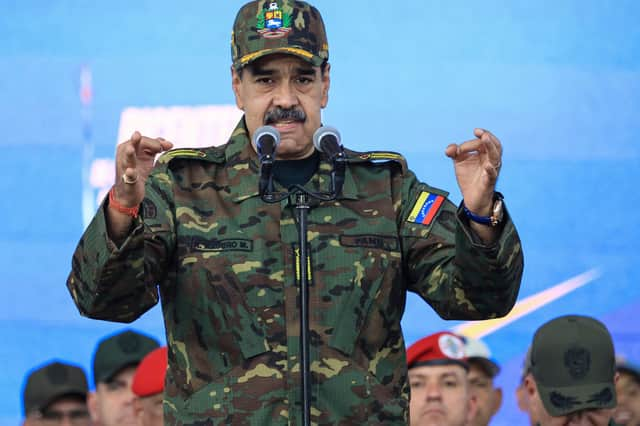
The response of Venezuelans, at home and in exile, suggests any still supporting Nicolás Maduro – the country’s former president, who now faces drugs and weapons charges in the US – are a small minority composed of those in league with him and those remaining in fear of what’s left of his illegitimate regime.

US in charge?
There is, however, growing evidence that strongly suggests some kind of backroom deal was struck. Acting President Delcy Rodríguez has issued a statement saying Venezuela deserves “peace and dialogue, not war” and extending an invitation to the US government to work together on “a co-operation agenda, oriented toward shared development”.
This suggests the US does have effective control over the major decisions that will now be taken by the Venezuelan government, not least in restoring the capacity of the South American country to extract and refine its vast oil reserves – the largest in the world.
Venezuela’s oil is not vital to the United States itself. After all, US imports of Venezuelan crude oil have dropped significantly due to compounding sanctions that started under President Barack Obama in 2015 and all but ended the oil trade by 2025.
Obama declared Venezuela a "threat to [US] national security", and froze the assets of seven Venezuelan officials the US held responsible for human rights repression that had resulted in at least 43 deaths during demonstrations.
Cuba next?
More important to the US strategically is that China procures as much as 80 per cent of Venezuelan crude while Cuba takes anything up to around 50 per cent. This has many implications regarding the future of both Taiwan and Cuba.
Firstly, the US has obtained further leverage that makes any Chinese invasion of Taiwan more difficult and therefore less likely. The second is that Cuba will likely be the next far-left domino to fall in Latin America.
Reports suggest that, of the 40 deaths following the US helicopter assault in Venezuela, some 34 were Cubans who tried unsuccessfully to protect Maduro from capture, underlining the interdependence of the two countries.
Previous to Maduro’s detention, Cuba was getting free oil in exchange for such support “services” – and that oil will likely no longer be flowing.
What Trump has done goes well beyond apprehending a cruel dictator – who stole the elections twice – so he will face prosecution for drug running. He has exposed as hollow the claims to moral supremacy of so-called “international law” and its related multilateral institutions when they are run by representatives of dictatorships.
Maduro’s Venezuelan regime weaponised narco-criminality while hiding behind the diplomatic shield of sovereignty.
Taiwan invasion by China less likely
Following continued provocation from the Venezuelan authorities, Trump has acted, and in procuring the detention of the country’s president, sent a message to the rest of the world that the United States can no longer be messed around with.
Trump’s good-cop, bad-cop approach to diplomacy, while unconventional, plays out by making life more difficult for known and proxy warmongers, including veiled or tangible threats from the likes of China, Iran, Russia and Cuba.
The end result is that Taiwan is surely less likely to be invaded by China; long-term US guarantees to Ukraine now look more credible; support to the population of Iran wishing to throw off the mullahs looks more valuable; and the possibility that Cuba’s regime will fall next is strengthened. These possible outcomes are good news for those who had put their faith in “international law” only to see it found wanting.
Safer with Trump in White House
Despite all that was said about Trump in his first presidential term, the world was a safer place than the four years that followed under President Biden. It was Trump who lowered the temperature with the sabre-rattling Kim Jong Un of North Korea after his unprecedented visit where he stepped over the Korean border – and it was Trump who progressed the Abraham Accords making peace in the Middle East a viable concept.
I have no doubts that had Trump won the 2020 presidential election, Putin’s invasion of Ukraine would never have happened. Very simply, Trump’s reaction would not have been predictable, making invasion for Putin highly risky, while it was clear Biden would take no action.
Likewise, had Trump been president, a faster progress of his Abraham Accords could have averted the Hamas attack on the peace festival on October 7, 2023, that initiated the war in Gaza.
Ironically, there can be hope that, after Trump’s response to the narco-terrorism used by Cuba and Venezuela as a form of hybrid warfare to undermine the United States’ domestic security, the application of policing to international law will ultimately strengthen its legitimacy rather than see it undermined.
Greenland not interested
Where Trump is on far weaker ground is in talking up the annexation of Greenland – a friend and ally – when its people show no interest in such a move to be the 51st US state.
It might be difficult for the Trump-haters to accept, but it is entirely possible the world is actually a safer place than it was just a week ago and that the forces of despotism have been set back considerably by Trump’s actions.
For what is the rule of law without law officers to enforce it? The law counted for very little in the Wild West until US marshalls asserted their dominance to ensure it was taken more seriously and the courts could prevail. Now Trump’s officers seek to restore law and, crucially, order.
Brian Monteith is a former member of the Scottish and European parliaments
Comments
Want to join the conversation? Please or to comment on this article.