
When Donald Trump stared into laser beams that could have blinded him, he revealed his weak point
As Joe Goldblatt prepares to protest against Donald Trump on his visit to Scotland, he recounts a meaningful encounter with the future US President at the opening to the Trump Taj Mahal casino in 1990


“No one speaks to Mr Trump!” These words were my first introduction to the man who would one day become President of the United States, twice.
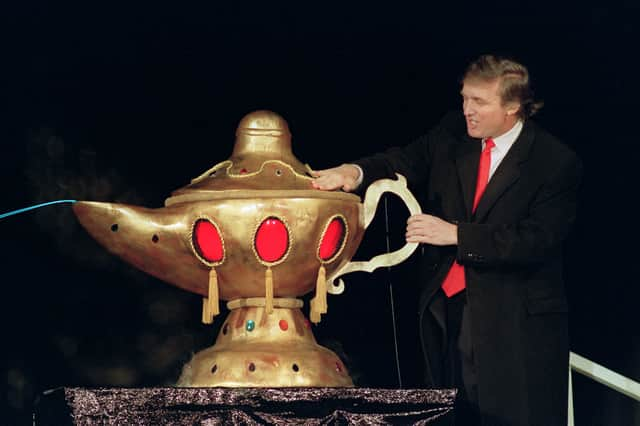
I produced the opening ceremony of his first casino resort, the Taj Mahal, in Atlantic City, New Jersey, and I asked for a word with the owner so I could provide him with a briefing about health and safety before he would walk onstage to greet his 10,000 new employees as high-powered laser beams projected coloured light above his head.
After being told “No!” by one of his many “Yes!” men, I proceeded to approach the powerful 6ft3 future world leader all the same. I simply explained that under no circumstances should he look directly into the argon laser beam as it could result in blindness.
A failure to listen to experts
At the event, as the opening notes to his theme song, The Eye of the Tiger, began to play at a deafening level, he strutted forward confidently until the laser projector accidentally fell several several inches, sending a dozen bright green beams through his midsection.
He may have misunderstood my instructions and perhaps thought he was being sawn in half. I shouted to tell him to keep walking and he turned to look in my direction. To my horror, he also stared directly into the laser beams. He covered his eyes, dropped to his knees, crawled to the lectern and, in a shaky voice, addressed the cheering crowd.
That was the first time I saw that within every ‘strongman’ there is a weak point. His weak point was his failure to listen to experts because he naively believed he had superior knowledge and expertise.
READ MORE: A denunciation of Donald Trump
Salesmen of political passion
Today we seem to have developed a fondness for strongmen, who have been elected or re-elected to high office in countries all over the world. From Brazil and Hungary to Turkey and the Middle East, these big-time salesmen seem to attract support because, as did their predecessors, they know what their needy and disgruntled ‘customers’ want.
These salesmen of political passion offer their supporters a version of the ‘emperor’s new clothes’, with their boundless confidence, endless ideas about how they will punish their rivals and enemies. And this is often delivered through large rallies just as another strongman did in 1930s’ Germany before he murdered over six million Jews, Roma people, homosexuals and virtually anyone who was not a member of the Aryan race.
When nation states or even local communities feel powerless, they seek personalities who exude the feeling of power and appear to be able to make strong, populist decisions. The problem with this choice is that often these strongmen are ill equipped to rule effectively in the long term – largely because of a combination of their ignorance and rapidly increasing arrogance after winning power – and they begin to make fatal errors that usually result in their eventual downfall.
Whether in the halls of Westminster, Holyrood, or within our local authorities, we need political leaders who can admit they do not have all the answers and who are prepared to seek the advice of experts, not those who stand upon a fragile soapbox of political rhetoric and fleeting charisma while seeking to persuade their supporters to accept their often ill-conceived and short-term ideas.
Trump’s lack of Enlightenment
America’s current political illusionist has arrived in our bonnie land, which was the birthplace of his mother Mary. I often wonder how much he really knows about Scotland and our storied past, stretching back to great thinkers of the Scottish Enlightenment such as Adam Smith and David Hume. I doubt if he or his so-called advisors – who still appear to be “Yes” men and women in the style of those that I met – know very much about Smith’s Theory of Moral Sentiments.
“As we have no immediate experience of what other men feel, we can form no idea of the manner in which they are affected, but by conceiving what we ourselves should feel in the like situation,” Smith wrote, expressing the means to acquire the sort of empathy that Trump seems to lack.
I find myself today telling younger citizens that they must vote for strong, well-evidenced policies rather than men or women who are weak but who have strong personalities. I encouraged my university students to vote and if possible to support a political candidate whose values align with their own. Ultimately, I suggested they might stand for public office and through their policies help improve the world!
Policies over personality
However, more and more, I hear my young friends describe political candidates by saying “I like him…” I remind them that personalities may be manufactured for mass consumption.
Social, economic, cultural, environmental, and other policies affect the soul of the nation. We must consider the policies of any candidate for elected office, over and above their personalities, if we are to best exercise our precious democratic right to vote.
So, as the weak man from America visits Scotland, I shall use my democratic right of protest and free speech to express my opposition to his policies. Although I may not speak to him directly, I, along with my fellow citizens, will warn him and others of the consequences of his ill-conceived and short-term policies that reveal the multiple weaknesses behind the facade of this illusory strongman.
We must find the courage to speak to Trump – the man who supposedly “no one speaks to” – even more loudly now.
Professor Joe Goldblatt is both a US and British-Scottish citizen. His views are his own.
Comments
Want to join the conversation? Please or to comment on this article.