
Why John Swinney can learn valuable lessons about winning elections from new friend Donald Trump
The US president’s mood clearly improved the longer his Scotland visit went on

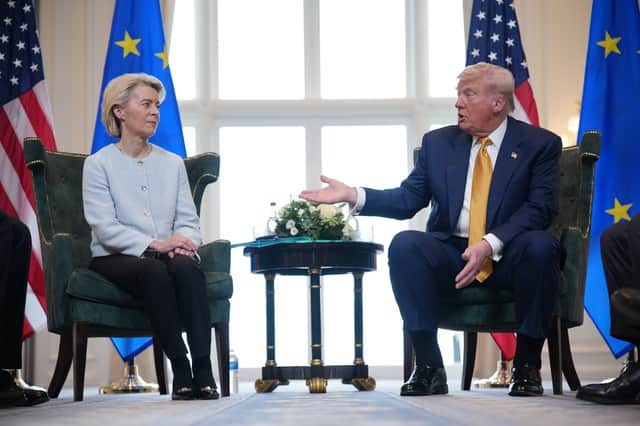
“I’m actually not in a good mood,” said Donald Trump, flatly, when asked about the prospect of striking a trade deal with European Commission president Ursula von der Leyen.
There was a ripple of nervous laughter among the assembled journalists and flunkeys at the Trump Turnberry golf resort on Sunday. Not in a good mood? He was supposed to be on his jolly holidays.
Trump wasn’t laughing though – he was deadly serious. Was it the round of golf he had just played? “No, the golf was beautiful, golf can never be bad,” he said, leaving it at that.

Art Of The Deal
Any number of things could have caused the famously mercurial president to be out of sorts. Maybe it was the weather, which had been blustery since his arrival in South Ayrshire on Friday evening, and may have helped land him in more bunkers than usual.
Or perhaps it was the small but vocal gathering of protesters who made their feelings about him known as his motorcade swept past on its way from Prestwick Airport. More likely, perhaps, is that Trump’s claim to be in a bad mood was a ploy – all part of The Art Of The Deal he aimed to strike that day.
If this was the case, he was successful. After little more than an hour, it emerged von der Leyen had made huge concessions for no discernible gain.
Humiliation for Europe
The European Commission had accepted a baseline 15 per cent tariff on most EU goods, agreed to buy $750 billion of US gas, and procure billions more of American military equipment. It was an entirely one-sided framework agreement that represented a big win for the US and abject humiliation for Europe. Trump’s spirits were surely lifting.
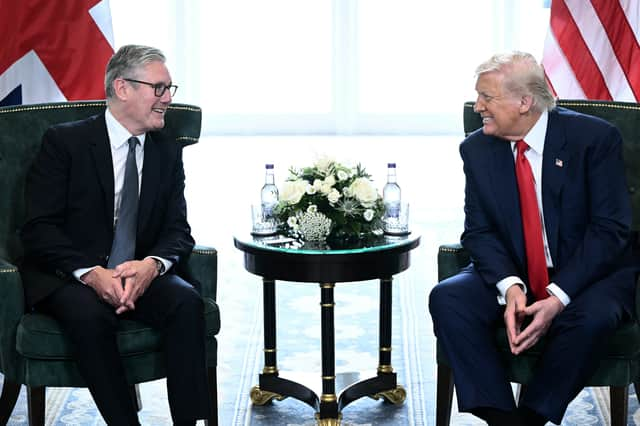
But next to arrive at the court of King Donald was that limey stiff Sir Keir Starmer, who had just introduced new laws on policing the internet, described by critics as censorious government over-reach and an attack on free speech. This came as news to Trump, when told by a reporter at Monday’s press conference with the Prime Minister that there were “new powers to censor your site”.
“To censor my site?” he asked. “You mean Truth Social?” Suddenly it felt rather tense again, but this time the president was able to lighten the mood. He turned to Starmer: “I don’t think he’s gonna censor my site because I say only good things about... Will you please uncensor my site?” Trump smiled. A visibly uncomfortable Starmer jocularly tried to reassure him “we’re not censoring anyone”.
A better mood
The brief moment of levity was broken when the Prime Minister went on to cite the suicide and pornography the Online Safety Act is supposedly designed to tackle. But the president was clearly in a better mood than the previous day and, over the course of more than an hour, he expounded at length on matters close to his heart, such as the folly of renewable energy and the “windmills” blighting views from his Scottish golf courses.
He even offered some unsolicited advice on how to win elections to two “good men” at opposite ends of the political spectrum, Starmer and Reform leader Nigel Farage. “I happen to like both,” he said. Another political leader looking for advice on winning elections could be some guy called John Swinney, next on the guest list after Trump’s flight to his other resort in Aberdeenshire.
The First Minister had just set out a highly ambitious plan to claim a mandate for a second independence referendum: emulating predecessor Alex Salmond’s 2011 success by winning an SNP majority at Holyrood in next year’s election. The meeting did not augur well. Swinney openly backed Trump’s Democrat rival Kamala Harris in November’s presidential election and had been highly critical of the US leader on foreign policy.
On Monday, Trump suggested there should be a gap of 50 or 75 years between votes on independence, which his good friend Starmer dismissed as “the politics of yesteryear”.
Donald and John’s special relationship
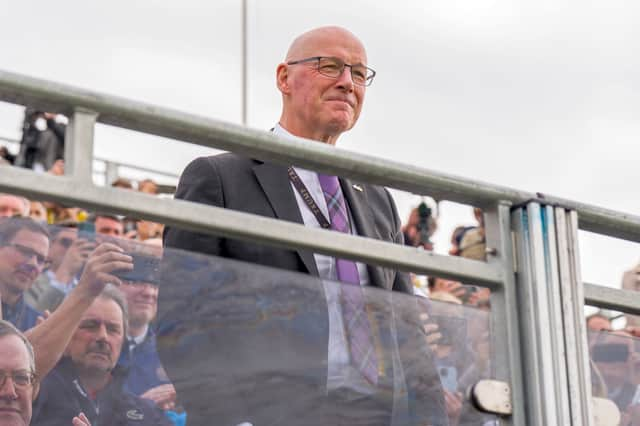
But in Aberdeenshire, Trump’s disposition was as sunny as the weather and Swinney was lavished with praise as a “terrific guy”, raising hopes of a tariff deal for Scotch whisky. “You’re really a very special guy,” the president told him as he opened his new course. “Thank you very much for everything, John.”
Trump’s mood was clearly far better at the end of his trip than it was at the beginning. Expected protests had not amounted to much, he had opened a new golf course, he had extracted huge concessions from Europe and he had made a new friend, called John.
And, in spite of their differences, perhaps there are things John could usefully learn from Donald. Whatever we think of him, and despite his many significant flaws, Trump is a phenomenally successful politician. Less than a year into his second term, he is already a major historical figure.
His tariffs have not crashed the American economy, US stocks are at record highs, and Trump is polling relatively well, with the Democrats scoring their lowest rating for 35 years in a Wall Street Journal survey last week.
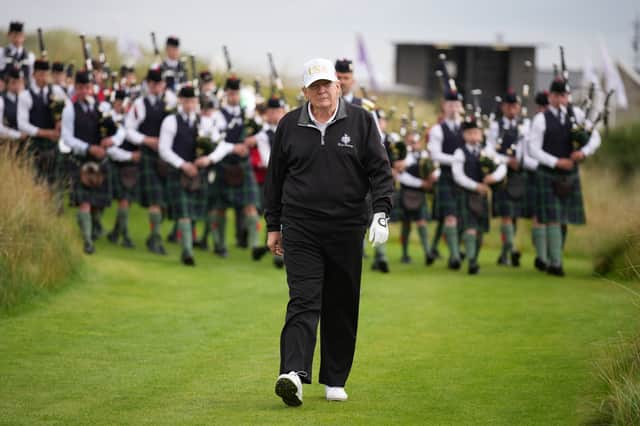
At his marathon Turnberry press conference, Trump offered this advice on winning elections: “Politics is pretty simple… Generally speaking, the one who cuts taxes the most, the one who gives you the lowest energy prices and the best kind of energy, the one who keeps you out of wars… You have a few basics and you can go back a thousand years, a million years, and whoever does these things…”
He could also have added sticking with the 80 side on issues that divide the public roughly 80-20. Maybe it’s populism, maybe it’s being in touch with the electorate, or maybe it’s a combination of the two.
With the SNP untethered from madcap former partners the Scottish Greens – firmly on the 20 side in every 80-20 split – Swinney might heed his new friend’s advice in search of that unlikely Holyrood majority.
Comments
Want to join the conversation? Please or to comment on this article.