
Why Nigel Farage's journey to becoming Scotland's saviour may start in Hamilton next week
A good result for Reform UK could release Scotland from its torpor and needless division, writes Brian Monteith

Is John Swinney really the safe pair of hands that his coterie make him out to be? Has he really steadied the sinking SNP ship or is it still listing badly, floating aimlessly without an engine or rudder in a sea of public despair?
Can Labour’s Anas Sarwar convince the Scottish public he should be the next First Minister? Or does he represent not much more than Swinney without the nationalism, offering little real change from the uber-liberal collectivism Holyrood has championed as its reason for being?
Or has Keir Starmer defined Labour as peddlers of false hope, offering seemingly seductive soundbites as policies – only to break the people’s trust by taking unexpected contradictory if not deceitful decisions?
And whisper it, could Nigel Farage actually shock the cosy collectivist consensus of Scotland’s MacChattering classes by providing a resonating voice to the heartfelt fears and deep concerns of ordinary Scots worried about the state of their country?
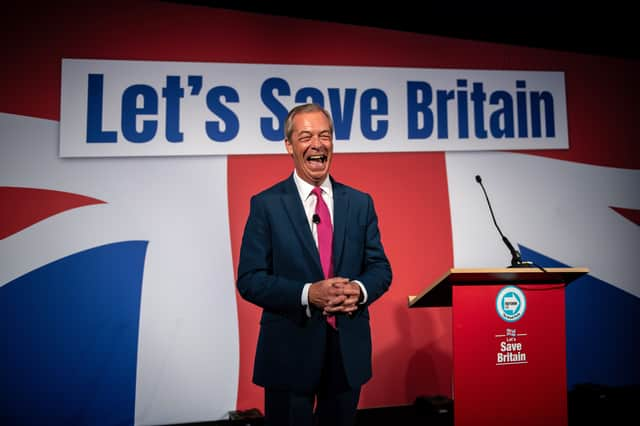

The Scottish Parliament by-election for Hamilton, Larkhall and Stonehouse on June 5 is likely to provide some pointers to what we might expect in next year’s elections. Hamilton is famous as the constituency where the SNP won a 1967 Westminster by-election – could it repeat the occasion and show both the SNP and Labour have lost the trust of the Scottish people?
The idea Swinney represents something of a change of direction for the SNP is absurd. It was he who led his party to rejection twice between 2000-2004 over 20 years ago. It was he who, as Education Secretary, presided over a marked decline in standards of attainment.
It was Swinney who was deputy to Nicola Sturgeon and remained a party cheerleader as Humza Yousaf brought open ridicule on the SNP. It was Swinney who backed all those failed attempts to have another independence referendum, Swinney who supported the highly divisive Gender Recognition Reform Bill that undermined women’s rights and Swinney who stands for the higher taxes that drive people to work outside Scotland (including many of his own civil servants).
Swinney is no safe pair of hands; his default judgment has been to defend the many calamities caused by SNP incompetence and arrogance, and putting independence before everything else. And his poor decision-making continues. If Swinney thought the way to demonise Reform UK was to hold a “summit” at the taxpayers’ expense then any prudent judgment he may have had has completely deserted him.
Why spend £10,213 – including £4,000 on the hire of Merchants House of Glasgow, £4,000 on audio-visual and £1,000 on catering and drinks – when there are parliamentary or government rooms available to the First Minister? Was the use of publicly owned facilities considered ultra vires for such politicking? If so, why did Swinney as the host, or the other parties involved not pick up the tab for the expense?
As if to endorse the idea that Sarwar’s judgment is no better than Swinney’s, he attended that Punch and Judy summit but now faces the likely ignominy of his Labour nominee for Hamilton coming behind the Reform UK and SNP candidates.
As an alternative to Swinney, Sarwar presents himself as representative of change – but his top brass in London, be it Starmer or Chancellor Rachel Reeves, have done everything in their power to dissuade the Scottish people of this claim.
Over the last ten months, Starmer’s government has raised taxes on working people and removed the winter fuel allowance from ten million pensioners when it promised explicitly not to introduce either of those measures. After campaigning previously in support of Waspi women (including her mother), the Chancellor announced there would be no funds provided to compensate them.
The Starmer government said it would reset the EU relationship but has in fact surrendered our sovereignty to make our own tighter laws on animal welfare. It’s offering to subsidise the university education of the German middle classes; continue the free-for-all enjoyed by French boats in our fishing grounds; and make it possible for Bulgarian youths to forego their minimum wage of £3 per hour in return for £12 an hour in the UK. Meanwhile he has signed over the Chagos islands to Mauritius and will pay them up to £30bn for the privilege.
It does not matter that Sarwar might be opposed to some or all of those decisions, his problem is Labour has shown that, when in power, it is prepared without shame to ditch campaign promises and abandon its electors. After witnessing the behaviour of Labour ministers under Starmer why should Sarwar – who even supported many of the policies of Sturgeon and Yousaf as well as Swinney – be believed as an agent of change?
Being a little more competent without doing things differently is not going to move the dials at Holyrood, or in our schools and hospitals or make ScotRail run on time.
No wonder then that Scots are warming to the messages being put out by Reform UK. Its pledges to stop net zero defenestrating our remaining industries, to drill baby drill, to take control of our borders away from the European Court of Human Rights, to restore the winter fuel allowance, to end the two-child benefits cap, to revive our coastal fisheries, and to defend our sovereign law-making in preference to EU technocrats throwing grit in the gears of prosperity are proving popular over the stale porridge offered by Holyrood and Farage is rated as more likely to deliver on his word.
Farage does not threaten to be a hammer of the Scots, he aims to be the salvation of the Scots, releasing the country from its torpor and needless division. A good result for his party at Hamilton could yet change the direction of Holyrood, delivering it from the disappointment and embarrassment it has become for far too many.
Brian Monteith is a former member of the Scottish and European parliaments and editor of ThinkScotland.org
Comments
Want to join the conversation? Please or to comment on this article.