
Why we shouldn't kill 'menacing' seagulls in towns – and what to do instead
Misleading language used by politicians that implies gulls are acting maliciously towards humans is simply not true. Instead, they are devoted, protective parents trying to look after their young
Around a month ago, I visited a friend who lives in Burntisland. His third-floor flat overlooks a level roof at the back, which a lesser black-backed gull had chosen to nest on and hatch a chick. It felt like a privilege to watch this fluffy new being investigate her world, while her parent watched carefully.
This memory makes quite a contrast to the screaming headlines that we frequently see at this time of year, proclaiming gulls to be a “menace” or a “nuisance” and blaming them for “mugging” and “divebombing” people.
Such language is unhelpful and misleading. It implies that gulls are acting maliciously against us, which is simply not true. It turns gulls into the enemy, rather than seeking to understand the causes of any tension and seek solutions.
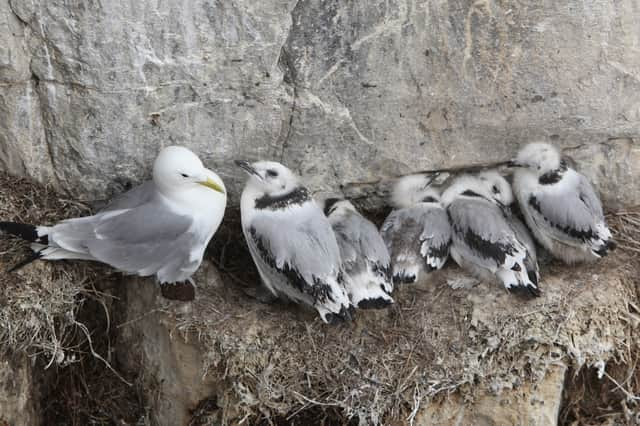

Gulls are constituents too
While some within the media are responsible for creating and amplifying a negative and inaccurate depiction of gulls, disappointingly, politicians also make judgmental, harmful statements about them. In June, during a member’s debate in the Scottish Parliament, various MSPs vilified gulls using the same inflammatory words as the tabloids and demanded that they be “controlled” – a widely used euphemism for ‘killed’.
MSPs represent their constituents. Gulls cannot vote but are constituents in the other sense of the word, being part of a larger whole, our shared community. And the human constituents, who do vote, overwhelmingly want wild animals to be protected.
A 2024 poll of more than 7,000 people in the UK found that 92 per cent think that it is important to protect wildlife in towns by legislation or regulation, and 76 per cent believe that human survival depends on protecting the survival of wildlife. MSPs should not allow scare stories to muffle the voices calling for us to live in harmony with other animals.

Intelligent and resourceful
Thankfully, many don’t, and other MSPs who spoke in the debate did so thoughtfully and well. At OneKind, we hear stories every day from our supporters that confirm how much people care about animals and want governments to do more to protect them. For more than 100 years, we have advocated for animals, supported by individual donors who want animals to be fairly represented in debates.
For many gull species, natural nesting sites and food sources are dwindling, due mainly to human activities. As intelligent and resourceful birds, they have adapted to life in towns, and what they have found is safe nesting sites and abundant food sources.
Gulls are devoted, protective parents. When people come near to their nest, they feel that their eggs or chicks are threatened and dive towards people to communicate this. Far from the nefarious intentions too often mis-attributed to gulls, this diving behaviour is born of deep care.
The other main complaint made about gulls – taking food from people’s hands – is a foreseeable consequence of decades of directly feeding them, littering, and having unsealed and often overflowing bins.
Stop feeding gulls
There are simple changes that could go a long way to reducing the behaviours that people have complained about. Everybody could stop feeding gulls and littering, and authorities should ensure that all bins are secure and ‘gull proof’ and seek measures that allow gulls and humans to feel safe during the birds’ breeding season.
There are some vulnerable people who can be at risk from gulls’ defensive behaviour, and it is, of course, very important that they are protected. There is help available for business owners, local authorities and individuals to minimise harms to gulls and advise on more complicated situations.
For example, Humane Wildlife Solutions is a business that offers expert advice and non-lethal alternatives to ‘pest control’, including services relating to gulls. They have also worked with NatureScot to develop guidance for the non-lethal removal of eggs and chicks.
Across the UK, many local authorities understand their responsibilities and are seeking to co-exist with gulls, adapting their practices accordingly. It was reported recently that in Lowestoft kittiwakes began nesting in the town centre following the destruction of a derelict building at the docks where some had been nesting.
They found ideal nesting sites in the town and the numbers grew. Building owners are now, rightly, being encouraged to provide simple wooden nesting ledges for them, in sites that are less inconvenient for people, rather than trying to remove the gulls.
Sharing the planet
In 2018 South Ayrshire Council launched their ‘feed a bin, not a gull’ campaign, encouraging people to dispose of food waste and other litter responsibly. Local primary school children took part by designing posters for the launch, a good initiative to empower and educate young people.
This is the path that those in power and the media should be following, seeking solutions to help people live alongside gulls and other wild animals, not repeating worn narratives of domination. The Scottish Government plans to hold a summit to discuss issues relating to gulls. I urge them to choose this less travelled path.
Now – in a time of nature and climate crises, following the devastating impact of Covid and avian flu, both linked to industrial animal farming – is an opportune time to recalibrate our relationship with other animals.
We must learn to share a little better the finite space on our planet. Can we care more and blame less? Can we look beyond the problems and remember the joy that comes from connecting with others, including our fascinating, clever gull neighbours?
Kirsty Jenkins is the director of policy at campaigning animal welfare charity OneKind
Comments
Want to join the conversation? Please or to comment on this article.