
Readers' Letters: Gregor Townsend has clearly lost the dressing room
A veteran rugby supporter says Scotland need to get rid of head coach Gregor Townsend
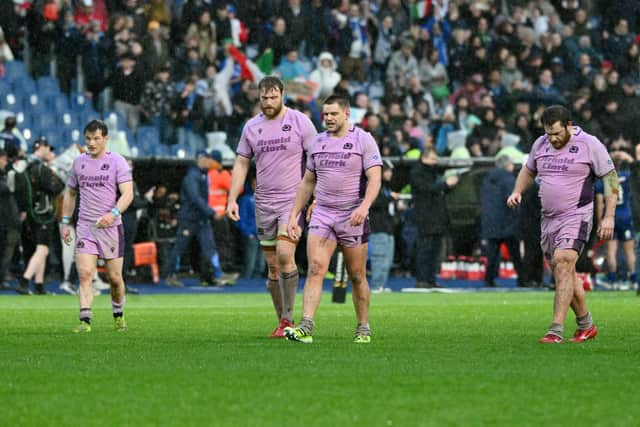
In my 85 years I have not seen a more demoralised Scottish rugby team. They looked defeated even before the start of Saturday’s match in Rome. Their body language was less than positive. In football parlance, “the manager has lost the dressing room”.
Scotland’s performance was dire. They lost lineouts and were even beaten in scrummage. Only their defence prevented this from being a whole lot worse. Head coach Gregor Townsend has to go, especially as his focus is divided between Newcastle and the national team. I’m not sure how that was allowed to happen.
Only a miracle next weekend will maybe save him until the end of the Six Nations.

Ian Smith, Troon, South Ayrshire
Pink blushes
Who at the SRU decreed our national rugby squad playing in Rome should wear a pink strip? Pink is absolutely not a motivational colour.
For much of the game our guys were on the back foot, outplayed by the Italians in blue. Unable to wear their usual navy blue, Scotland could have played in yellow – a decidedly motivational colour.
But pink? Saturday’s result proves my point.
Doug Morrison, Tenterden, Kent
Proper barney
Scotland’s rugby team was doomed from the start by the insipid purple strip it wore for the match against Italy on Saturday. While the game was greatly marred by heavy rain and a referee wth a rather Trumpian appetite to be the centre of attention, one suspects the team’s morale was mainly undermined by being forced to look like Barney the Dinosaur.
Gregory Shenkman, London
Wrong wavelength
The letter from Luke McCullough, Corporate Affairs Director of BBC Scotland (7 February), makes depressing reading. It can be summarised as valuing quantity more than quality in Radio Scotland’s music programming. His emphasis on audience figures, if taken to its logical conclusion, will lead to Radio Scotland mirroring the output of commercial stations.
The recent changes to Radio Scotland’s late-night schedules seem to show just that. Specialist programmes which built strong communities of listeners have been jettisoned in favour of ‘easy listening’ – in other words, the musical content already provided by many other stations.
Mr McCullough lists some of Radio Scotland’s better musical output, without mentioning that listener pressure has sometimes been needed to retain them. It would be good if Radio Scotland management could now reflect on what is widely considered to have been a misguided decision, and mend the damage it has done.
Nigel Lindsay, Bo’ness, West Lothian
Charter obligations
As a daily Radio Scotland listener I support the BBC’s Luke McCullough’s view that the station offers scope for emerging talent . I do feel strongly, however, that the station’s drive to more “extensive music” output on weekdays could be more balanced with documentaries, the written word and in-depth current affairs. Moreover the vast majority of music is pop music which has spoilt Mornings and dominates The Afternoon Show, Get it On and Up Late. That’s over ten hours a day of cheap radio that only appeals to a select audience. The BBC has a charter obligation to inform, educate and entertain. Increasingly it’s just one form of the latter for Radio Scotland it seems.
Perhaps the Director of BBC Scotland could explain that to listeners, but of course, she doesn’t give interviews, even to Reporting Scotland, as evidenced by being “unavailable” to answer questions about controversial findings from the BBC’s public consultation last year.
Neil Anderson, Edinburgh
Anglocentric
Clare Balding, from the Home Counties, bemoaned the fact, during BBC coverage of the opening ceremony, that “this country has a huge disadvantage at the Winter Olympics as we do not have mountains, snow and ski centres”.
Well her beloved Hampshire doesn’t. Thank heavens we have the authoritative commentary and, indeed, geographical knowledge of the likes of Hazel Irvine to explain curling!
John V Lloyd, Inverkeithing, Fife
Milking it
Paul Dover, UK Director at Aria Foods, announced at the National Farmers Union Scotland (NFUS) AGM in Glasgow that Aria Foods is going ahead on its decision to put controversial anti-methane additives into cattle feed for its dairy cows (Scotsman, 6 February).
It is claimed that the synthetic feed additive, Bovaer, could reduce cow methane emissions by 30-45 per cent and – wait for it – help farmers be more environmentally-friendly. Now that should save the planet. Wait a minute, there are only 2.65 million dairy cows in the UK out of the 9.6 million cows in the UK. There are 1.5 billion cows in the world so Aria Foods is just green posturing. There are 8.3 billion people in the world who emit methane gases from their bodies – so does Aria Foods have a synthetic feed additive for them?
Clark Cross, Linlithgow, West Lothian
Risk worth taking?
The appointment of Peter Mandelson as ambassador in Washington says a lot about what Keir Starmer and his advisors thought were the requirements for the job in Trump’s Washington. Not the usual diplomatic professional but a smoothy smoocher with a track record of operating in a world most of us can only guess at. A political risk certainly, but who is to say their reading of the situation wasn’t accurate.
Edward Link, Kinross
Write to The Scotsman
We welcome your thoughts – NO letters submitted elsewhere, please. Write to [email protected] including name, address and phone number – we won’t print full details. Keep letters under 300 words, with no attachments, and avoid ‘Letters to the Editor/Readers’ Letters’ or similar in your subject line – be specific. If referring to an article, include date, page number and heading. And please do ensure any names mentioned are correct.
Comments
Want to join the conversation? Please or to comment on this article.