
Readers' Letters: Sarwar's words on men in women's prisons ring hollow now
Prime Minister’s ideas on solving prison population crisis don’t impress reader
So Prime Minister Andy Burnham is now instructing his Justice Minister to investigate housing male inmates in the female prison estate as a means of relieving the overcrowding issue in English prisons.
That’s the same Labour government that vehemently criticised the Scottish government for attempting to house biological males in the female prison estate here.
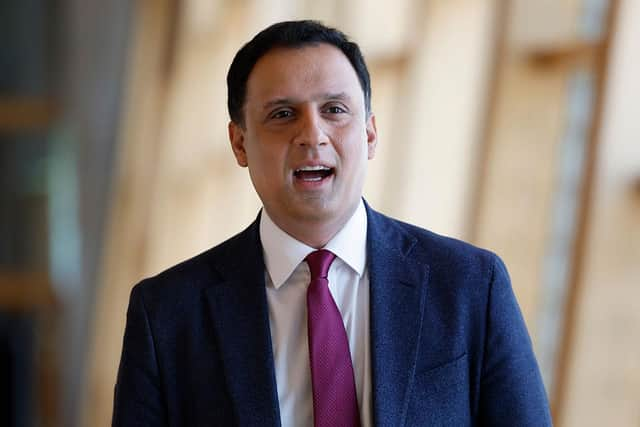
Indeed, it was current Labour minister Anas Sarwar who previously stated that no Labour government would accept a situation where women’s safety was put at risk in such a manner. Now, all of a sudden, the newly ennobled champion of women’s rights has gone quiet on the issue. Could it be that actually being in government is turning out to be a lot more difficult for him as compared to endlessly sniping from the opposition sidelines?

As women are at a lesser risk of reoffending, giving early release to more women than men in order to empty a female jail prior to re-stocking it with male offenders may offer a way forward, provided you avoid the sexes mixing.
However, you then breach equality laws by offering a more rapid path to freedom based solely on the sex of the offender. Remember, all are equal before the law. No exceptions to cater for public opinion are permitted.
Robert Menzies, Falkirk
SNP fails police
The Scotsman leader column sums up Police Scotland when it quotes the General Secretary of the Scottish Police Federation David Kennedy, who said the public should “not necessarily” have “faith” in Police Scotland (12 August). It is obvious to every man and his dog, but not to the SNP government, that Police Scotland no longer has the capacity to arrest the number of people it used to since police stations and offices closed and the custody suites are no longer there to hold prisoners. This was caused by financial cuts driven by this failed government.
Chief Superintendent Rob Hay, President of the Association of Scottish Police Superintendents, had already warned that the decline in arrest numbers should concern the public since Police Scotland did not have enough police officers due to being starved of finance.
In her annual report Chief Constable Jo Farrell said there were 83,765 instances of people being taken into a custody centre in 2025/26, down from 99,216 in 2024/25. Why, crime is still increasing?
Why is Jo Farrell not standing up for her officers and the public by making it crystal clear to the Scottish government that she needs more funds to run Police Scotland, increase police numbers and tackle escalating crime? After all, she has been in charge since October 2023.
Could it be her £281,522 salary?
Clark Cross, Linlithgow West Lothian
Confused Burnham
Andy Burnham is confused about both climate change and the economy and has no plans for crises.
The latest IPCC report clearly states there should be no new oil and gas projects and shows that countries that do not stop new fossil fuel projects will do worse economically. So why is he now wanting new oil and gas projects which are massively damaging on carbon emissions, the future economy and will also fail to bring down the cost of living? Such regressive projects will damage Scotland.
Mr Burnham can reform tax and doesn’t have to have austerity – which has damaged the UK for years – or Keir Starmer’s fiscal rules. But does he understand that fiscal rules are self-imposed and a currency-issuing government can invest in public services, with the scarcity being resources, not money? Does he understand that a wealth tax would bring in £10 billion in one year?
As they are not mentioned, there are no plans on the illegal war on Iran. Mr Burnham supports Donald Trump, as he allows the US use of UK bases. But the closure of the Strait of Hormuz will result in essential fuel and food supply shortages here. So he should be planning for immediate shortages and trying to stop the war to restore essential supplies. But the Bank of England wishes to raise interest rates to deal with rising energy and other costs from the war. Raising interest rates here will have zero effect on the price of oil from the conflict area and instead will likely add to inflation here, unemployment and the recession risk, while making rich people richer. Lowering interest rates is better. Where is the UK government response?
P Yates, Edinburgh
Stop fiddling
Instead of musing about leopards perhaps Brian Barbour and David Millar should consider the shortcomings of Nero’s approach to adversity. While Mr Barbour (Letters, 12 August) indulges in an anti-SNP love-in with Mr Millar, neither gent offers a solution to fixing broken Britain.
Robert IG Scott has repeatedly written to attempt to convince us of the SNP’s demise while, to his chagrin, they remain the largest party at Holyrood and support for independence remains at around 50 per cent and has not declined to the pre-referendum level of around 25 per cent as some on these pages had predicted.
At least Charles Lowson (Letters, same day) appears prepared to contemplate some form of federalism, but with evidence of failure throughout the “United” Kingdom why are so many people seemingly unable to see beyond our current constitutional nightmare?
Stan Grodynski, Longniddry, East Lothian
Grid expectations
At last, unlike the SNP, Scottish Power or SSE, David Morris (Letters, 12 August) has gone into print to acknowledge that dunkelflaute is a major problem for the costs of wind and solar electricity.
However, readers should note that the claim “low light and low wind... affects Scotland for between 50 and 150 hours per year” is akin to the prediction by Michael Fish that rumours of hurricane winds were incorrect only to observe the immense wind damage the next night.
Anyone who tracked the renewable output in October 2025 would know that, for an extended period of days, renewables struggled to generate 10 per cent of Scottish demand, and over the winter of 2010 there were six weeks when there was a complete lack of significant wind power to generate electricity.
It is the responsibility of the grid operator to dictate the back-up generation units needed to keep the lights on. Suffice to say, the cost will run into hundreds of billions of pounds as the impact of a prolonged shutdown would be a disaster for Scottish households. Note that the SNP solution is to add 70GW of floating wind turbines and hydrogen plant to the existing 18GW of wind turbines and 5GW of gas, hydro and nuclear plant.
Why do households have to pay for such a vast quantity of generation plant to meet a maximum demand of only 5GW? Surely, instead of increasing capacity that requires such a massive hike in grid capacity that ruins the scenic beauty of rural Scotland, Holyrood should halt the increase in generation plant to match the anticipated Scottish demand in 2050?
Ian Moir, Castle Douglas, Dumfries and Galloway
Power play
David Morris responds to Ian Moir’s letter regarding renewable energy with some very wise words. However, I think we risk oversimplifying the situation as black and white, whereas the drive for more renewables has many grey areas. For instance, the so called dunkelflaute days are not as straightforward as Wikipedia may suggest. There can be as many as 50-150 hours per month, and usually in November, December and January peak energy consumption periods. To assume new, unproven technologies will take up the slack is rather wishful thinking. We’ve heard about wave, tidal, hydrogen etc for years, but currently none are viable in a significant way. Mr Morris contends Mr Moir is wrong by “maintaining that energy transition to renewables can be sacrifice-free if managed carefully”. Sadly, there is little evidence that the powers that be can provide any sensible transition without sacrifice, careful or otherwise. While I support the drive for renewables we need to balance that with sensible diminishing use of gas and nuclear, otherwise our sacrifice could be power cuts which will be catastrophic for all concerned.
Ian McNair, Cellardyke, Fife
Choose hydro
The Scotsman’s article on the plight of Scotland's small hydropower schemes (9 August) shines a welcome light on a problem the sector has been battling for more than a decade. But the implications now go far beyond small hydro.
Scotland stands on the brink of a new era of hydropower development. Some of the largest pumped storage hydro projects ever contemplated in Britain are being developed in the Highlands, representing billions of pounds of potential investment and infrastructure that will be critical to storing renewable electricity and strengthening Britain's energy security.
Yet the same Scottish business rates framework that has produced the extraordinary outcome described at Inver Hydro will also apply to this new generation of hydro infrastructure. That should concern us all.
At precisely the moment Scotland is seeking to attract enormous private investment into long-duration energy storage, we risk creating uncertainty over one of the fundamental costs those investors will face throughout the lifetime of their assets.
The Scottish government therefore has a historic opportunity. It can correct an anomaly in the rating system and provide the certainty needed to unlock what could be the greatest period of hydropower construction in Scotland since Tom Johnston and the great post-war hydro programme.
This isn't simply about helping an established renewable sector. Getting this right matters to investment, energy security and Scotland's ability to build the infrastructure Britain now needs.
Kate Gilmartin, Chief Executive, British Hydropower Association, Ferndown, Dorset
Write to The Scotsman
We welcome your thoughts – NO letters submitted elsewhere, please. Write to [email protected] including name, address and phone number – we won't print full details. Keep letters under 300 words, and in the body of the email – no attachments – and avoid 'Letters to the Editor/Readers’ Letters' or similar in your subject line. If referring to an article, include date, page number and heading. No poems.
Comments
Want to join the conversation? Please or to comment on this article.