
Readers Letters: Time to take shambolic Edinburgh Airport into public ownership?
A disgruntled reader compares Edinburgh Airport to Vienna Airport
I’ve just returned from holiday in Austria and despite stories of passport problems in Europe, both my entry and exit to Vienna Airport was quick and smooth.
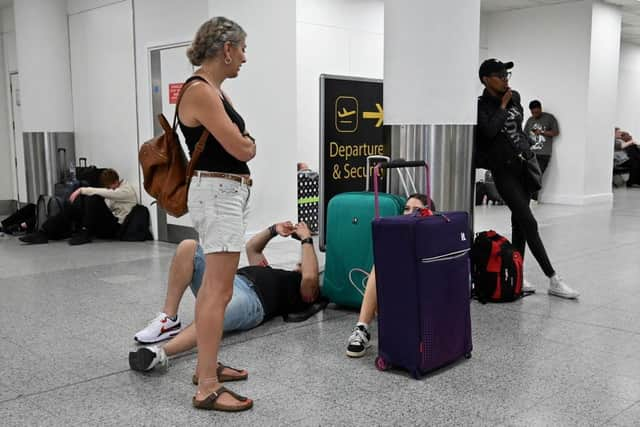
The problem was on my return to Edinburgh Airport, where it took over an hour from landing to get through passport control. This was caused by only six passport inspection booths being opened, and with two planes landing together it doesn’t take much to overwhelm the system; indeed some poor passengers were stuck on an uncovered queue on the Tarmac and it was a chilly morning – imagine if it had been raining!
Overall, Edinburgh Airport is a shambles compared to Vienna Airport, which handles twice as much traffic as Edinburgh, 32 million passengers compared to 16 million. Vienna is newly expanded with excellent facilities and integrated train links.

So I wondered, who owns Edinburgh Airport and profits from such things as the £8.50 drop-off charge?
The answer isn’t, as you might expect Edinburgh City Council or the Scottish or British government, but the private sector. It used to be state owned by the British Airports Authority but this was privatised by Margaret Thatcher in 1987 and it is currently jointly owned by a French company, Vinci Airports, and Global Infrastructure Partners, a subsidiary of Blackrock, the biggest US private finance company in the world. So this means Edinburgh or Scotland has no control over our major airport.
So I wondered, who owns Vienna Airport? The answer is the people of Austria own the majority, including the airport workers who own 10 per cent of the shares. Maybe it’s time the British government started taking our public assets back into public ownership instead of wasting billions of pounds on building nuclear weapons.
Or perhaps the Scottish government could nationalise our airports? After all, we nationalised the railways! Something certainly needs to be done, otherwise this poor introduction to Scotland through lengthy delays is unlikely to improve our tourist trade.
Hugh Kerr (MEP 1994-99), Newtongrange, Midlothian
Hydrogen bombs
Frances McKie (Letters, 1 July) seems to think hydrogen is a safe, non-corrosive and inexpensive source of power.
How terribly wrong. Although one of the most abundant elements, hydrogen is so corrosive – chemically active – that it barely exists in a free state. To produce one unit of hydrogen gas (from electrolysis of water) as a source of power at the point of use requires the input of about five units of electricity, so as well as being hazardous it is very expensive and to be used only for specialist purposes – I was such a user for the whole of my professional life.
A McCormick, Terregles, Dumfries
Talking shop
Jane Ann Liston writes: “At the last COP, several countries stated that because the UK was not signing up to the emission reduction targets, then neither would they” (Letters, 2 July). That is only partly correct.
At COP30 in Brazil numerous countries (not several) yet again refused to commit to phasing out fossil fuels, with 85 countries refusing to sign up to Nationally Determined Contributions spelling out in detail how they would cut their emissions.
It is worth noting that at the time of the first COP in 1995 fossil fuels provided 63 per cent of global electricity. In 2025 it was 59 per cent. Green progress? That's 30 years of COP talking shops with minimal progress, so why is the UK still wasting money going to these meetings? What was the total carbon footprint of these 30 COPs?
Here are just ten of the numerous countries which are still burning coal to drive their economies: China, India, US, Indonesia, Japan, Australia, Russia, South Africa, Poland and Kazakhstan.
The only people benefiting from the Climate Bogeyman are those employed on the Climate Change Gravy Train.
Clark Cross, Linlithgow, West Lothian
Worth a punt?
Over-centralisation – be it at Westminster or Holyrood – is seen by many, Andy Burnham included, as “the” structural impediment to long-term economic growth – and devolution the centrifugal force by which this hegemony can be broken up. Accordingly, “growth in every postcode and hope in every heart” is now the tagline for the ten-year vision of our prime minister in waiting. Ten years is an eternity in politics – a Never Never Land the equivalent of six UK prime ministers or two full terms of a US presidency. Many of us won’t be around to experience these aspirational benefits. So, good luck with the vision thing, Andy!
A more fundamental policy question, perhaps, is whether any correlation exists between devolution and improved economic outcomes?
Devolution is highly context specific: partial-legislative devolution to the German Lander and executive devolution to French Mayoralties have singularly failed to deliver improved economic outcomes over the last ten years. And, since inception, partial-legislative devolution in Scotland, Wales and Northern Ireland has also done little or nothing to improve overall economic performance.
Regarding Manchester, the UK city-region exemplar of executive devolution, the Institute for Government (IfG) reports mixed findings: job creation, productivity and innovation have all outstripped the national average; growth, however, has been unequal – concentrated in just four of the ten city-region boroughs; taking buses back into public control has helped create a better integrated public transport system; social housing, however, has been a notable failure; and health outcomes for the population have remained patchy and disappointing.
The IfG concludes that UK city-regions can indeed work, but only under certain prescribed conditions. Currently, these are only partially met. In the absence of anything better, however – and on balance – further functional-devolution, Burnham-style, is probably worth a tilt north of 10 Downing Street North.
Ewen Peters, Newton Mearns, East Renfrewshire
Man for a job?
One of the last things Keir Starmer’s former Downing Street Chief of Staff, Morgan McSweeney, said on the latest Radio 4 Political Thinking programme to Nick Robinson was, “I live in Scotland”, which sounded strange, since he has hardly had a mention in the Scottish press, and members of the public would not recognise his face or even know his name.
Perhaps it's much the same in England, despite the fact he was recently one of the most powerful political figures in the UK, passing on words of wisdom to the PM.
Why did he do the programme? Well, although he joined the legions backing Andy Burnham, he declared he was not seeking a political job, although by its very nature this was a job interview.
McSweeney took the blame for a number of things – the Mandelson appointment which cost him his job in particular. He came across as articulate and intelligent, almost the stereotypical loquacious Irishman, who came over to the UK at 17, worked in pubs and on building sites, until working reception at Labour HQ, and going on to greatness. Will he get a job? Almost certainly. Contact him in Scotland.
Crawford Mackie, Edinburgh
UK failings
Another day, another anti-SNP Scottish government letter from Brian Barbour (3 July), on this occasion around the principles of “selflessness, integrity, accountability, openness and honesty”.
An objective reader might legitimately ask the question that if Mr Barbour is so concerned with such principles in government then surely his preferred UK government has much bigger questions to answer around Peter Mandelson’s appointment, incinerated PPE and the skeletal HS2. In addition, while the McCrone report was finally released to the Scottish public after being kept secret for over 30 years, the Scottish public has still not been provided details of the UK government polling ahead of the independence referendum (in spite of a court order for the release) and the UK government is also now refusing to reveal the arguments supposedly justifying the refusal of the Section 30 order sought by the elected Scottish government.
None of the above failings excuses shortcomings of the SNP and Scottish government, but Mr Barbour’s repeated attempts to divert from the myriad problems now confronting a Britain that is broken economically, socially and democratically, as well as morally, merely support the assessment that he has run out of ideas as to how to bring about the fundamental change that will improve the lives of most of the people inhabiting these islands.
Mr Barbour should note that voters who have supported the SNP over the last two decades were sufficiently informed and wise enough, seemingly unlike voters supporting the Tories and Labour in England, to vote in favour of retaining close ties with our European neighbours. According to a recent academic study, Brexit is costing Scotland around £30 billion per year.
Stan Grodynski, Longniddry, East Lothian
Enlightenment
The letter from Charles Lawson (2 July) about yellow tennis balls reminds me of a BBC Tomorrow’s World programme from many years ago which suggested there would be safety advantages if car brakes lights were yellow rather than red because yellow is the colour that the human eye reacts to the quickest.
But of course, it is now too late to change brake lights.
Kenneth McKay, Carrbridge, Inverness-shire
Write to The Scotsman
We welcome your thoughts – NO letters submitted elsewhere, please. Write to [email protected] including name, address and phone number – we won't print full details. Keep letters under 300 words, and in the body of the email – no attachments – and avoid 'Letters to the Editor/Readers’ Letters' or similar in your subject line. If referring to an article, include date, page number and heading. No poems.
Comments
Want to join the conversation? Please or to comment on this article.