
Readers' Letters: Why ruin land for power we don't need?
Reader says it’s too easy to call people protesting about wind farms ‘Nimbys’
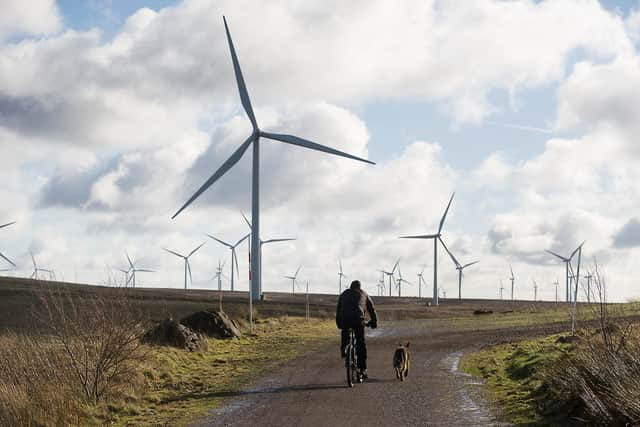
Reporter Katharine Hay is wrong to describe rural wind farm opponents as Nimbys (4 June). The question is more fundamental, involving the wholesale transformation of rural communities into industrial wastelands.
By and large rural communities care and are involved in all the things that visitors to the countryside enjoy, all the things that are said to be good for mental health and general wellbeing. If we wanted to live in the town, we would do so. Most importantly, the data clearly shows – beyond doubt – that enough renewable developments have already been built or consented to cover both Scotland's peak electricity demand in 2050 and the full export capacity to England, so why do we need more developments, especially in areas which require long distance transmission to areas of demand?
Madness is said to be doing the same thing over and over again and expecting a different outcome. We have been building wind farms for 30 years now and I defy anyone to identify any impact upon climate change which, if anything, is accelerating.

Christopher H Shaw, Glentrool Forest, South Ayrshire
Unworthy of name
Sir Keir Starmer's first name was given to him in memory and honour of the great Keir Hardie, one of the major founders of the Labour Party. Its main objective was to get better pay for working people and alleviate poverty.
Why, then, does the UK Government still employ Ed Miliband as Secretary of State for Energy and Climate Change whose policies are costing this nation, with a negligible greenhouse gases output, trillions?
Poverty, hunger and inadequate funding of education, infrastructure and defence still abound.
Charles Wardrop, Perth
Poll dancing
Alan Hinnrichs is uncharacteristically coy in avoiding providing evidence for his claim that support for Scottish secession stands at 59 per cent (Letters, 4 June). Would this be from a poll whose panel enthuses about the “rewards” its members receive for participation? Would it be from a poll that discounts “don’t knows”? Or would it be from an internet poll run by a separatist party or newspaper?
Perhaps it is simply as fanciful as the rest of his material. As they used to say in Private Eye, I think we should be told. Jill Stephenson, Edinburgh
Gaza despair
What appalling, deeply distressing scenes were screened on Channel 4 News on Tuesday, with people in Gaza desperate for food being mown down by Israeli Defence Force bullets.
Former UK Supreme Court senior judge Lord Sumption, interviewed on the programme, said he believed Israel was committing gross breaches of international humanitarian law in Gaza by killing on an indiscriminate scale. He also opined that genocide was the most plausible explanation for what was taking place.
Gaza is now in ruins, with most of its infrastructure, hospitals, schools and other public buildings shattered beyond repair. People are starving, hundreds are being slaughtered every week and children are suffering unimaginable horrors. Why are our Labour MPs not up in arms? How can they watch this deteriorating catastrophe every night on TV news and do nothing? Why is Scottish Secretary Ian Murray not leading a delegation to Westminster to demand we stop supplying Israel with arms as of now?
I truly despair!
Alan Woodcock, Dundee
Missed opportunity
Peter Stevenson makes no reference to the Abraham Accords between Israel and some Arab states following the former’s peace agreements with Egypt and Jordan in his article on Israel (Perspective, 5 June). By early October 2023 the Israeli/Saudi Arabia Accord negotiations had progressed well and reportedly were close to agreement.
Had they been finalised, the whole situation in the Middle East would have been transformed, and Iran’s malign influence significantly weakened.
On 7 October it was immediately obvious the Hamas invasion (almost certainly supported by Iran) was to sabotage any Saudi/Israeli rapprochement. The Saudis hate Hamas too, but fell into that trap by suspending the negotiations.
Hamas also assumed, rightly, Israel would react with massive military action, and that any sympathy and support for Israel in the West would diminish, the longer such action continued. The inevitable deaths of its own Gaza population and destruction of infrastructure were of little consequence to the Hamas leadership, so it had to ensure Israel’s reaction was not quickly successful; and Israel fell into that trap too.
It struck me then that Israel could have announced to the UN that the 1,450 brutal murders and kidnappings proved how necessary the talks with the Saudis were for long-term peace in the region; and called on the Saudis and friendly Arab neighbours to help finalise the talks without delay, to condemn unequivocally the Hamas actions and murders, and to join Israel’s efforts in isolating Hamas (and by extension Hezbollah and Houthis) and supporting the moderate Palestine leadership.
Preferably with such wider agreement, Israel could also have cut the water, power and other supplies to Gaza, but promised immediate reinstatement if all 252 kidnapped hostages were freed, alive and well, within, say, 14 days – failing which, robust military action as permitted by the UN and international law would follow.
Was that feasible, or merely naive? At least Israel would have retained the moral high ground and support of its traditional allies for longer than it has done in the last 20 months.
John Birkett, St Andrews, Fife
Iran ignored
I refer to the article by Stephen Gethins MP, “Why West can’t let Israel continue to flout international law as Gaza suffers” (Perspective, 31 May). He gives views and comments on the hideous situation in Gaza, but nowhere in his full page article is Iran mentioned.
A lot of us struggle to fully understand the full context of what has and continues to happen. This is not helped by omitting to even mention Iran’s role in all of this.
I suggest Mr Gethins revisits the issue and opine on what Israel should do given the reality of what they are facing.
Roy McCluskey, Liberton, Edinburgh
Tired teachers
The Scotsman highlights the pressure teachers are under regarding workload. Following an EIS teachers union survey at least 10 per cent of teachers reported working the equivalent of two days extra per week unpaid and 40 per cent reported working an extra 7 hours per week, again unpaid.
Teachers are expected to work a 35-hour week with a maximum of 22.5 hours devoted to class contact, and that equates to an average of approximately two thirds teaching and one third set aside for preparation and other essential tasks, such as marking course work.
On the surface, class contact versus preparation balance appears reasonable and 50 per cent of teachers appear able to work within those parameters. However, it would appear a substantial number of teachers require more time and it would be worth further investigation to understand why.
As an aside, we are aware the SNP, in their previous election manifesto, suggested a 1.5 hours reduction in class contact per week to allow extra time for preparation etc. Of course, this hasn’t been implemented due to other priorities; however, this did suggest there were pressures on teachers that needed to be recognised and the EIS survey result indicates that more research should be done to prior to implementing such a change.
A Lewis, Coylton, Ayrshire
Spot on, Billy
When Billy Connolly called Holyrood a “wee pretendy parliament” many years ago, this was generally taken as a barbed reference to the place where the less well gifted intellectually could make a pretence of being serious politicians.
The recent stramash with presiding officer Alison Johnstone appearing to lose her equilibrium over remarks made by MSP Douglas Ross tends to prove the comedian's point. People with the mindset of the PO that was displayed to all should not be doing that job. It is as simple as that. I am not sure she understands what being neutral means.
Many Scots are showing signs of having had enough. Rather than the incessant SNP calls for a referendum on breaking up the UK, perhaps the continuing existence of Holyrood would be infinitely more relevant to the people of this country.
Alexander McKay, Edinburgh
Not missing lynx
The proposed introduction of the lynx to our countryside, reminds me of advice given when I suggested taking a walk in Californian woodland. “Sure,” said my host… remember to take your gun.”
Those walking here should be similarly equipped if the introduction of wild species proceeds. Wolves have also been suggested.
These creatures are not jolly Disney characters. They are dangerous wild animals.
Malcolm Parkin, Kinnesswood, Kinross
Write to The Scotsman
We welcome your thoughts – NO letters submitted elsewhere, please. Write to [email protected] including name, address and phone number – we won't print full details. Keep letters under 300 words, with no attachments, and avoid 'Letters to the Editor/Readers’ Letters' or similar in your subject line – be specific. If referring to an article, include date, page number and heading.
Comments
Want to join the conversation? Please or to comment on this article.