
Alexander Dennis to shut Falkirk site and put 115 jobs at risk despite Scottish Government help


It comes after the Scottish Government in 2025 stepped in to fund a furlough scheme for staff at Alexander Dennis
Bus firm Alexander Dennis is proposing to shut its Falkirk site and convert its Larbert manufacturing facility, putting up to 115 jobs at risk of redundancy.
It comes after the Scottish Government in 2025 stepped in to fund a furlough scheme for staff at Alexander Dennis after the firm announced it was considering consolidating its operations at a single site in Yorkshire, putting about 400 jobs at risk.
It is understood that about 85 employees have since left the business.
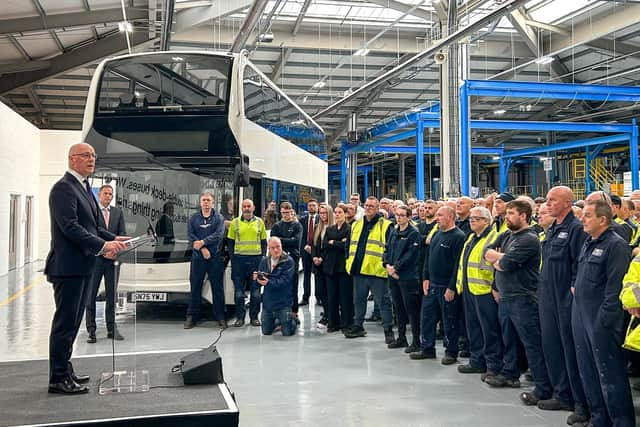
Alexander Dennis has now announced it is consulting on plans to convert its Larbert manufacturing facility to a chassis manufacturing site, supporting all of its low-emission and zero-emission bus products, while the company would close its facility in Falkirk.
Paul Davies, Alexander Dennis president and managing director, said: “We are proposing to retain jobs and restart manufacturing at Larbert with a focus on chassis manufacturing.
“This represents the best possible outcome for our business, employees, customers and supply chain partners in the current climate.
“This new approach would enable us to better align with the current market whilst improving our efficiency. It also allows us to continue to adapt to rapidly changing and challenging market dynamics.
“We remain grateful to the Scottish government for the furlough scheme support to secure these jobs, maintaining skills and manufacturing capability in central Scotland.”
Alexander Dennis said that the UK domestic bus manufacturing sector has lost significant market share in 2025.
More than half (51 per cent) of all zero-emission buses purchased in the UK are sourced from overseas manufacturers, the company said.
Mr Davies said: “We continue to repeat the same calls to both governments to level the playing field, recognise the cost of manufacturing in the UK and the fact that these higher costs flow through the supply chain.
“Manufacturing in this country needs to be better supported if we are to generate the economic benefit that the country so badly needs.”
Last week, the Scottish Government announced the results of the £45 million Scottish Zero Emission Bus Challenge Fund (ScotZEB3).
The round confirmed that 334 zero emission vehicles were to be built in total with Alexander Dennis awarded 123 buses (36.8 per cent), whereas just under half of all orders - 166 buses – were awarded to Chinese company Yutong.
Transport Scotland announced £45 million in Government cash for five bus operators, with Rock Road and Lothian Buses set to purchase from the Falkirk-based manufacturer.
Responding to news of the consultation, a Scottish Government spokesperson said: “The Scottish Government remains in regular contact with Alexander Dennis and trades unions and stands ready to discuss all options, across a range of areas, to protect skilled jobs and achieve the best economic outcome for Scotland.
“The company retains the option to evidence a claim for up to £4.1 million of Scottish Government funding to support its staff furlough scheme, subject to conditions being met. No claim has yet been received.”
Unite general secretary Sharon Graham said: “The Scottish and UK governments have been woeful throughout this process. They have enabled Alexander Dennis’ decision with half of the new bus orders going to a Chinese company instead of boosting Scottish green manufacturing and supply chains. Unless there is urgent action to stop these job losses then this political weakness and failure should not be forgiven.”
Robert Deavy, GMB senior organizer in manufacturing, said: “How many Scottish jobs must be lost and factories closed before our governments understand the risks of sending contracts around the world?
“Every bus from China, ferry from Turkey and tugboat from Vietnam is degrading our industrial capability, costing our country good jobs and apprenticeships and hollowing out communities.
“We are losing crucial skills and supply chains and that, in such an uncertain world, is economic madness and a senseless risk.”
Comments
Want to join the conversation? Please or to comment on this article.