
Donald Trump announces 10% tariffs on UK imports

The US president unveiled his tariffs on Wednesday evening
Donald Trump has announced 10 per cent tariffs on UK imports and claimed the United States was taken advantage of by other countries for decades.
In an event the US president dubbed “Liberation Day”, Mr Trump unveiled tariffs hitting nations across the world, telling supporters it was a “declaration of economic independence”.
The 10 per cent set for the UK was the lowest tariff to be unveiled by the president, with the European Union hit with 20 per cent.
Before the speech, the Prime Minister had insisted the Government had “prepared for all eventualities”, while Chancellor Rachel Reeves admitted the UK would not be “out of the woods” on tariffs even if an economic deal could be reached with the White House.


The US is a key export market for Scotch whisky producers, who will now face having their drink become more expensive for consumers across the Atlantic.
A Scotch Whisky Association spokesman said: “The industry is disappointed that Scotch whisky could be impacted by these tariffs. We welcome the intensive efforts by the UK government to reach a deal with the US administration, and we continue to support this measured and pragmatic approach towards a mutually beneficial resolution.”
Making his address, Mr Trump confirmed that from midnight in Washington, 5am Thursday in the UK, a 25 per cent tariff would be imposed on all foreign cars imported to the US – a move which experts fear could cost 25,000 jobs in the British car industry.
There will also be a flat baseline tariff of 10 per cent on all countries, which in turn will hit the UK.
Going through a chart that marked the tariffs being imposed on different countries, the president said: “United Kingdom – 10 per cent, and we’ll go 10 per cent so we’ll do the same thing.”
The president also hit out at “exorbitant” 20 per cent VAT rates, which he views as a barrier to US firms seeking to sell into the UK market as he promised reciprocal tariffs.
Speaking in the White House rose garden, Mr Trump said: “April 2, 2025 will forever be remembered as the day American industry was reborn, the day America’s destiny was reclaimed, and the day that we began to make America wealthy again.
“For decades our country has been looted, pillaged, raped and plundered by nations near and far. We will supercharge our domestic industrial base, we will open foreign markets and break down foreign trade barriers.
“And ultimately more production at home will mean stronger competition and lower prices for consumers. We’re gonna come back very strongly. Taxpayers have been ripped off for more than 50 years. But it is not going to happen anymore.”
UK business secretary Jonathan Reynolds described the United States as “our closest ally” and stressed the government would “remain calm and committed” to doing a deal to mitigate the impact of the tariffs announced.
But Sir Ed Davey accused Mr Trump of launching a “destructive trade war”. The Liberal Democrat leader said in a statement: “Today Donald Trump has launched a destructive trade war that threatens the jobs and living standards of people across the UK and around the world.
“We need to end this trade war as quickly as possible – and that means standing firm with our allies against Trump’s attempts to divide and rule.
“The Prime Minister should bring our Commonwealth and European partners together in a coalition of the willing against Trump’s tariffs, using retaliatory tariffs where necessary and signing new trade deals with each other where possible. If the government gives in to Trump’s threats, it will only encourage him to use the same bullying tactics again and again.”
The Confederation of British Industry (CBI) said UK businesses needed a “measured and proportionate approach” to the announcement of tariffs.
Rain Newton-Smith, chief executive of the CBI, said in a statement: “Business has been clear: there are no winners in a trade war. Today’s announcements are deeply troubling for businesses and will have significant ramifications around the world.
“A cool and calm reaction from the UK government is the right response. UK firms need a measured and proportionate approach, which avoids further escalation. Retaliation will only add to supply chain disruption, slow down investment, and stoke volatility in prices.
“The government has rightfully tried to negotiate a carveout to any incoming tariffs through a bilateral economic deal. As they seek to grow the economy, negotiating stronger trading relationships with all like-minded partners will be foundational to any success.
“The UK must use this unpredictable period to double down on its commitment to free, fair and open trade. Doing so will provide businesses with the confidence needed to kickstart growth, foster innovation, and boost productivity.”
Talking about the tariffs he is about to put on other nations, Mr Trump said: “We will charge them approximately half of what they are and have been charging us. So the tariffs will be not a full reciprocal.
“I could have done that, yes. But it would have been tough for a lot of countries.”
The EU was hit with levies of 20 per cent, while China – which Mr Trump said was imposing tariffs of 67 per cent, was targeted with what the US president called a “discounted” rate of 34 per cent.
Mr Trump said that he would impose “reciprocal tariffs” that would help “make America wealthy again”.
He added: “In many cases, the friend is worse than the foe in terms of trade.
“We subsidise a lot of countries and keep them going and keep them in business.
“Why are we doing this? I mean, at what point do we say you got to work for yourselves.”
Mr Trump warned world leaders who want an exemption to his “reciprocal tariffs” should change their trade policy.
He said: “Terminate your own tariffs, drop your barriers, don’t manipulate your currencies, and start buying tens of billions of dollars of American goods.”
British businesses had been braced for the impact of the president’s “liberation day” tariffs, which have the potential to derail the UK Government’s hopes for economic growth.
Earlier the Prime Minister insisted the UK was prepared for all outcomes.
Speaking at Prime Minister’s Questions, Sir Keir told the Commons: “We’ve been preparing for all eventualities ahead of the confirmation of US tariffs later today.
“Let me be clear with the House, a trade war is in nobody’s interest, and the country deserves – and we will take – a calm, pragmatic approach.
“That’s why constructive talks are progressing to agree a wider economic prosperity deal with the US. That’s why we’re working will all industries and sectors likely to be impacted.
“Our decisions will always be guided by our national interest, and that’s why we have prepared for all eventualities and we will rule nothing out.”
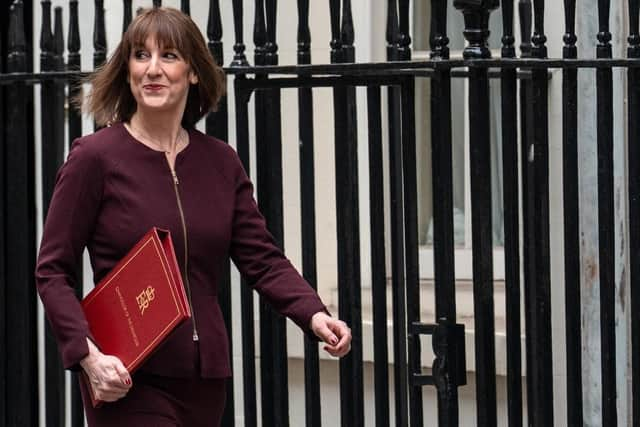
MPs also heard concerns from the Chancellor, who told the Commons Treasury Committee agreeing closer ties with an economic deal would not necessarily mitigate Trump’s tariffs.
Ms Reeves said: “We don’t want to be posturing here, the prize on offer is a good economic agreement between us and the United States”.
“We are not going to do anything to put that in jeopardy, we are not going to rush into action to get a quick headline.”
She said the main impact on the British economy would be from “global tariffs” rather than UK-specific ones, thanks to depressed demand and higher inflation in other countries.
She said: “I think that’s really important to understand, because even if we are able to secure an economic deal with the United States – which we very much want to secure and are working hard to secure that – even if that’s possible, (it) doesn’t mean somehow that we are out of the woods and not impacted by tariffs.
“So we don’t just want to see an agreement between the UK and the US, we want to see free trade, fair trade continue.”
The UK is not expected to immediately retaliate, with Ms Reeves insisting the Government would not be “posturing” in search of a “quick headline”. Ms Reeves said she had been discussing the situation with European Commission economy chief Valdis Dombrovskis.
The European Union hit back with counter-tariffs during Mr Trump’s first White House term and commission president Ursula von der Leyen said this week “we do not necessarily want to retaliate, but we have a strong plan to retaliate if necessary” in response to Wednesday’s announcement.
Elsewhere, the Finance Secretary Shona Robison warned Mr Trump’s incoming trade tariffs left Scotland’s “food and drink, engineering and advanced manufacturing” export sectors “potentially at risk”.
Highlighting the strained global tensions, Ms Robison welcomed the UK government’s “sustained investment in building defence infrastructure and in supporting defence personnel”.
But she warned further spending on defence could not lead to more public service cuts, appealing to Ms Reeves to consider a wealth tax. A wealth tax could be applied to someone’s net worth or assets.
Economists at the Office for Budget Responsibility have warned that US tariffs could eliminate Ms Reeves’s “headroom” against her day-to-day spending plans, requiring her to make more cuts or hike taxes to meet the rules she has set herself.
Comments
Want to join the conversation? Please or to comment on this article.