
Rachel Reeves says she is ‘pushing ahead with biggest drive for growth’ ahead of Budget
Ahead of the statement in the House of Commons, Ms Reeves said she would “take the fair and necessary choices to deliver on our promise of change”.
Rachel Reeves has promised to “push ahead with the biggest drive for growth in a generation” and not “lose control of public spending” as she prepares to deliver the Budget.
The Chancellor is set to deliver her second Budget on Wednesday, when she has warned she will raise taxes to fill a black hole in the public finances.
Ahead of the statement in the House of Commons, Ms Reeves said she would “take the fair and necessary choices to deliver on our promise of change”.


She said: “I will not return Britain back to austerity, nor will I lose control of public spending with reckless borrowing.”
Her priorities for the Budget would be cutting the cost of living, delivering public service reforms, and starting to reduce the cost of public debt.
The Chancellor said: “And I will push ahead with the biggest drive for growth in a generation.
Read more here: When will Rachel Reeves announce the UK Budget? What does it mean for Scotland? What to expect?
“Investment in roads, rail and energy. Investment in housing, security and defence. Investment in education, skills and training.
“So together, we can build a fairer, stronger, and more secure Britain.”
As the Chancellor aims to address the cost-of-living crisis, she has announced minimum wage rates are to increase next year, giving a pay rise for millions of workers.
From next April, the National Living Wage will rise by 4.1 per cent to £12.71 an hour for eligible workers aged 21 and over, which the government said would increase gross annual earnings of a full-time worker on the rate by £900, benefiting around 2.4 million low-paid UK workers.
The National Minimum Wage rate for 18 to 20-year-olds will increase by 8.5 per cent to £10.85 an hour, which the UK government said is a yearly boost of £1,500. This is part of a movement towards phasing out 18 to 20 wage bands and establishing a single adult rate.
The National Minimum Wage for 16 to 17-year-olds and those on apprenticeships will increase by six per cent to £8 an hour.
SNP Housing Secretary Mairi McAllan said the rise is “welcome” but a “whole package” of measures on the cost-of-living is needed in the Budget, and warned against an “incoherent, sort of piecemeal approach” from Ms Reeves.
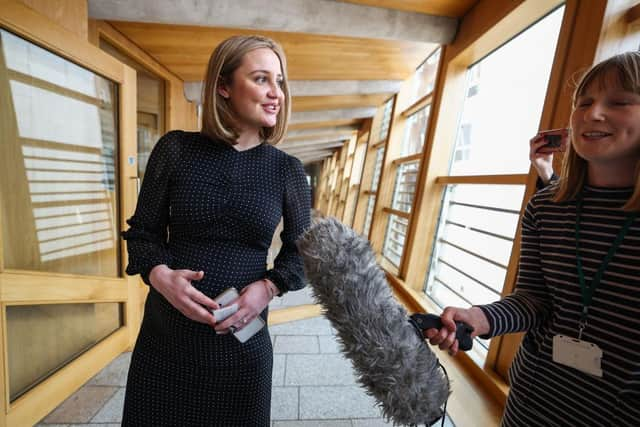
When asked if the minimum wage increase was positive, Housing Secretary McAllan said: “It definitely is. You will never find us doing anything other than welcoming an increase in the minimum wage, and of course, we are pressing for a Living Wage across Scotland.
“What I would say, however, is that that's one improvement, when we might still have a two child benefit cap in place, we still have Local Housing Allowance that's frozen, and other means by which people's income is being diminished.
“So we would rather see a whole package of income maximization that supports people in really difficult times, rather than a sort of incoherent, sort of piecemeal approach. But always welcome an increase in the national minimum wage.”
Trade unions welcomed the increase. UNISON general secretary Christina McAnea said: “Giving low-paid workers a significant rise means their money will go further come the spring.
“Making household budgets stretch further to cover the rising cost of the weekly shop and essential bills is a constant worry for thousands of families across the UK.
“Many of those whose pay is going up again in April work in our essential services. They’ll spend the extra cash on goods and services where they live, which helps grow local economies.”
But business groups were more cautious. Fiona Graham, Chief Operating Officer at Family Business UK said: “Paying a fair wage sits at the heart of family businesses which treat their employees as part of an extended family.
“But, having hit businesses with increases in National Insurance, the threat of more expense in the Employment Rights Bill and for family businesses a 20 per cent inheritance tax bill, this is not the time to add to their costs through above inflation wage increases.
“Last year’s increases have already raised the cost of employing a full-time Minimum Wage worker by £2,367 a year. And whilst for us and our members fair pay remains a priority, these rising costs risk becoming unsustainable in the context of wider economic pressures.
“But, perhaps our biggest concern is that businesses are being increasingly priced out of hiring people, especially young people who will find fewer and fewer opportunities to take their first steps on the career ladder.”
Ms Reeves had seemingly been setting up for a rise in income tax, but this has now been ruled out.
But the Chancellor has pledged she “will take action to help families with the cost of living”.
Ms McAllan also asked for UK government to unfreeze the Local Housing Allowance (LHA) in a bid to help fight Scotland’s homelessness crisis
The LHA sets the maximum amount of housing benefit which renters can claim. But in April this year the government announced that it will freeze LHA rates until at least next year.
Ms McAllan said: “The problem is that, whilst it's frozen, the gap between the support that people can get and local rents is just ever widening, and that's obviously making the private rented sector unviable for people and leaving them potentially homeless.
“So what we need to see is it to be needed to be unfrozen. We need it to keep up with rents.”
Ms McAllan also asked the Chancellor to give a hand with the problem by not cutting Scotland’s capital budget.
Ms Reeves is widely expected to adopt what is being called a “smorgasbord” approach to raising taxes.
This could include freezing income tax thresholds, a move which would drag more people into paying higher tax without raising the headline rate. Ministers on Wednesday also announced plans for regional mayors in England to tax overnight tourism stays if they wished.
The soft drinks levy, also known as a “sugar tax”, is also set to be expanded to include pre-packaged milkshakes and lattes. The levy will also affect soft drinks such as Irn Bru, which changed its formula in 2018 after the UK government first introduced a sugar tax.
Currently drinks with between five and 7.9g per 100ml are taxed at 19p per litre. But the new rules mean the lower threshold will drop to 4.5g.
This means that drinks like Irn-Bru, 7Up, Pepsi and Fanta will all be hit. They contain between 4.5 and 4.7g of sugar per 100ml. The new rate will be introduced in 2028 to give firms time to change their formula.
Irn Bru producer AG Barr and other soft drinks giants like Coca-Cola had appealed directly to Prime Minister Sir Keir Starmer to warn the change would result in them facing £220 million in extra costs.
Comments
Want to join the conversation? Please or to comment on this article.