
SNP and Tories unite in call for Keir Starmer no confidence vote
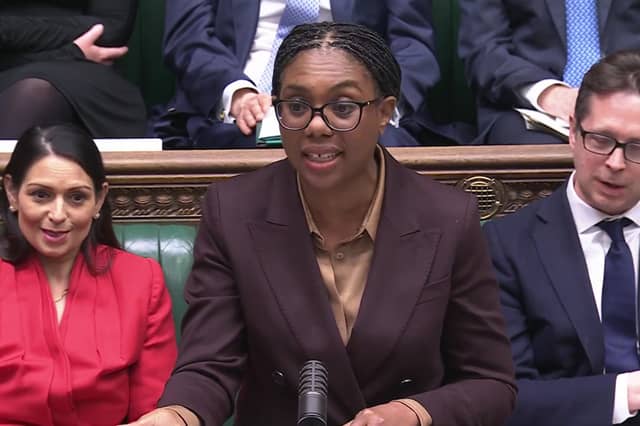

Stephen Flynn and Kemi Badenoch both said they believed Labour MPs should hold a vote on whether they support Sir Keir remaining as Prime Minister.
The SNP and Tories have united in a call for Sir Keir Starmer to face a vote of no confidence amid the furore surrounding the appointment of Lord Mandelson as ambassador to the US.
The Nationalists’ Westminster leader Stephen Flynn and Conservative leader Kemi Badenoch both said they believed Labour MPs should hold a vote on whether they support Sir Keir remaining as Prime Minister.
Confidence motions are usually brought in by the opposition, but it would not pass without the support of Labour MPs.
The call came during an emergency debate in the Commons, brought forward by the Conservatives to scrutinise the appointment of Lord Mandelson to the job in Washington, despite failing security vetting.
Intervening on Mrs Badenoch during her opening to the debate, Mr Flynn said: “Does she not believe that the sorry souls opposite us should have to put their money where their mouth is, and that there should be a vote of no confidence in this Prime Minister in due course?”
Mrs Badenoch replied: “I think he is right, because I don’t believe the Prime Minister has the intention of doing the honourable thing himself, even though that’s the standard to which he held everyone else.
“The decision about whether he will ultimately take responsibility for his actions is now up to Labour MPs. We heard many powerful statements from that side of the House yesterday.
“Labour MPs know that the Prime Minister has let the country down, he’s let Parliament down, and he’s also let the Labour Party down. It is clear to everyone, except the Prime Minister himself, that he has failed on his own terms.
“It is clear to the public that he is failing at the job, it is clear to civil servants that he is throwing them under the bus, and it is clear to members across this House that he is not fit to lead.
“This cannot go on. This House deserves better. The country deserves better. The Prime Minister is not fit for Office. The first duty of any Prime Minister is to keep this country safe. This Prime Minister has put the country’s national security at risk. He must take responsibility. It is time for him to go.”
The SNP famously sided with the Tories in a motion of no confidence against Labour Prime Minister James Callaghan in 1979, beginning Margaret Thatcher’s time in office.
Last night, Scottish Labour MPs told The Scotsman there is little prospect of the Prime Minister being removed before May's elections.
The emergency debate came after Sir Olly Robbins - the Foreign Office’s former lead civil servant who was sacked by the prime minister last week amid the furore over Lord Mandelson’s vetting - told MPs Sir Keir tried to make a former aide, Lord Matthew Doyle, an ambassador.
Sir Olly revealed he had several conversations in March 2025 with Downing Street about finding a role for Lord Doyle, a former head of communications, and was under “strict instruction” that then foreign secretary David Lammy must not be told of efforts to secure a post.
Mr Doyle was suspended from the Labour whip this February after it was reported he campaigned in a local election in Moray in 2016 on behalf of candidate Sean Morton, who had by then been charged with possessing indecent images of girls under 15 and of a couple having sex with a dog.
Sir Olly said: “There were several discussions initiated by No 10 with me about potentially finding a head of mission opportunity for Matthew Doyle, who was then the prime minister’s director of communications.
“I was under strict instruction not to discuss that with the then foreign secretary.”
He added: “It was, to be honest, hard to find something that I thought might be suitable. But I also felt quite uncomfortable about it and I kept giving advice that I thought this would be very hard for the Foreign Office, and hard for me personally, to defend.”
He said it was part of “a creep of senior diplomatic roles going to non-career diplomats”.
He added: “It was difficult for me, personally, honestly, as a leader, to explain why very talented and experienced diplomats were having to leave the organisation, and people who would be widely considered to have rather fewer credentials would be input in these important jobs.”
Later, in a statement, Lord Doyle said he had “never sought” any ambassadorial role, adding: “I was never aware of anyone speaking to the FCDO about such a role for me.”
Labour MSP Pam Duncan-Glancy was sacked from the frontbench, had the whip suspended and was removed as a candidate after it emerged she had continued her friendship with Mr Morton after his conviction.
Sir Olly told the Foreign Affairs Committee that No10 had a “dismissive approach” towards Lord Mandelson’s vetting ahead of him becoming US ambassador.
He told MPs that there was a “very, very strong expectation” from No 10 that Lord Mandelson “needed to be in post and in America as quickly as humanly possible”.
The former permanent secretary at the Foreign Office said that when he took on that role in January 2025, the Developed Vetting (DV) process was already under way.
“Due diligence (which assesses reputational suitability and checks if a candidate is fit to serve) had been completed by the Cabinet Office,” he said.
“Mandelson was being granted access to highly-classified briefing on a case-by-case basis.”
He said this “resulted in a dismissive approach to DV” from Number 10.
“Nonetheless, despite this atmosphere of pressure, the department completed DV to the normal high standard,” he said.
Lord Mandelson was granted developed vetting (DV) status despite the concerns raised by UK Security Vetting, the expert agency which carries out checks.
Sir Olly said he had not seen the UKSV document relating to Lord Mandelson, but was briefed on its finding by the Foreign Office’s security chief.
He told MPs he was briefed that UKSV considered Lord Mandelson a “borderline” case, “leaning towards recommending that clearance be denied”.
The risks in his case did not relate to the peer’s links to disgraced financier Jeffrey Epstein, Sir Olly said.
The Foreign Office’s security chief assessed that the risks could be “managed and mitigated”.
In a letter to the Commons Foreign Affairs Committee ahead of his appearance on Tuesday, Sir Olly said: “DV clearance is a risk judgment. This is especially true the more senior a candidate is and the longer their career.
“Managing these risks as part of the clearance process is not unusual.”
He said he therefore agreed with the Foreign Office’s estates security and network directorate (ESND) approach, and clearance was granted.
That meant that when Sir Keir told MPs the “proper process had been followed… he was correct”.
Comments
Want to join the conversation? Please or to comment on this article.