
'UK spends twice as much switching off windfarms as it does on small nuclear reactors'
More than £1 billion has been forked out in constraint payments this year until the end of August - a 60 per cent increase on last year.
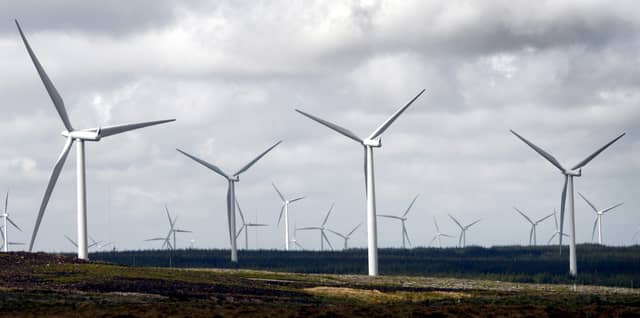

The UK government has paid almost twice as much to turn off windfarms in Scotland as it plans to spend on developing small modular nuclear reactors by the end of this decade, industry leaders have said.
The Nuclear Industry Association said ministers plan to invest £2.8 billion in the technology, compared with £5.1bn in so-called constraint payments that have been made since 2021.
Some £1.04bn was forked out in constraint payments this year up until the end of August. This is up from £648m in the same period last year.
Constraint payments are made to electricity generators when electricity generators are asked to turn off power because the grid is congested and cannot transport the power to where it is needed.
It is understood that the figure is much higher this year than last year because of high winds. More wind means more electricity generated - and if there is not enough capacity in the grid then generators are asked to turn off power.
In 2021, the year before Hunterston B nuclear power station in Ayrshire was retired, constraint payments were £250 million. They are on course to reach £1.5 billion this year.
The UK Government wants to open small modular reactors in Scotland, potentially at former nuclear sites such as Torness, Hunterston, and Dounreay. All of these sites already have grid transmission connections.
But this has been blocked by the Scottish government which holds planning powers. The SNP opposes nuclear energy.
Tom Greatrex, chief executive of the Nuclear Industry Association, said: “Scottish network costs are getting out of control. Scotland shouldn’t pay twice as much to compensate wind generators as the UK is investing in SMRs. We should build back baseload power on the existing transmission corridors to hold down bills and get the jobs and investment that come with new nuclear.
“It’s time to get back to a common sense energy policy, with a balanced mix of power sources giving Scotland the energy stability and security it needs.”
Constraint payments in Scotland have been higher since the closure of Hunterston B in 2022 - and are likely to increase when Torness - Scotland’s last remaining power station - shuts in 2030.
Output that varies with the weather - such as electricity coming from wind farms - is much harder to balance with consumer demand than predictable, baseload output, and therefore much more expensive for the grid to manage.
The National Energy System Operator has forecast that balancing costs could double by the end of the decade, when Torness nuclear power station is due to retire, unless more transmission capacity is deployed.
Billions of pounds of transmission investment in Scotland is planned, but that investment is also paid for on consumer bills.
A Scottish government spokesperson said: “New nuclear is expensive, takes decades to deliver and produces radioactive material that need to be securely stored for many years. New renewable energy projects are faster to deliver and we have seen elsewhere in the UK how the costs of major nuclear projects can spiral.
“The Scottish government has no role in setting constraint payments which are reserved.
“Development of electricity infrastructure, such as transmission networks, that are being planned and developed in Scotland will help manage existing constraints on the system and support increased demand for renewable power across Britain as we transition to a net zero economy.”
A UK Government Department for Energy Security and Net Zero spokesperson said: “Breaking the link with fossil fuels, upgrading our network and transitioning to clean power is the only way to bring down bills for good.
“We’ve cut VAT on electricity to give families breathing space, following £150 of costs we removed earlier this year.”
Comments
Want to join the conversation? Please or to comment on this article.