
What will Andy Burnham agree at the UK-EU summit in Brussels?
Multiple deals will be announced, which the Prime Minister hopes will boost the UK economy and cut the cost of living.
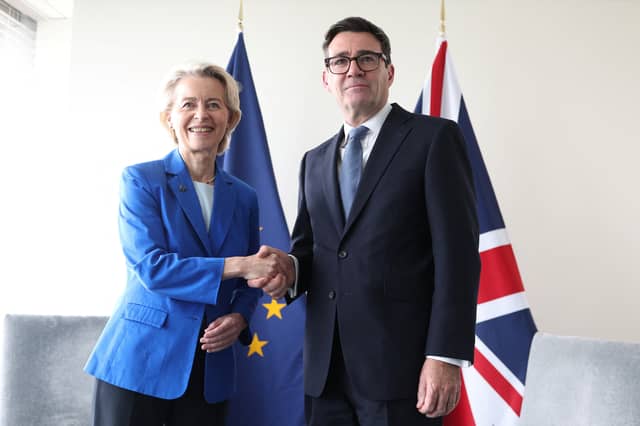

Andy Burnham is in Brussels on Friday for the second UK-EU summit.
Multiple deals will be announced, which the Prime Minister hopes will boost the UK economy and cut the cost of living.
There are likely to be agreements around youth mobility, food and emissions.
But the bigger picture is more interesting.
With Mr Burnham publicly criticising Brexit, the summit is a chance for a closer relationship with the bloc.
A relationship which could eventually lead to the UK rejoining the EU.
Youth mobility
The youth mobility scheme is one of the key measures which will be announced on Friday.
Between 80,000 and 100,000 British 18 to 30-year-olds will be eligible to live work and study in Europe for up to three years.
The same number of Europeans will be allowed into the UK - with the number from each country largely based on the population size.
But it is expected that there will be caps on the number of Britons able to work in individual EU countries, based on the number of people from those countries who are allowed to come to the UK.
So some young Britons could be rejected from the scheme even if the full quota is not met.
Before the UK left the EU, all Britons were able to work and study in Europe freely.
Food and agriculture
The UK government has said that a food and drink deal could “add up to £5.1 billion a year to our economy” and “ease pressure on prices”.
The draft deal would remove post-Brexit checks on food and agricultural exports.
It could allow exports of fresh sausages, burgers shellfish and seed potatoes to resume.
It would also remove the need for £200 Export Health Certificates, which confirm the product meets the health requirements of the country it is going to.
The deal would also get rid of £25 Phytosanitary certificates, which show plants and seeds do not have pests or diseases.
Inspectors fees and port fees could also be removed.
Emissions
The UK government has said that the emissions linking agreement “could add up to £3.8 billion a year to our economy”.
The agreement is set to pave the way for mutual waivers to each side’s mutual carbon border adjustment mechanism (CBAM), which would exempt some £7 billion worth of British exports.
The CBAM puts a charge on carbon pollution created during the production of imported carbon-intensive goods in a bid to stop them undercutting domestic products while shifting emissions abroad.
What about rejoining?
At this summit, a deal over rejoining the EU is not on the table.
But Andy Burnham has said he would like to present options for a new relationship with the bloc next month.
He is coming under increasing pressure to rejoin, with former chancellor Rachel Reeves and ex-foreign secretary David Lammy saying the UK should reverse Brexit.
Scottish Labour leader Michael Marra also wants to rejoin.
Although the UK will not return to the EU after this summit, it could be a small part of a long journey back.
Comments
Want to join the conversation? Please or to comment on this article.