
Will Chinese turbine national security concerns derail Scotland's floating wind ambitions?
The UK government will make a crucial decision on whether to allow Chinese companies to join Scotland’s renewables supply chain.

The Scottish Government has had a long history of close connections with China - its office in Beijing marked its 20th anniversary in April.
But as national security fears deepen over the hostile state, questions have emerged for Scotland’s two governments’ over whether letting Chinese companies into our energy infrastructure would be a risk worth taking to support an industry poised to employ 100,000 people and pump £47 billion into the UK economy.
This is a step-change from pandas and overseas students. This time, it is crucial energy infrastructure that critics warn could be placed in the hands of the Chinese government.
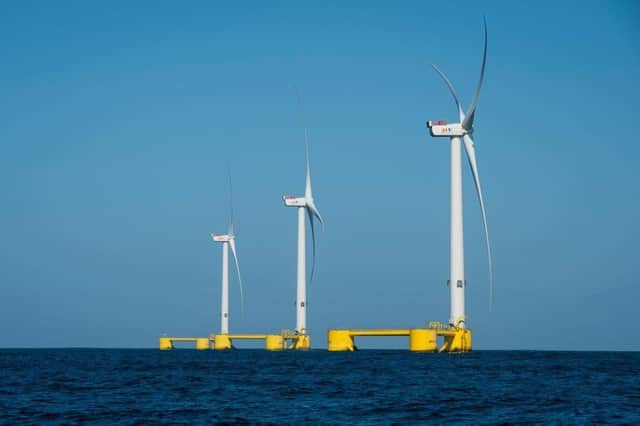

Scotland has ambitions to become the European leader of offshore floating wind, but will need a domestic manufacturing base for turbines to scale up at the pace needed.
Amid heightened tensions with Beijing over the Chinese spy fiasco this week, and Chinese supplier, MingYang, attempting to strong arm the UK government into approving its £1.5bn investment plans, the Scottish Government and its international development agency (SDI) has been lobbing the firm for years to secure a factory to be built near Ardersier Port.
READ MORE: Chinese firm piles pressure on UK government to approve massive wind turbine factory in Scotland
Danish firm Vestas has earmarked a wind turbine blade factory in Leith. But the MingYang facility, if approved, would be the largest, and first fully integrated, wind turbine manufacturing site in the UK, employing up to 1,500 people in Scotland.
With Scotland’s offshore wind ambitions poised to dramatically step up the pace over the coming decades, it has become clear that a manufacturing base within Scotland would make success more likely and create thousands of jobs instead of investment being made overseas. But ironically, it looks almost certain that Alex Salmond’s much-ridiculed vow in 2011 that Scotland could become the “Saudi Arabia of renewables” could only become a reality with foreign investment playing a central role.
For MingYang to press ahead with its turbine manufacturing hub in Scotland, the UK government will need to give the green light. But Sir Keir Starmer’s Labour government is coming under intense pressure over China, with the hopes of such a move dwindling politically.
Last year, it was reported that a Chinese-flagged ship cut Baltic Sea internet cables, lumping the nation alongside Russia as a threat to European key infrastructure. And as director general of MI5, Sir Ken McCallum, starkly warned this week, Chinese state operatives pose a daily national security threat to the UK. Sir Ken said China was "the biggest state-based threat to the country's economic security".

Insiders believed the UK government cooling on the MingYang question was a temporary backing off due to attempts to keep Donald Trump content while trade talks intensified over the summer. Two things that irritate the US president more than most are the growing Chinese economy, and trade in particular, and wind turbines. It was a recipe for disaster.
The Trump administration reportedly warned the UK government over allowing MingYang to invest in Britain. Concerns about Chinese influence also ramped up with a row with another Chinese company Jingye Group, which owned a critical steelworks in north-east England, before being nationalised by the UK government.

Despite MingYang supplying Italy with wind turbines, proposals to do the same for Germany have been axed, with national security thought to have played a role.
The UK government is able to essentially block investment under the National Security and Investment Act. A letter sent by UK minister Pat McFadden to the Commons Business and Trade Committee in April stated that floating wind turbines “may be qualifying assets” under the legislation.
Mr McFadden stressed that a memorandum of understanding signed between the-then Conservative UK government and MingYang in 2021 expired in 2023, but confirmed the Labour administration was “aware of the proposed procurement agreement between Green Volt and MingYang”.
Another dynamic to the MingYang question is that two developers poised to bring forward flagship floating wind projects off the coast of Scotland have been linked with using the Chinese company to supply turbines.
The Green Volt project has billed itself as the first commercial-scale floating offshore windfarm in Europe. The 560 MW development is hoped to “become a catalyst for a highly specialised floating wind supply chain”.

Supply chain documents boast Green Volt is “uniquely positioned to kick start a local supply chain in Scotland and the UK unlocking first-mover advantage for global exports in the growing floating offshore wind industry”.
But it warns “significant parts of the supply chain are not yet established”.
The project has a commitment for £350m of Scottish manufacturing, with up to £500m of additional investment from outside of Europe - opening the door for MingYang to supply the turbines.
A Green Volt spokesperson said: “We are developing the largest commercial-scale, floating offshore windfarm in the world, working to hugely ambitious timelines to deliver the government’s goal of 43-50 GW of offshore wind by 2030.
“Having secured a contract for difference from the government last year, we are identifying supply chain partners to help us build the windfarm. As yet, no turbine supplier has been confirmed for Green Volt.
“We will comply with any government regulation and guidance around security of critical national infrastructure in the selection of all our suppliers.”
The Green Volt project is one of a dozen flagship floating wind proposals under the Innovation and Targeted Oil and Gas (INTOG) contracts that would kick start a world-leading scale-up of offshore floating wind. The proposals would also allow North Sea oil and gas platforms to decarbonise, harnessing the renewable power.
Cerulean Winds, which won three separate INTOG contracts, has also been linked with MingYang as a turbine supplier.
READ MORE: Rachel Reeves told to fast-track windfall tax reforms or risk losing £40bn North Sea investment
By 2050, floating offshore wind could contribute over £47bn to the UK economy and employ 100,000 people. The economic benefits and potential domestic jobs when oil and gas employment is declining makes the MingYang question one that is difficult to ignore.
Louise Gilmour, GMB Scotland secretary, said: “We would, of course, welcome the creation of jobs in Scotland, but not any jobs at any price.

“Multi-nationals arriving in Scotland and delivering on promises to create secure, well-paid unionised jobs have too often been the exception, not the rule. There is no upside for Scots or our economy in importing unfair working practices from abroad while ignoring the erosion of terms and conditions.
“Meanwhile, when the world is becoming more uncertain and dangerous month by month, it seems naïve to downplay potential risks to our national security. The need for an industrial strategy capable of creating jobs while protecting our security and the rights of our workers was already pressing, but our changing world means it is now beyond urgent.”
Claire Mack, chief executive of Scottish Renewables, said: “Scotland has established one of the world’s largest floating offshore wind pipelines, having already delivered multiple gigawatts of fixed offshore projects, which is attracting intense global interest as an investment opportunity.
“The delivery of that future pipeline presents a unique point to build expert manufacturing and operational capacity in Scotland.
“Our industry faces a number of pressures to deliver projects as quickly as possible, at a cost as low as possible and to create high-quality, sustainable jobs as we do so.
“We are working together as an industry and with both governments to ensure we maximise our existing investments and attract further investment that drives economic growth and fits comfortably with overarching international policy objectives.”
The UK and Scottish governments have been embroiled in talks with MingYang for years. Scotland’s international investment body, Scottish Enterprise International (SDI), has seemingly played a key role in discussions.
As well as various SNP ministers, including John Swinney and Kate Forbes, meeting the company, correspondence show “SDI have been working with MingYang for several years, have hosted various inward visits and support Team Scotland coordination with DBT [UK Department for Business and Trade] to streamline engagement with the company”.
Alongside, the meetings with MingYang, SNP ministers including Mr Swinney, Ms Forbes and Energy Secretary Gillian Martin, have received intense lobbying by Flotation Energy, one of two firms bringing forward the Green Volt development.
In March, the company held four separate meetings in the space of 13 days, with discussions including “ the opportunity to the Scottish supply chain”.
More recently, in August, Flotation Energy met Ms Martin to “discuss the challenges facing Scotland’s offshore energy sector”. That came the day after Mr Swinney met the Chinese ambassador, for the second time in the space of a year, with the Bute House talks including “trade and investment” and “renewable energy”.
Asked about the potential Chinese investment in Scotland’s energy infrastructure, SNP Westminster leader Stephen Flynn told The Scotsman that “Scotland’s energy sector didn’t just grow yesterday”.

He said: “Scotland’s energy sector has been working internationally for 50 years across the planet in order to secure investment here in Scotland.
“We need to make sure we can deliver projects. We’re going to have to work with international partners from across the globe to make that a reality. As part of that, the UK government’s having to make decisions on who can and who can’t operate in the UK.”
David Whitehouse, the chief executive of industry body Offshore Energies UK (OEUK), insisted “we want to see the manufacturing of turbines come to the UK and Scotland”.
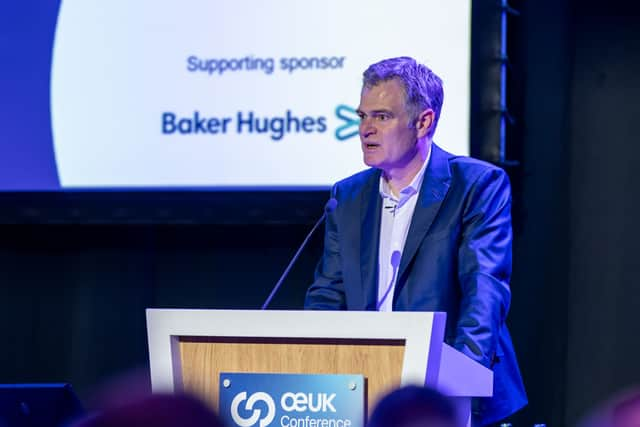
He said: “I think floating wind is a huge opportunity for not just Scotland, but the wider UK. It really plays to our strengths.
“We have the opportunity to design what we install around the ports that we have. I genuinely think it’s a real opportunity. At the moment, the first floating wind farm at scale is Green Volt - that’s a project that would tie into our existing assets.
“The way we get these projects moving and give confidence to those projects to move ahead is to give confidence to the [oil and gas] platforms that they are going to support that [and] they have longevity.”
Comments
Want to join the conversation? Please or to comment on this article.