
The small and 'proud' Scottish firm making curling stones for Winter Olympics

Granite is harvested from Ailsa Craig every five to ten years.
At a small factory in East Ayrshire, a team of just 15 workers are carving, grinding and polishing the curling stones now being used over 1,000 miles away at the Milan Cortina Olympic Winter Games.
Kays of Scotland, which is based in Mauchline, have manufactured curling stones since 1851.
Every five to 10 years, the team harvest granite from Ailsa Craig - a striking volcanic plug island in the outer Firth of Clyde famous for its unique stone and rich birdlife.
Over the years, their curling stones have been used across the world from Canada to China, including at every Winter Olympic Games since Chamonix in 1924, with the exception of the 2002 event in Salt Lake City.
The team make around 2,000 stones a year, with a target of 48 stones during every four-day working week.


Operations Manager Ricky English said: “It fills everybody full of pride to see our curling stones on the world stage.
“We’re just a small factory in the heart of a wee part of Mauchline.
“You bring all the granite from Ailsa Craig on the West Coast of Scotland, back from the island, to us here in the factory, and you then make something that you see on the world stage.
All granite harvests are carried out in compliance with strict planning and environmental legislation and take place every five to ten years.
“It’s quite a big process,” Mr English added.
“We have a 52 page planning document we have to adhere to.
“We have to do that in the winter months because the Ailsa Craig is a Site of Special Scientific Interest and it’s obviously a nature reserve for the birds.
“Then we have the logistical side of it. Obviously because we have to do it in winter, when there’s no birds there, you’ve got a landing craft then we have to put an excavator and dumping truck on that.”
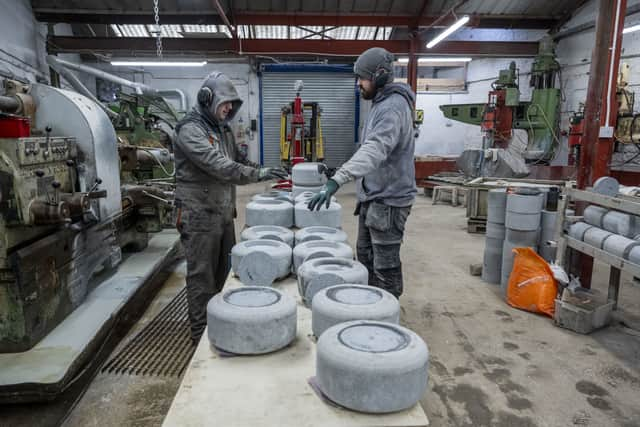
Once harvested, the granite is then transported to the mainland by boat to be stored until they start the process of transforming the granite boulders into finished curling stones.
Stone offcuts are utilised in their unique range of giftware. Currently being sold to the public is a range of goods using the same type of granite that makes up the curling stones used in Milano Cortina 2026.
Why is the Ailsa Craig so special?
For the main body of each curling stone, Kays use Ailsa Craig Common Green granite.
“At Ailsa Craig, when the two stones hit together, it’s perfect for impact rather than shattering on impact,” Mr English explained.
“It kind of absorbs that energy and shoots it out the other end like a spring motion which makes it perfect for the body of a curling stone.”

Make sure you keep up to date with news from across Scotland by signing up to our free newsletter here.
Meanwhile, Kays insert Ailsa Craig Blue Hone granite as the running surface of the stone.
He added: “When we use the Ailsa Craig Blue Hone, that’s effectively a waterproof type granite and it’s very hard-wearing which makes it perfect for going over a surface like ice.”
Comments
Want to join the conversation? Please or to comment on this article.