
Scots astronomers help discover faint exoplanet in distant system


Researcher hails ‘serendipitous’ discovery using cutting edge camera developed and built in Edinburgh
Astronomers at a leading Scottish university have helped uncover a faint elusive planet in one of the most intensely studied planetary systems in the Milky Way after what has been described as a cosmic game of cat and mouse.
In what represents a significant breakthrough in our understanding of the galaxy, the team at the University of Edinburgh and their German colleagues pinpointed the new planet around the star, Beta Pictoris, located around 63 light years from Earth.
The relatively young star was already known to host two giant planets, known as Beta Pictoris b and Beta Pictoris c, but the latest discovery, known as Beta Pictoris d, had been obscured until now.

The researchers said the third planet is 100 times fainter than Beta Pictoris B and is among the lightest exoplanets ever imaged from the ground. Like Jupiter and Saturn, Beta Pictoris d is a gas giant, but at just 2.4 times the mass of Jupiter, it is much lighter than the system's two previously known planets.
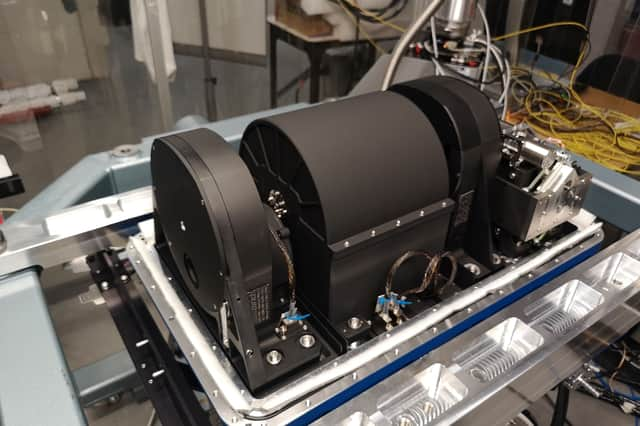
The discovery was initially made by the astronomers using the European Southern Observatory’s Very Large Telescope in Chile, which had been fitted with a cutting edge infrared camera developed and built by the Science and Technology Facilities Council’s UK Astronomy Technology Centre in Edinburgh, in collaboration with ETH-Zurich and Leiden University.
To confirm the discovery, the team then searched through more than a decade of archived observations from the European Southern Observatory's telescopes, finding evidence of the planet in images dating back 11 years.
Dr Ben Sutlieff, an astronomer at the University of Edinburgh and co-lead of the new study, published in The Astrophysical Journal Letters, said: “This was a serendipitous discovery. We initially wanted to look more at a known planet in the system, Beta Pictoris b, to see how it changed over time. However, when we went to analyse our images of the system, we noticed something else that led us down an entirely new path.
“Systems with multiple directly imaged exoplanets are the ‘holy grails’ of discoveries, because they can teach us a lot about what different exoplanets are like in the same formation environment.”
Beth Biller, professor of exoplanet science at the University of Edinburgh, and co-author of the study, added: “Planets seem to have friends, many of the famous directly imaged exoplanet systems seem to have multiple giant planets in the same system, and there are likely to be even more lower mass planets hiding in these systems that might be revealed with instruments in the future.”
William Taylor, instrument scientist at the UK Astronomy Technology Centre, said the find was testament to the “remarkable capabilities” of the NIX camera.
“Detecting a planet this faint next to a much brighter star is an immense technical challenge, and it is rewarding to see an instrument we led here in Edinburgh helping astronomers uncover new worlds,” he explained.
An independent team led by Aidan Gibbs at the University of California also detected Beta Pictoris d using the James Webb Space Telescope, with their findings published alongside the Scottish and German team’s results in The Astrophysical Journal Letters.
Comments
Want to join the conversation? Please or to comment on this article.