
Soldier’s brain reunited with body 85 years after his death
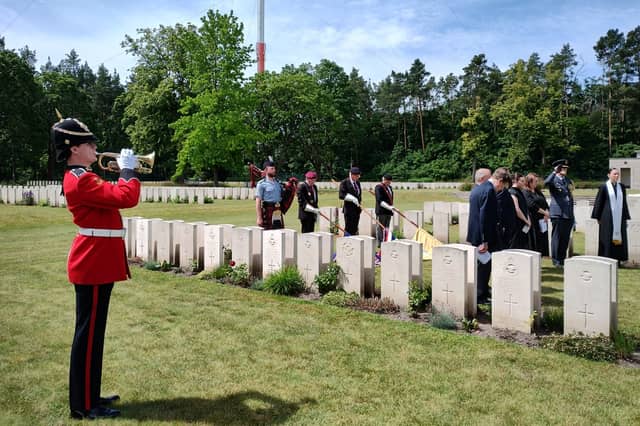

A Highland soldier’s brain has been buried with his body 85 years after his death.
Private Donnie MacRae was born in 1907 and died in a prisoner of war hospital on March 6 1941.
He suffered from a rare neurological condition, Guillain-Barre Syndrome and, during a post-mortem examination, German doctors removed parts of Mr MacRae’s brain and spinal tissue for research.
The samples were sent to the Kaiser Wilhelm Institute for Psychiatry, now renamed the Max Planck Institute for Psychiatry, in Munich, and remained there after the war ended.
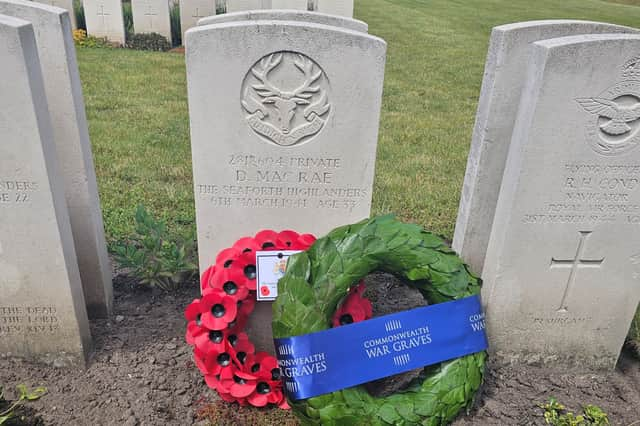
Ministry of Defence’s Joint Casualty and Compassionate Centre (JCCC) case worker Nicola Nash said Private MacRae’s family was not aware that parts of his brain and spinal tissue had been removed until an international research group began working through samples stored in the institute in an attempt to return them where possible.
It was due to this group that the samples taken from Private MacRae were brought to light and able to be returned to his grave.
“That particular piece of history – that the samples were taken by German medical services – has sort of been forgotten or overlooked,” said Rich Hills, director of commemorations at Commonwealth War Graves Commission (CWGC).
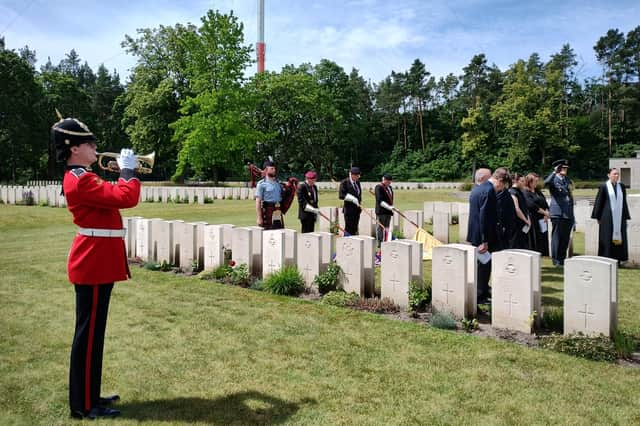
A service was held at Private MacRae’s grave in the Berlin 1939-1945 War Cemetery with two of his relatives present this week.
Mr Hills said Private MacRae’s family was “relieved”.
“I spoke to two of the family members, and they were just relieved and they were reassured that the (samples) had been reunited with the original remains,” Mr Hills said.
“I think it was just an absolute relief that the right thing was being done.”
Private MacRae was born in 1907 to Roderick MacRae and Mary MacLean in Badachro, South Gairloch. He had three brothers, John, William and Alexander.
The family were music lovers, with a strong tradition of bagpiping, but Roderick and his sons were also highly accomplished tailors.
Ms Nash said Private MacRae had plans to set up his own tailoring business in Blair Atholl, Perthshire, where his brother, Alexander, lived and worked as a chauffeur at a local hotel.
However, in 1939 Donnie enlisted with the Territorial army and was called up to fight.
He joined the 4th Battalion, Seaforth Highlanders, and in January 1940 embarked for France to join the British Expeditionary Force (BEF) as part of the 51st (Highland) Division.
Private MacRae and his comrades were captured by the Germans and became prisoners of war in 1940.
He died the following year in a camp hospital at the age of 33.
His body was buried by the Germans and later reburied by the Allies in the Commonwealth War Graves Commission cemetery in Berlin.