
Ambitious rail hub plan on site of huge WW1 'devil's porridge' munitions factory near Gretna
Expansion plans for snowplough storage sidings include train building and nuclear waste transport

It is the only thing moving on the vast former munitions site that was once a hive of wartime activity.
The shunting locomotive “Charlie” trundles its way past a derelict platform from where up to 20 ammunition trains a day left for the front line.


The former steelworks engine, painted in Ministry of Defence (MoD) dark green, works its way along the sliver of land back in rail use at what was once the world’s largest armaments factory.
However, that could be just the first stage of an ambitious scheme to transform the otherwise derelict site into a multi-purpose rail hub.
The complex on the Solway coast in Dumfries and Galloway produced more than half the ammunition used by Britain in the First World World - the so-called “devil’s porridge” - and later rebuilt as an arms storage depot in the Second World War.

It was still supplying arms in the Iraq war 20 years ago but the last munitions were removed by 2010 with the site left dormant by the MoD.
However, two years ago, a rail company took a lease on 18 acres at the western edge of the site at Eastriggs, near Gretna, and now wants to acquire the remaining 1,300 acres still in MoD hands.
So far, Rail Sidings Limited (RSL) has stored a variety of rolling stock there, including snowploughs, which are maintained on site, along with bitumen tankers, freight hoppers and other wagons.

But it said the expansion could create a cross-Border rail freight distribution centre and even host the final assembly and testing of new trains, such as future fleets for ScotRail.
RSL managing director Gary Draisey, who used to run the MoD’s rail operations in the UK and Germany, said: “I came here a number of times and was always conscious this was a site with huge potential.
“The MoD is looking to dispose of the site over the coming months and we’ve put in an offer.
“We are looking to develop it as a freight hub, as well as for storage and engineering.

Mr Draisey said the rail yard had the advantage of its strategic location near the Border.
He said: “The important thing to note from the rail freight perspective is that there’s a terminal in Manchester and one at Mossend, near Glasgow, but nothing in between.
“Containers are being loaded in Felixstowe [in eastern England], go all the way to Mossend by rail, and are then transferred to lorry and being driven as far south as Barrow [in Cumbria] - it defeats the object of using rail.”

Mr Draisey said there was a big opportunity to support many local businesses, such as a quarry and timber production.
He said: “Companies in this area who have approached us said they would love to use rail, with the benefits that gives them in cost and better distribution, but there’s no available railhead.
“This site could also be used for new trains for ScotRail. The trains could be built 80 per cent complete and then Eastriggs used to finish, test and commission them.
“There are very few sites in Scotland which have this capacity.”
Other potential work includes in the decommissioning of the former Chapelcross nuclear power station, two miles away, which closed in 2004.
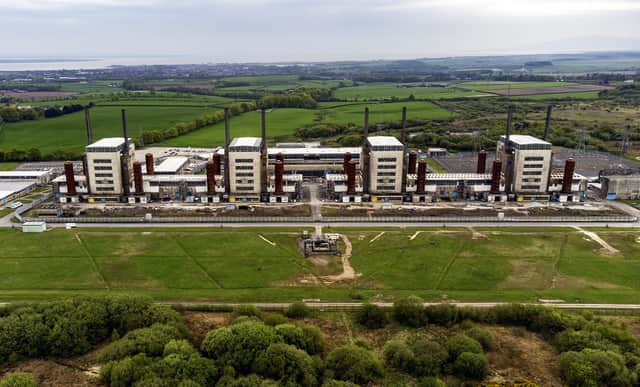
Luis Eckersley, a RSL manager, said: “A lot of the low level waste will have to be disposed of and the only way you can move it is by rail.”
Among those sharing their enthusiasm for the site is Charlie’s driver, who came out of retirement to join RSL at Eastriggs, returning to a site where he had worked since the age of 15.

Barry Rayson, 75, who began as a messenger boy in 1966, was allowed “over the wire” to where the ammunition was stored when he reached 18, to drive fork lifts and tractors.
He said he had never felt a sense of danger: “We were all taught the proper way.”
He said: “The job has been brilliant. It was exciting joining at 15 - it was amazing.”

Mr Rayson’s father and great uncle also worked at the munitions complex, which stretched east for nine miles to Longtown across the Border when it was established in 1915.
It was completed within months to address an acute shortage of ammunition in a war that had been expected to last only a few months.
HM Factory Gretna, as it was called, employed 30,000 people, 12,000 of them women.
Sir Arthur Conan Doyle, visiting the site, coined the phrase ”devil’s porridge” to describe the hand mixing of waste cotton and chemicals such as nitroglycerine to make the propellant cordite used to fire bullets and shells.

The story of the site is told in the purpose-built Devil’s Porridge Museum in Eastriggs, which opened in 2014.
Tom Hughes, its youth and community engagement officer, said the site was again being considered for munitions production - but he hoped history would not repeat itself.
He said: “Last November, the UK Government announced that we need two new munitions factories.

“This area is on the shortlist of five locations. We want to be relevant, but we don’t want to be that relevant. But all these things keep coming back.”
Mr Draisey said he thought it unlikely that Eastriggs would be chosen for the new plant, but it would not dash his plans.
He reckoned start-up costs would be higher than elsewhere because of the lack of water supply, electricity, qualified staff and the necessary licences.
Mr Draisey said: “We’re hoping not, but even if the site was chosen, only about 200 acres would be required.”
An MoD spokesperson said: “Eastriggs has been identified as a potential development site for a range of defence uses, which are being assessed.
“Consequently, the planned disposal of Eastriggs depot has been paused until a decision has been made on any future use of the site.”
Comments
Want to join the conversation? Please or to comment on this article.