
New CalMac ferry Glen Sannox taken out of service to become standby vessel

Arran ferry which arrived seven years late to be tied up in Stornoway
A £200 million CalMac ferry that has been in service for fewer than 18 months is to be tied up in port as a standby vessel in case anything goes wrong with the rest of the fleet.
The long-awaited Glen Sannox started serving Arran - one of CalMac’s busiest routes - in January last year after being completed seven years late and some four times over budget.
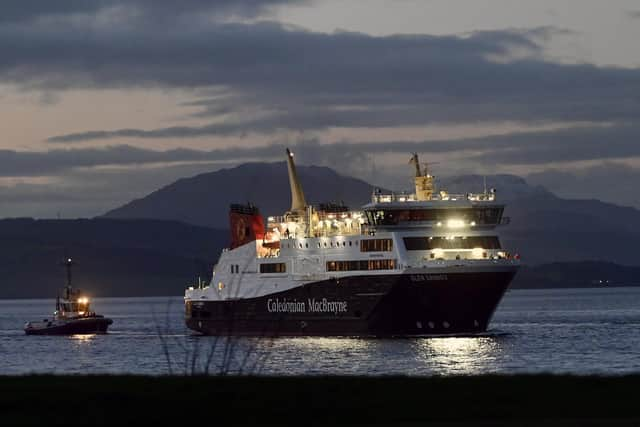

However, the operator’s second largest vessel will now be put on “operational standby” in Stornoway to act as one of two “resilience vessels” this summer.
It will leave Arran’s main routes served by a 32-year-old ferry and a chartered catamaran whose only catering is from vending machines.
Caledonian Isles sails between Ardrossan and Brodick while Alfred operates to Arran’s main port from Troon.
The impending move comes three months after Arran islanders expressed dismay at the prospect of their new ferry being redeployed to the Western Isles.
CalMac said Glen Sannox was chosen for the role because it could operate in more ports than many of its other ferries.
Its spokesperson said: “She will be berthed in Stornoway on standby and hasn't been scheduled to operate on any route yet.”
The firm denied the decision was because there was a high likelihood of another of its ageing large ferries suffering problems following a series of breakdowns around Easter.
However, chief executive Duncan Mackison told The Scotsman last month that CalMac would remain “on the edge” of further major disruption until three new ferries were delivered from Turkey by next year.
The CalMac spokesperson said: “Our network was affected by unprecedented disruption for several weeks earlier this year, with almost a third of the fleet unavailable at one point.
“We are grateful to communities for their patience and understanding during that challenging period.
“Glen Sannox, which was a much-needed support during the recent disruption by operating the Castlebay-Oban and the Stornoway-Ullapool routes, is doing berthing trials on the Little Minch this week and will be on-hand to provide further support if required.
“The fleet has now returned to normal operations and thanks to the retention of [catamaran] Alfred, we now have a resilience vessel in the major vessel fleet until October.
“Throughout the summer, this should allow us to manage any unplanned technical issues more readily and increase confidence levels in those who travel on our services.
“The resilience vessel will likely change over the summer but the plans for this haven't been finalised yet.”
The spokesperson said Alfred was limited as to where it could operate, while Ullapool-Stornoway ferry Loch Seaforth could not operate anywhere else and Barra ferry Isle of Lewis could only also serve the Stornoway route.
They said Glen Sannox would be based in Stornoway to be able to respond quickly if required to take over a route in the Western Isles.
CalMac said 42-year-old ferry Isle of Arran - one of its oldest - which is docked in Greenock, would act as a second resilience vessel, covering routes in Argyll and on the Clyde.
Bill Calderwood, secretary of the official Arran Ferry Committee, said: “The need for a resilience vessel to cover for the summer has been clearly stated.
“Arran asked for vessels that would provide a consistent timetable and improved resilience to help build customer confidence if visiting our island.
“First and foremost, we need reliable ferries.
“The current agreement [Alfred operating from Troon and Caledonian Isles from Ardrossan], although not ideal, should help provide service consistency which we hope will be delivered with an improved level of reliability.
“The extension of the Alfred contract [on the Troon route] supports the key services from Ardrossan.
“The need for the network and our community to have a resilient vessel is clear and the benefits to our economy and customer confidence is a much needed change across the network.”
Sheila Gilmore, chief executive of VisitArran, also accepted the need to redeploy Glen Sannox away from the island.
She said: “It is imperative to Arran's community and economy that we have a reliable ferry service.
“We're pleased that Caledonian Isles is sailing from Ardrossan, whilst Alfred sails from Troon.
“This offers stability in the Arran service for all users. There needs to be a resilience vessel within the network and it would appear that Glen Sannox fulfils that role at present."
However, Alex Reid, a director of the Scottish Rural and Islands Transport Community, posted on business networking site LinkedIn: “CalMac is taking its second newest and supposedly most environmentally friendly vessel and tying it up in Stornoway.
“In what world does any transport operator do this? If the ferry is working reliably then it should be sailing as many hours as possible to recover the hundreds of millions of pounds spent on it.”
A Transport Scotland spokesperson said: “The operational decision on the deployment of vessels across the network is rightly one for the operator. CalMac will keep under review where vessels are best placed to operate.”
Glen Sannox suffered a series of problems after being completed by the Ferguson Marine shipyard in Port Glasgow which will cost more than £3m to repair.
They include a replacement propeller after vibration caused a crack in its hull, which is scheduled to be installed during the ferry’s annual overhaul in November.
Sister vessel Glen Rosa, which was also earmarked for the Troon to Brodick route, is due to be completed by Ferguson Marine by the end of the year.
Comments
Want to join the conversation? Please or to comment on this article.