
Ryanair predicts what will happen to air taxes when Scotland takes control next year
Air passenger duty to be replaced by air departure tax in April 2027


Air tax for passengers will be reduced rather than raised when Scotland takes control of it next year, the boss of one of the country’s biggest airlines has told The Scotsman.
Ryanair chief executive Eddie Wilson said the Scottish government would make more money overall by cutting air departure tax (ADT) when it replaces air passenger duty (APD) because that would boost the number of air travellers.
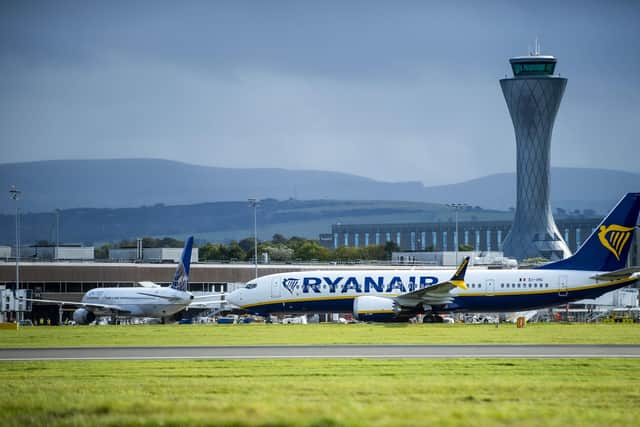
However, his assessment comes in stark contrast to that of the country’s busiest airport, where Ryanair is the biggest airline.
Edinburgh Airport chiefs fear the move will trigger a “potential tax hike that will affect millions of Scots”.
The SNP announced in this year’s Scottish Budget that ADT rates would remain the same as APD when it is introduced in April 2027, with 2028 rates to be announced in next year’s Budget.
Economy class passengers pay £7 APD for UK flights, which increases to £8 on Wednesday and £13 for international flights up to 2,000 miles (£15). APD is £90 for flights up to 5,500 miles (£102).
The SNP originally planned to introduce ADT ten years ago with a view to halving, then abolishing the tax.
However, to help both meet Scotland’s emissions targets and bolster the Scottish government’s squeezed finances, industry observers think tax rates will be raised.
Mr Wilson told The Scotsman: “As a devolved government, if they’ve got control over that taxation, they will do what happened in other countries, which is if you lower access costs, you will attract [more] passengers and you will make as much money, if not more.”
“We’ve seen this happen in other countries like Sweden, which has abolished air tax and Ryanair has grown its traffic there by about 40 per cent.
“Scotland needs a different approach to the rest of the UK.
“If they [ministers] want to make the airports more competitive, then lower the taxes.”
Other airlines have been noticeably mute on the subject, with Easyjet, Scotland’s largest carrier, referring to Airlines UK.
The umbrella body said: “Airlines look forward to engaging with government to review and understand how they will approach this change with a view to protecting and enhancing Scottish short and long-haul connectivity, supporting the Scottish visitor economy and ensuring air travel remains affordable for customers.”
However, Edinburgh Airport has criticised the SNP for announcing a “fundamental change to aviation taxation” without consulting the aviation industry, which it said had created uncertainty.
The change will also see passengers travelling within the UK from Highlands and Islands airports continuing to be exempt from the tax, subject to approval by the UK government.
However, ADT would be introduced on international flights from the airports, such as KLM’s between Inverness and Amsterdam, and connecting flights via Heathrow, such as with British Airways.
First Minister and SNP leader John Swinney declined to say whether ADT would rise all fall.
He said: “We will set that out when the time is right. The crucial point is that we will engage with all interested parties.
“I take a very thoughtful approach towards taxation because I recognise its significance to people’s daily lives and in the commercial operations of companies.
“We have to consider all the different aspects of the extent to which ADT supports public expenditure and how much it affects investment. I don’t think it’s causing uncertainty.”
The Scottish Greens said it would replace ADT with a frequent flyer levy so those who travelled a lot paid more than families going on an annual holiday.
The party said that would build on its success in securing a higher ADT rate for private jets from next year in return for supporting the Scottish Budget.
Comments
Want to join the conversation? Please or to comment on this article.