
Summer of sport could provide investment opportunity alongside priceless memories

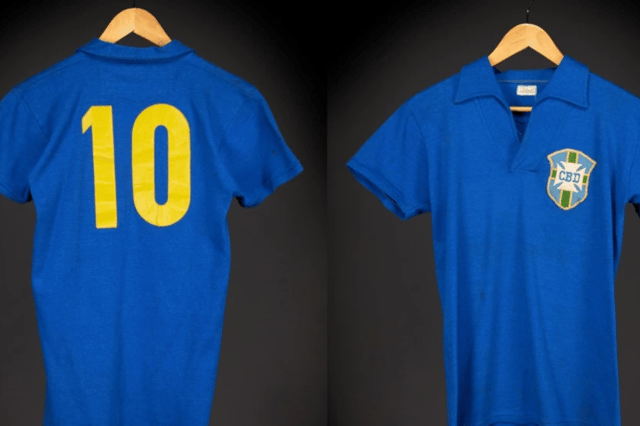

Memorabilia from the World Cup and Commonwealth Games could be worth hanging onto, if you get your hands on the right piece.
This year will be the biggest summer of sport in Scotland for decades.
While our return to the World Cup was perhaps less thrilling on the pitch than people had hoped, the excitement and atmosphere created by the Tartan Army off it will live long in the memory on both sides of the Atlantic
And now Glasgow has continued the party, kicking off the 2026 Commonwealth Games and bringing some of the world’s finest athletes to the city to compete for sporting immortality.
Major events like these will create priceless memories for everyone involved, from the eager young fans getting their first taste of World Cup heartbreak to the thousands of volunteers who will help bring the Glasgow Games to life, to the athletes themselves looking to convert years of gruelling training and dedication into bronze, silver of gold success.
They can also provide a rare opportunity for a certain kind of investor, through the programmes, mascots, medals, boots, strips and everything else associated with them.
For sports memorabilia collectors, every item has the potential to bring in a big return, while each passing year only adds to the growing value of iconic treasures from games past.
‘Scarcity’
One of the biggest determining factors for memorabilia is how rare the piece is. Scotland fans will be returning from the World Cup with empty wallets, pounding hangovers and a bag full of commemorative programmes, souvenirs and other branded World Cup merchandise to mark the occasion. While some of these may gain in value over the days and years to come, most have been produced in such quantity that they are likely to be worth less than they were bought for, even if the memories they evoke are priceless.
The same is true at the Commonwealth Games - a souvenir programme from or ticket to a major event might seem worth holding onto, but in most cases it is likely to add very little value.
“Programmes and tickets and commemorative souvenirs are the kind of item likely to pop up on online auction sites such as ebay in the weeks and months after an event, and they can have some value,” explains Tommy Alexander, auctioneer and valuer at Great Western Auctions, Glasgow.
“Commemorative medals for example, may immediately following the games be in some demand as collectors want one for their own collection
“And decades down the line it might have some modest value, but it’s far more likely to be most valuable to the person who received it.
“Scotland appearing in a World Cup, is sadly a rare thing so if you’re a collector of anything Scotland football related you will be interested in getting your hands on souvenir programmes for example, but it’s a case of supply and demand. So because these things have only been recently produced, they exist now in the greatest quantity they will ever exist in, which means they are not considered so valuable.”
History
June 14th, 2026, the Boston Stadium. Scotland take on Haiti in their first World Cup appearance since 1998, going on to claim their first World Cup win since beating Sweden 2-1 at Italia ‘90.
A complete ticket for the Sweden match, in good condition, is likely to fetch a few hundred pounds at auction. And if it takes Scotland another 28 years to make it to a World Cup, items associated with the Haiti game - note the last victory in a World Cup game - could see a similar increase in value.
“It takes a bit of historical context to really appreciate if an item is something of significant value or not,” explains Tommy.
“If an item is part of a long run of victories it is not so remarkable, but if it relates to a victory that turns out to be the defining moment in a performer’s career, the win that catapulted them to bigger success, or perhaps their last ever win, then it has much greater value.”
People are more conscious of memorabilia collecting now than in the past, and there is a culture of doing that now that there wouldn’t have been in the 1930s for example.
‘You had to be there’
Ticket stubs, souvenirs, mementos of all kinds can all have some value then, and there is one major determining factor which is the biggest at play in sports memorabilia - the moment they relate to.
“The memorabilia market is quite diverse, but in an auction setting what always sells well are actual match or competition items,” explains Tommy.
“So even a commemorative piece which may be very rare will not capture the imagination like a strip or a ball from an iconic match, or something that is identifiable as having been part of a truly significant sporting moment.”
Just this month the shirt worn by Pele during the 1958 World Cup final sold for £3.6m at a Sotheby's auction in New York. The strip was significant as it was arguably the game’s greatest ever player’s first World Cup, and he scored twice in the final to win the first of his three World Cups.
It is the second most valuable football jersey ever sold, behind the £7.1m paid in 2022 for the Argentina shirt Diego Maradona wore when he scored the 'Hand of God' goal against England at the 1986 World Cup.
The importance with these items - and something for collectors to be aware of - is provenance. That is proof that this shirt is THE shirt worn by Pele in the final, and not a replica or a fake.
The strip worn by the Scottish football icon Jim Baxter in the famous 3-2 victory over England in 1967, for example, was expected to fetch up to £60,000 when it went under the hammer in 2023. But despite auctioneers McTear's insisting the shirt had "cast iron" provenance, they pulled it from sale after another shirt came forward with the same claim.
“Often the more time goes by the more difficult it is to conclusively make that attribution,” admitted Tommy.
If you are lucky enough to attend the Commonwealth Games, happen to be there for a truly historic record breaking moment, and grab a little piece of that moment you might find that it’s worth hanging on to. Although it will never be worth as much as, say, John McGinn’s boots from the Haiti game.
“There is quite a disparity between sports,” Tommy said. “Football memorabilia is very popular, whereas while lots of people will watch athletics, there is not quite the same collecting culture associated with it.
“It all depends on the sport and the moment - if you had the shoes worn by Usain Bolt when he broke the 100 metres record for example there would be very high demand.”
Cash in the attic?
A lot of people might be reading this and rethinking the value of a piece of old sporting memorabilia that has been gathering dust in the attic, and Tommy admitted that these pieces are likely to be among the most valuable, being the most rare and the most unique.
“People are more conscious of memorabilia collecting now than in the past, and there is a culture of doing that now that there wouldn’t have been in the 1930s for example.
“So from our perspective, early historic pieces are very very popular.”
If you think you may have a piece of value or significance, it is always advisable to take it along to an expert to get it appraised, whether you are interested in selling it or not.
And if you do manage to grab hold of a piece of sporting history this summer, remember that while there may be some value in selling it, the memory it evokes is priceless and if it’s truly unique it will only grow more valuable with time.
Scottish Sports Memorabilia
John McArthur, Valuer & Auctioneer with McTear’s auctioneers in Glasgow, lists some of the best Scottish sporting items he has seen go under the hammer.
Tommy Gemmell’s Champions League final boots - £14,000
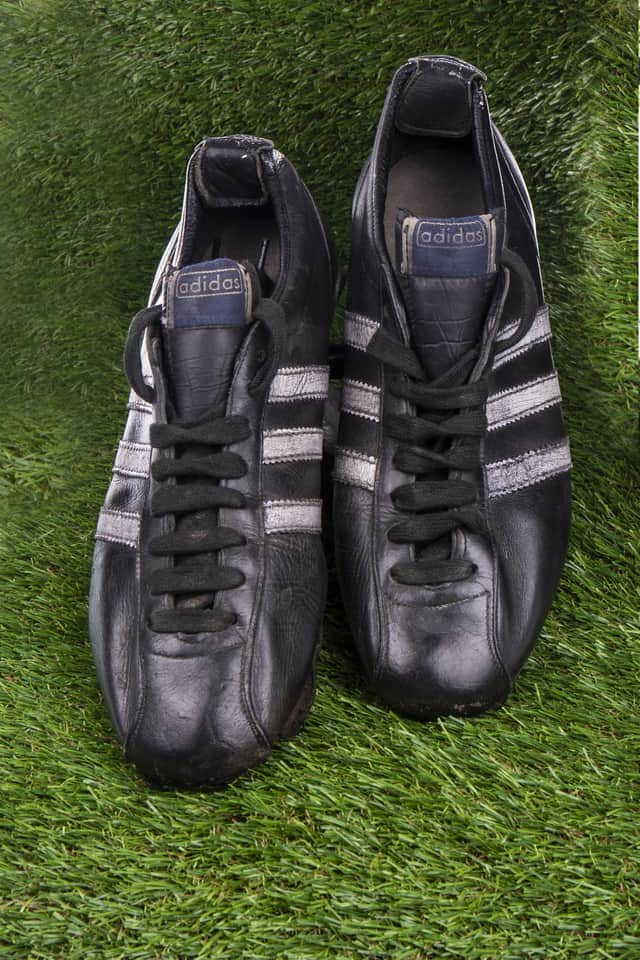
The black leather with silver adidas stripes were worn by legendary Celtic player Gemmell when he scored in the 1967 European Cup Final to help Celtic win the trophy - the first time any British team had won the European Cup.
The boots were gifted by Gemmell to the vendor, a close friend of Bertie Auld who had asked for a 'Token from Tam' for his son. After a training session, Gemmell tossed his 'worn out' boots to the vendor's father saying “I wore these in Lisbon, tell the wee fella to look after them!”
They were exhibited at Hampden Park until June 2019.
Alfie Conn’s 1972 European Cup Winner’s final shirt - £15,000

Considered the most important Rangers FC shirt to come to auction this Umbro no.8 has an embroidered crest with the inscription ‘European Cup Winners Cup Final 1972. It was worn in the 1972 European Cup Winners Cup final in Barcelona, when the Glasgow giants faced Dynamo Moscow and secured a historic 3-2 victory.
Midfielder Conn was an integral part of the squad between 1968 and 1974. This was the first time a shirt from that game has come to auction, making it a rare opportunity to own one of the club’s most important relics.
Alan Morton Scotland International Jersey - £2600

Born in Partick, Glasgow on 24th April 1893, ‘The Wee Blue Devil’ cemented his place in footballing history as a member of Scotland's Wembley Wizards who defeated England 5-1 in 1928. He played for Scotland in his first full International in 1920, and some 12 years later he had amassed a then record total of 31 appearances for the national side, most of which were attained whilst a Rangers player.
Reckoned by many to be the finest outside left in Great Britain, never mind Scotland, his ball control and passing ability were second to none.
This jersey came from the 1924-25 British Home Championship game against Wales. Scotland won the match, played at Tynecastle Stadium, 3-1, and went on to top the table winning all three of their games.
Kenny Dalglish Scotland International jersey circa 1975 - £3,800
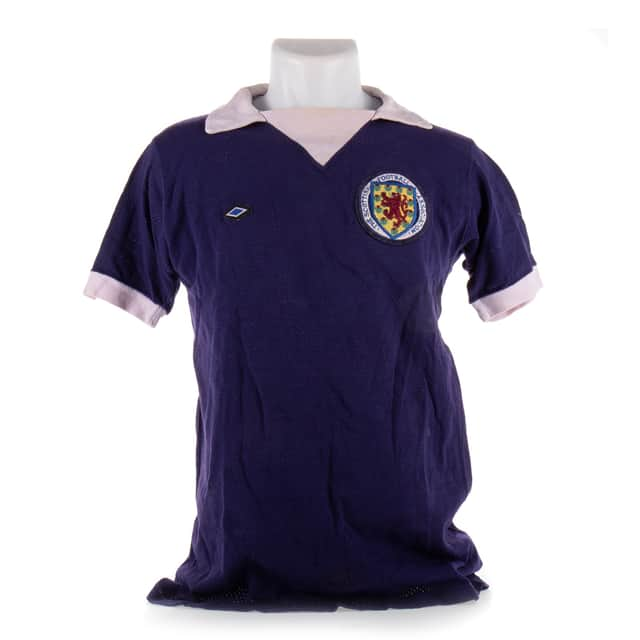
The Umbro short sleeved number 7 shirt worn by Sir Kenneth Mathieson (Kenny) Dalglish around 1975 attracted such a high price simply because of its association with one of the game’s true greats. ‘King Kenny’ made 338 appearances for Celtic and 515 for Liverpool, earned a record 102 caps for the Scotland national team and scored 30 goals.
He won the Ballon d'Or Silver Award in 1983, the PFA Players' Player of the Year in 1983, and the FWA Footballer of the Year in 1979 and 1983. Often considered the greatest striker in post-war British football, he has been inducted into both the Scottish and English Football Halls of Fame.
His international career was defined by his skill, leadership, and love for his country, and left an indelible mark on Scottish football history.
Comments
Want to join the conversation? Please or to comment on this article.