
Edinburgh Book Festival round-up: Evelyn Clarke | David Olusoga | Harriet Tyce


Our latest report from the Edinburgh International Book Festival is a Traitors-themed treat, with appearances from historian and broadcaster David Olusoga, crime novelist Harriet Tyce, and collaborative authors V. E. Schwab and Cat Clarke, whose new novel takes place in a seclued Traitors-like castle.
David Olusoga arrived at the Book Festival almost as if he had just walked there from Calton Hill. The historian, writer and TV presenter had to explain that the current series of A House Through Time, which is set there, was filmed last summer.
He said he had been “nagging” for some time to bring the show to the city, where he is a regular visitor. His ancestors on his mother’s side hailed from Tranent, and every time he comes north he visits farm where they worked.
He described the process of researching many possible houses for the show before making a choice, key deciding factors being that the house has history stretching across the social spectrum, and has had plenty of different occupants. “We give up on a house when we encounter happy, long-lived people,” he laughed.
Olusoga, who left an academic career pathway to become a TV producer then presenter, is passionate about putting working-class stories on television. Indeed, he is passionate about all stories: “History has to be scholarly, but it’s also about empathy, emotion, connection with people who lived and died before we were born, it’s also an imaginative journey.”
Enjoying The Scotsman's coverage of the Edinburgh festivals? For just £2 a month you can get unlimited access to scotsman.com plus 2-for-1 Fringe tickets. For details visit www.scotsman.com/subscriptions
Black British history, he says, is in an exciting period because new stories of Black Britons are continually being discovered, like that of Pablo Fanque, the 19th-century circus impresario who features in the Beatles’ song ‘Being for the Benefit of Mr Kite!’
However, there is another side to this: a backlash which few anticipated. He described this as “an assault on history”. “The determination of some to put those histories we have discovered back into the box is astonishing, ferocious and well-funded. I don’t know how we engage in that struggle, but I know we have no choice.”
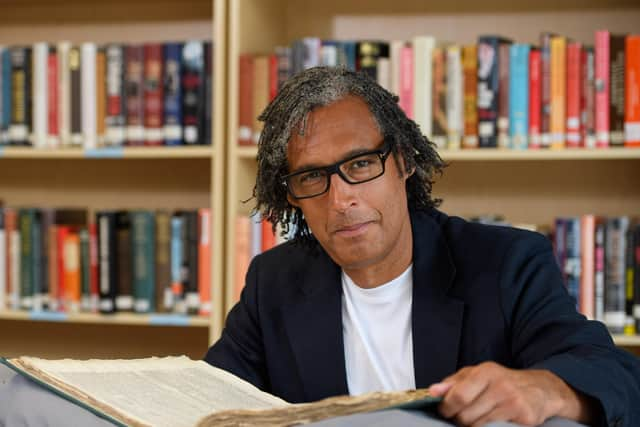
On a lighter note, Olusoga was one of two Traitors appearing at the festival in less than 24 hours, reaching the final of the celebrity series as a Faithful. “If I was still there now, I wouldn’t suspect Alan Carr,” he said wryly.
The other was crime novelist and former barrister Harriet Tyce, a long-surviving Faithful on Series Four. She described taking part as “a gamble”, but one which paid off: sales of her novels increased by 95 per cent after she appeared on the show.
Her latest novel, Witch Trial, is set in Edinburgh, telling the story of the trial of two teenage girls for the alleged murder of another young woman whose heart gave out while experimenting with the occult. Tyce, who grew up in Edinburgh but practised law in London, had to familiarise herself with the Scottish legal system with a little help from her father, Lord Nimmo Smith, a retired judge.
The book allowed her to revisit key locations in the city - Arthur’s Seat, Greyfriars Churchyard - as well as learning to read tarot cards, which she consulted about when she should start writing. Crime writing, she said, is her natural metier: “Even if I wrote a love story, someone would end up dead!”
Talk of traitors competing in a remote Scottish castle takes us very neatly to The Ending Writes Itself, by Evelyn Clarke (a collaboration between writers Cat Clarke and V. E. Schwab), which brings six struggling mid-list authors to a castle on a Scottish island to compete to finish a novel left behind after the death of the world’s most successful writer.
One audience member described the conversation between Clarke and Schwab, who are old friends, as “possibly the funniest book talk I’ve ever listened to”, and I have to agree. It’s a miracle the book happened at all given that Schwab had vowed never to collaborate, and Clarke, who is now a screenwriter, had sworn never to return to publishing.
What is more shocking that anything that happens in the castle is that the book is full of horror stories from the publishing industry, all of which are true. It was, Clarke said, “pure catharsis”. Susan Mansfield
The Scotsman’s arts newsletter is now sent twice a week - subscribe today
Enjoying the Arts & Culture journalism on scotsman.com? Make it easier to find by selecting us as a preferred Google source
Want the latest Scottish headlines sent directly to your phone? Sign up to our new WhatsApp channel here
Comments
Want to join the conversation? Please or to comment on this article.