
Father of modern geology hailed on 300th anniversary of birth


New edition of biography and rock tour among events commemorating James Hutton’s achievements
He was one of the seminal figures of the Scottish Enlightenment whose diligent research challenged religious dogma and revolutionised the way we think about the origins of the Earth.
Now, the towering contribution of James Hutton is to be honoured with a new edition of a landmark biography of the father of modern geology, alongside a series of events to mark the 300th anniversary of his birth.
A friend of James Watt and Adam Smith, Hutton laid the foundation for the science of geology with his best known work, Theory of the Earth, which was published in 1788, and set out how the Earth’s features had been shaped by a series of cycles longer than man or scripture could measure.
His findings, arrived at in large part thanks to Hutton’s trips to inspect the layers of igneous rocks at Salisbury Crags and Siccar Point, a rocky outcrop near Cove, offered a resounding rejection of the prevailing Biblical narrative, which held the Earth to be a little over 6,000 thousand years old.
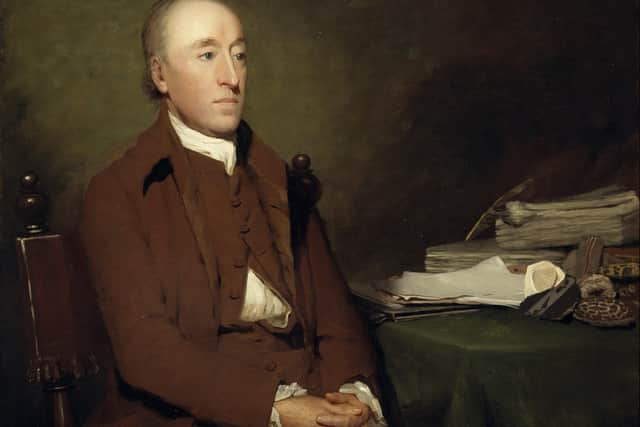
At the time, Hutton’s revolutionary work saw him denounced by faith figures and theologians, but his concept of ‘deep time’ - which set out a process of erosion, sedimentation and uplift taking place over the course of millions of years - offered significant inspiration for Charles Darwin and others.
In recognition of the tercentenary of Hutton’s birth later this week, a second edition of Ray Perman’s acclaimed biography, ‘James Hutton: The Genius of Time’ is being published by the Edinburgh-based publishing house, Birlinn.
Featuring references to new sources and original documents, and fresh insight into how Hutton was influenced by the French chemist and apothecary, Guillaume-François Rouelle, the book aims to showcase Hutton’s vital research, and explain how his theories have remained influential.
Mr Perman, who was the founding chair of the James Hutton Institute, said the achievements of the subject of his biography were “no less” than those of Smith and David Hume, and argued that Hutton fully deserved “his place among the polymaths of the Scottish Enlightenment.”

He explained: “Hutton’s Theory of the Earth has given geology a foundation on which to build our understanding of how the land on which we live was formed and how it has been destroyed and renewed in a seemingly endless cycle.
“He was attacked as a ‘system monger,’ whose concept was a figment of his imagination which did not fit the facts. So he went to great pains to find, record and publish the evidence on which he based his theory.”
Mr Perman, a fellow of the Royal Society of Edinburgh (RSE), of which Hutton himself was a founding member, pointed out that Hutton did not consider himself a geologist any more than he considered himself a doctor, farmer, businessman, chemical engineer, or canal builder - roles which he occupied at various parts of his life.
“He described himself as a philosopher and was unconstrained by academic pigeon-holing, believing himself as entitled to propose an explanation for why it rained as he was to publish a dissertation on language,” he said.

Indeed, Mr Perman described Hutton, who studied classics at the University of Edinburgh, as a “visionary” as well as a practical scientist, noting that some of the processes he cited could not be seen, measured, or reproduced experimentally, but were nonetheless “happening deep within the earth or were occurring so slowly as to be imperceptible even across the span of a human lifetime.”
Hutton, who also published works on subjects as diverse as why it rains and a theory of language, died aged 70 in March 1797.
The task of compiling a modern biography of the geologist, chemist, and naturalist was hampered by the fact that very few of his own papers, consisting of a handful of letters he sent or received, have survived, and Mr Penman, a writer and journalist for more than three decades, said that several scholars have searched in vain in the hope of finding a “vast cache” in some dusty attic.
Even so, the new edition of the biography will help inform modern readers of Hutton’s immense geological breakthroughs. It is one of several ways in which the tercentenary is being marked.
Mr Perman will be taking part in an all-day symposium at the RSE’s headquarters next month to honour Hutton’s legacy and showcase how his work remains relevant.
The event, taking place this Wednesday, will feature a series of talks and workshops, with expert speakers addressing how Hutton’s interdisciplinary approach can address current challenges, and how his ways of thinking can be supported today.
Mr Perman’s talk will set out Hutton’s significance to the RSE and the Scottish Enlightenment, while others scheduled to address the symposium include Martin Hendry, professor of gravitational astrophysics and cosmology at the University of Glasgow, Professor Dame Lorna Dawson, head of centre for forensic soil science at the James Hutton Institute, and the writer, broadcaster and academic, Dr Vanessa Collingridge.
Elsewhere, Historic Environment Scotland’s rangers will be offering people a close-up tour of the famous rock formations at the southern section of the Radical Road in Edinburgh which inspired Hutton, while a new exhibition at Paxton House will explore Hutton’s influence on the concept of geological time. The Scottish Geology Festival, which runs throughout June, is also celebrating Hutton, with the theme of the event focusing on 300 years of ‘deep time’.
The new edition of Ray Perman’s ‘James Hutton: The Genius of Time’ will be published by Birlinn on 3 June.
Comments
Want to join the conversation? Please or to comment on this article.