
How Miss Baird’s Primary 5 class set an example to Scotland about the Ukraine War
Expressions of solidarity with Ukrainians as they defend their country and democracy against the Russian invaders help them feel less isolated and alone
In the aftermath of the devastation caused by the Second World War, forward thinking local leaders across Europe, took to the idea of town twinning as a way of building connections and expressing solidarity between local communities. It is still valuable, with towns across Scotland celebrating their twinning links.
As a school pupil, there were posters of Aschaffenburg and Cognac on the school’s walls that I can still remember. I was reminded of its relevance on a visit to Ukraine last weekend.
I have been travelling to and working in Ukraine for more than 20 years – my first visit was as an election observer during the Orange Revolution. There were clear dirty tricks at play and the winning candidate’s face, Viktor Yushchenko, was still showing signs of his poisoning a few weeks before polling day.
The Russians who had opposed Yushchenko and who were struggling to come to terms with Ukraine’s independence, achieved in the previous decade, were the chief suspects.


The Russian way of war
Yet last weekend, I undertook perhaps my most memorable visit to the country. The cold snap meant that the journey was trickier than usual, taking some 21 hours to travel from the airport in Krakow to our accommodation in Kyiv. Despite a war and freezing conditions, the Ukrainians had managed to keep the roads passable.
We arrived in the capital in the early hours of the morning as Kyiv experienced one of the heaviest bombardments in months during the coldest weather, so far, of winter.
That bombardment reflected the Russian way of war. The Russian missiles targeted the city’s gas, electricity and water works. That meant that as temperatures plunged to a chilly minus 20 degrees, Ukrainian homes were deprived of light and electricity.
At the same time, Russian drones hit people’s homes. I saw the aftermath of the attack on a residential apartment block, in a residential area, where a family had been wiped out. To make matters worse, the Russians also killed a first responder in what is termed a ‘double tap’ attack.
This describes the practice of bombing a target and then sending another attack a short time later to kill the emergency workers who arrive to help the survivors. Reflect on that, an attack deliberately aimed at killing medical staff sent to help injured civilians.
A frontline city
Having worked in the country for a number of years, I have a lot of Ukrainian friends and I asked them about the war and our visit. Their answer was resolute.
As the war drags on – it has now lasted for longer than the entire war between the Soviet Union and Nazi Germany – expressions of solidarity from their friends across Europe really do matter. Knowing that they are not alone counts at a time when a reduction in air-defence missiles from the US and other allies means that their cities and homes are more exposed than ever.
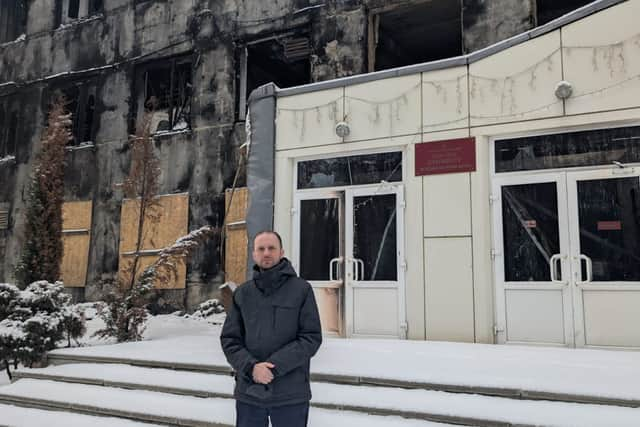
That work is even more important beyond Kyiv. Communities can feel even more cut adrift given the logistical challenges involved in travelling to Ukraine. I spent last Saturday in Sumy, five hours from Kyiv and just a few kilometres from the front line. I had been asked to go because of a twinning agreement between Angus and Sumy.
It was well worth it. Sumy has struggled through four long years of war. The Russians regularly target the city with drone, missile and artillery attacks. Across the city, civic, education and other civilian targets are regularly attacked.
Even a short ceremony with the governor to leave flowers at the site of a recent strike that killed 37 shoppers was affected. Two minutes after laying flowers for those lost in the atrocity, we were moved on, so as not to attract any unwanted attention.
Touching letters from Scotland
The fact that Angus and Sumy have a partnership, and I was able to deliver some gifts, was welcomed. The leadership provided by councillors across the political spectrum in Angus such as Lloyd Melville, Jack Cruickshanks and a thoughtful letter from the Provost made a difference. The shield of Angus and the local tartan, as well as a flag signed by the First Minister and other leaders, now sit alongside other messages of support in Sumy.
The military governor was especially touched by the beautifully written letters that had been sent by Miss Baird’s Primary 5 class at Timmergreens Primary School in Arbroath. It may have been a small gesture but it was one that made those affected by the war feel that little less isolated.
Similar projects are going on elsewhere, including that of Councillor Jordan Meade who has done so much to connect historic Chernihiv with Kent, including the delivery of fire-fighting and other equipment.
Russia will not stop at Ukraine
The time since the full-scale invasion of Ukraine will soon surpass the length of the First World War. During that time, the Ukrainian people have suffered from Russia’s aggression and barbarity.
They are the front line in the protection of democracy and rights that we take for granted. Anyone who thinks Russia will stop at Ukraine hasn’t been paying attention.
As they defend us, the least Ukraine should expect is our solidarity and, every now and again, we should be able to say thank you. I was proud of the message that was delivered from one end of Europe to another earlier this week. Just like those twin town posters on the wall at my school, the connections from community to community count.
Stephen Gethins is the MP for Arbroath and Broughty Ferry
Comments
Want to join the conversation? Please or to comment on this article.